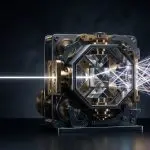
An international team of researchers has directly visualized how vibrations normally separated by symmetry can interact within crystals possessing an intrinsic sense of rotation, known as ferroaxial materials. Illuminating these crystals with a specially designed “white beam” of light revealed “star-of-David clusters” adopting opposite orientations, shown in red and blue, directly demonstrating the connection between the quantum phase and atomic vibrations. This unconventional interaction, termed “resonant chiral dressing,” acts as a dynamical bridge between vibrational modes, offering a new theoretical explanation for how previously independent vibrations can connect. The findings, published in Nature Physics, open new routes to detect and control exotic quantum phases with light, and suggest that symmetry restrictions in materials may not be as rigid as previously thought.
Ferroaxial Materials Exhibit Symmetry-Breaking Vibrational Coupling
Crystals possessing an intrinsic sense of rotation are challenging long-held assumptions about symmetry and its influence on atomic vibrations, as researchers have demonstrated a dynamic link between vibrations normally considered independent. An international team, spanning the University of Texas at Austin and the Max Planck Institute for the Structure and Dynamics of Matter, revealed this unconventional coupling within ferroaxial materials, a class of crystals exhibiting a unique ordered state. Utilizing a specialized light scattering technique, the team observed that collective fluctuations within these materials act as a bridge between vibrational modes previously segregated by symmetry constraints.
The discovery centers around a newly identified interaction termed “resonant chiral dressing,” a process that dynamically connects vibrations through the material’s inherent handedness. Xinyue Peng, a graduate student at UT Austin, explains that by looking at how vibrations respond to left- and right-circularly polarized light, researchers can see the handedness of the charge-density wave and map individual ferroaxial domains. The team focused on a layered material exhibiting an exotic quantum state at room temperature, where ions and electrons form a wave-like pattern known as a charge-density wave (CDW). This CDW manifests as a tiling of star-of-David clusters, possessing a distinct orientation that imparts a sense of handedness to the crystal, known as ferroaxial order. This order doesn’t respond to conventional electric or magnetic fields, making it difficult to study with standard methods.
These clusters aren’t static; they vibrate collectively, modulating the CDW’s strength, a coordinated motion termed an amplitudon. The research revealed that when the energy of this amplitudon aligns with that of an ordinary vibration, “the vibrational response changes,” according to Francesco Barantani, a lead author of the paper. “Our observations show that CDW fluctuations can actively connect crystal vibrations that symmetry would normally keep apart.” This finding, supported by theoretical work from the MPSD in Hamburg, suggests a pathway to control quantum states with light, potentially unlocking new avenues for materials manipulation.
Helicity-Resolved Light Scattering Detects Amplitudon Resonance
The study of collective atomic motion within materials has long been constrained by the principles of symmetry, which often dictate which vibrations can interact and which remain isolated; however, recent advances are challenging this established understanding. Researchers are now demonstrating that dynamic mechanisms can overcome these symmetry-imposed limitations, revealing previously hidden connections between vibrational modes. This investigation employed helicity-resolved light scattering, a method measuring how crystal vibrations respond to light polarized in clockwise or counterclockwise directions, to reveal the interplay between the crystal’s quantum phase and atomic vibrations. The team discovered that certain vibrations exhibited a stronger response when the light’s rotation matched the crystal’s inherent handedness, creating an imbalance in polarization intensity. This imbalance peaked when the energy of a standard vibration aligned with that of an amplitudon, a coordinated oscillation modulating the charge-density wave.
Our observations show that CDW fluctuations can actively connect crystal vibrations that symmetry would normally keep apart.
Francesco Barantani, a lead author of the paper
Resonant Chiral Dressing Enables Quantum State Control
This discovery builds on the observation of a charge-density wave (CDW) manifesting as a star-of-David tiling within the layered material, a pattern exhibiting a distinct sense of handedness. The key to understanding this connection lies in the collective motion of the CDW, specifically the periodic modulation of its strength known as an amplitudon. Theoretical work by Angel Rubio’s group at MPSD further clarified the process, revealing that “the amplitudon acts as a resonant bridge between vibrations of different symmetry, linking the lower energy of atomic motions with the higher energy of the electronic sector.” Because this effect occurs at room temperature, the team suggests that ultrafast laser pulses could selectively activate these interactions, offering a practical pathway to manipulate quantum states within these materials.
By looking at how vibrations respond to left- and right-circularly polarized light, we can see the handedness of the CDW and map individual ferroaxial domains.
Xinyue Peng, a graduate student at UT Austin




See today’s quantum computing news on Quantum Zeitgeist for the latest breakthroughs in qubits, hardware, algorithms, and industry deals.