Researchers have achieved amplification of a 260 GHz wave, a significant step toward more powerful and precise terahertz technology with applications in advanced spectroscopy and astronomy. The approach, detailed in a study published in the IEEE Journal of Quantum Electronics, combines a low-noise dual-wavelength Brillouin laser with resonant tunneling diodes to overcome the traditional trade-off between power and noise in terahertz oscillators. To understand and minimize noise, the team leveraged the Leeson effect to model the behavior of the resonant tunneling diodes, allowing for targeted improvements in their amplifier design. The resulting device demonstrated over 40 decibels of amplification with nanowatt-level input power, and the authors suggest that combining photomixing and injection-locking provides a promising route toward low-phase-noise, high-power 1 THz radiation sources.
Waveguide RTD Injection-Locking Reduces Terahertz Phase Noise
A newly demonstrated hybrid terahertz oscillator design achieves over 40 decibels of amplification at 260 GHz, a frequency increasingly vital for applications ranging from high-resolution spectroscopy to distant astronomical observation. Researchers overcame a longstanding trade-off between power and noise by combining a dual-wavelength Brillouin laser (DWBL) with a resonant tunneling diode (RTD). DWBLs typically exhibit exceptionally low phase noise but limited output power, while RTDs offer higher power at the expense of increased noise. Central to this advancement was a detailed analysis of the noise characteristics within the RTD itself; the researchers meticulously examined free-running RTD phase noise and frequency fluctuations to pinpoint the origins of unwanted signal distortion. According to the published study, they developed a theoretical model based on the Leeson effect to describe the phase noise behavior of the RTD oscillator, allowing for targeted noise reduction in the amplifier’s design.
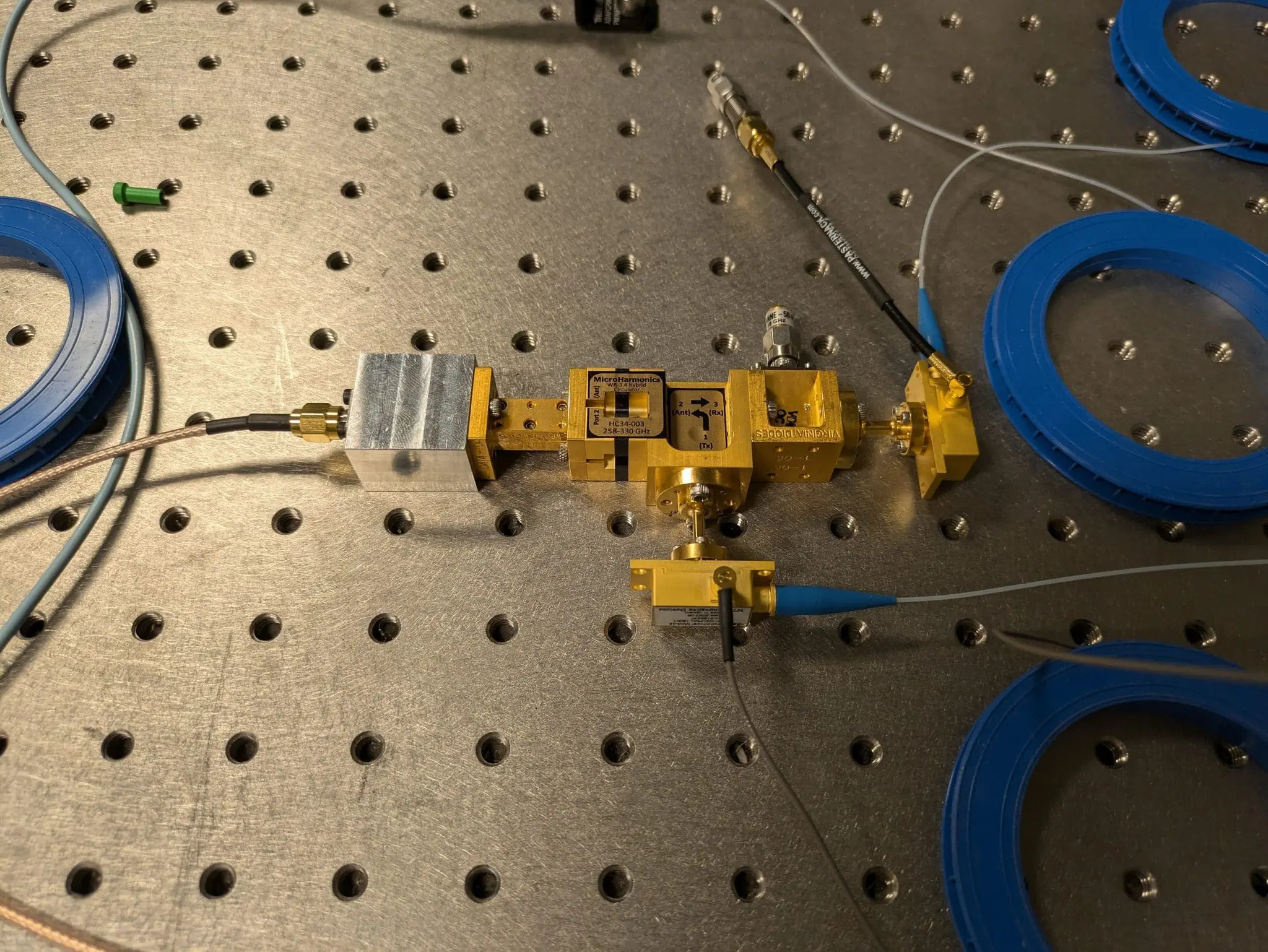
This model proved crucial in predicting the oscillator’s phase noise, with experimental results closely validating the theoretical predictions. The resulting amplifier demonstrated significant gain, exceeding 40 dB, with input power measured at the nanowatt level, representing a substantial improvement in signal strength. The architecture relies on low-loss waveguide components to facilitate efficient signal transmission and amplification, and the researchers suggest that the combination of photomixing and injection-locking offers a viable pathway toward generating even higher-frequency, low-noise terahertz radiation, potentially reaching 1 THz.
Leeson Effect Model Analyzes RTD Oscillator Fluctuations
The pursuit of more powerful and precise terahertz technology currently balances competing demands; traditional terahertz oscillators often struggle with either insufficient output power or excessive noise that limits their utility in applications like radio astronomy and high-resolution spectroscopy. This pairing seeks to leverage the DWBL’s inherently low phase noise with the RTD’s capacity for higher power generation at terahertz frequencies, but understanding and mitigating the RTD’s noise contribution proved critical. The researchers also proposed a novel method for predicting RTD oscillator phase noise, with experimental results closely aligning with their theoretical predictions.
By optimizing the injection locking phase, the researchers were able to achieve over 40 decibels (dB) of amplification of a 260 GHz wave for nanowatt-level input power.


See today’s quantum computing news on Quantum Zeitgeist for the latest breakthroughs in qubits, hardware, algorithms, and industry deals.