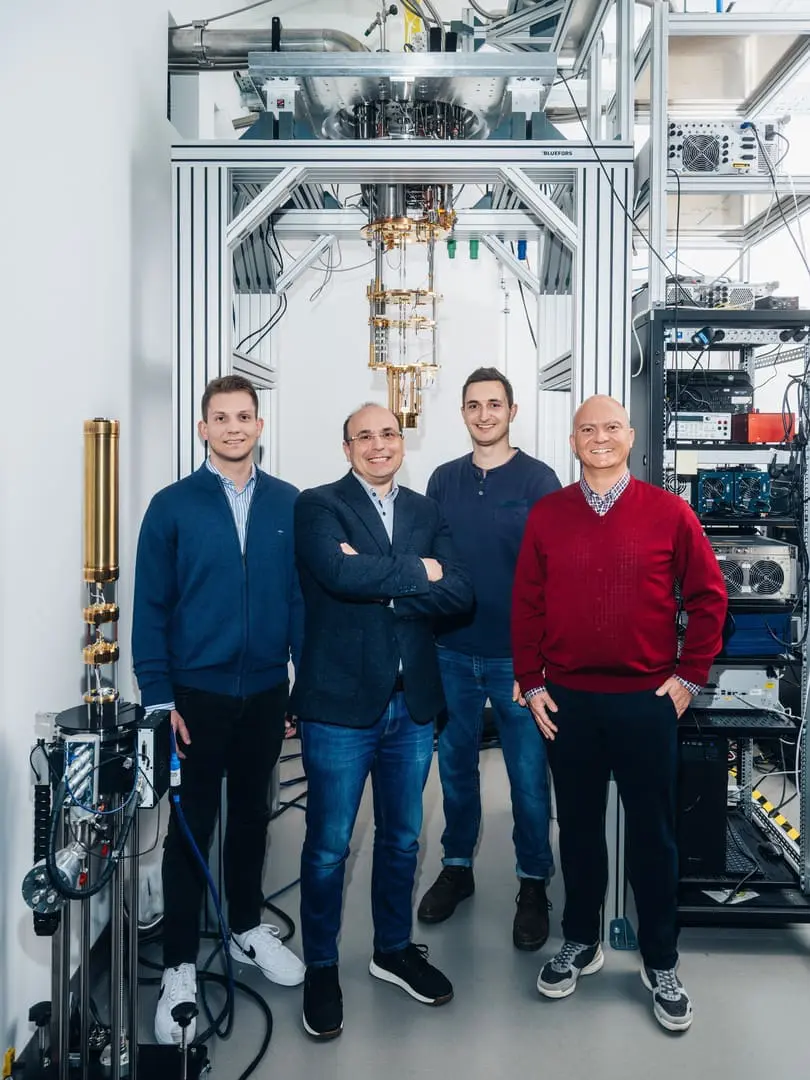
Physicists at the University of Vienna have extended the lifespan of magnons, tiny waves in magnetic materials, to 18 microseconds, a hundredfold increase over the previous limit of a few hundred nanoseconds. This breakthrough addresses a key obstacle in the development of practical quantum computers, potentially enabling devices dramatically smaller than current prototypes. Researchers achieved this by exciting short-wavelength magnons in ultra-pure spheres of yttrium iron garnet cooled to just 30 millikelvin, demonstrating that magnon lifespan is limited not by fundamental physics, but by material quality. “In this state, magnons are no longer fleeting signals, but become long-lived, reliable carriers of quantum information,” explains the team, suggesting the possibility of building a quantum computer the size of a 1-cent coin.
Yttrium Iron Garnet Enables 18-Microsecond Magnon Lifetimes
This advancement isn’t simply incremental; it fundamentally alters the potential scale of quantum computing hardware, suggesting devices could one day be built no larger than a 1-cent coin. The research, recently published in Science Advances, demonstrates that extending magnon lifetimes isn’t constrained by immutable physical laws, but rather by the purity of the materials used to generate them. By exciting short-wavelength magnons, inherently less susceptible to surface defects, they observed these significantly prolonged lifetimes. “Even the least pure sample surpassed all previous records,” indicating that further improvements are achievable through advancements in materials science. This discovery is crucial because it shifts the focus from theoretical physics to practical material engineering.
This extended lifespan transforms magnons from fleeting signals into robust carriers of quantum information, comparable to superconducting qubits. “With lifetimes of 18 microseconds, magnons transform from lossy intermediate links into robust quantum memories and low-loss communication links on a chip,” explained the researchers. Magnons could potentially serve as a ‘quantum bus’ connecting hundreds of qubits, or as universal translators in hybrid quantum architectures, enabling communication between otherwise incompatible technologies, ultimately allowing for scalable and versatile quantum computers.
Short-Wavelength Magnons Circumvent Surface Defects
Following initial demonstrations of viable magnon-based quantum systems, researchers have focused on overcoming limitations imposed by material imperfections. Surface defects within crystalline structures previously acted as significant barriers to extending magnon lifespan, restricting their potential as quantum information carriers. The University of Vienna-led team addressed this challenge by intentionally exciting short-wavelength magnons, a technique that inherently minimizes susceptibility to these surface irregularities, a critical step toward practical applications. This extended coherence isn’t simply a marginal gain; it fundamentally alters the possibilities for magnon-based quantum technologies, transforming them from transient signals into robust elements for quantum computation and communication. Importantly, the research revealed that magnon lifespan isn’t dictated by an immutable law of physics, but rather by the quality of the material itself, opening avenues for targeted material engineering.
The breakthrough hinged on two key strategies: the scientists excited short-wavelength magnons, less susceptible to surface imperfections, and cooled ultra-pure yttrium iron garnet (YIG) spheres to just 30 millikelvin, a temperature barely above absolute zero. This discovery is crucial because it means that progress isn’t limited by undiscovered physics, but by the ability to engineer increasingly flawless materials.
The key to this breakthrough was a combination of two ideas. Firstly, instead of conventional uniform magnons, the team excited short-wavelength magnons, which are inherently insensitive to surface defects in the crystal – precisely the defects that had limited the lifetimes in all previous experiments. Secondly, the researchers cooled ultra-pure spheres of yttrium iron garnet (YIG) in a mixed-phase cryostat to just 30 millikelvin – a fraction of a degree above absolute zero.
The potential for compact quantum computing received a significant boost with the demonstration of remarkably extended magnon lifetimes, promising devices dramatically smaller than current prototypes. Unlike photons which require space for propagation, magnons, tiny waves of magnetization, travel within solid magnetic materials, potentially enabling dense, chip-based quantum circuits.


See today’s quantum computing news on Quantum Zeitgeist for the latest breakthroughs in qubits, hardware, algorithms, and industry deals.