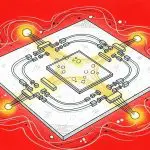

IonQ has achieved 99.99% two-qubit gate fidelity, a critical step toward building practical quantum computers and resolving longstanding challenges with error rates. The company reports this milestone marks a turning point, evolving from a startup to what it claims is the world’s preeminent full-stack quantum platform and merchant supplier. Chairman & CEO recalls encountering IonQ’s foundational work as a student; “I vividly recall reading our founders’ seminal paper demonstrating the world’s first quantum logic gate as an undergraduate physics student.” He noted that for those interested in quantum mechanics in the 1990s, it was a significant development. This achievement, alongside advancements in quantum networking and sensing, positions IonQ to reshape the development and commercialization of quantum technologies, delivering solutions across engineering, life sciences, and artificial intelligence.
IonQ’s 2025 Revenue Growth and Commercial Expansion
IonQ’s recent performance signals a shift in the quantum computing landscape; the company reported a 202% year-over-year increase in GAAP revenue for 2025, a substantial increase beyond its initial role as a research-focused company. This growth is largely organic, with nearly 80% stemming from its core compute business, a figure the company anticipates will accelerate further in the coming year. This suggests IonQ is not simply benefiting from industry expansion, but actively driving it, establishing itself as a key player in a rapidly evolving field. For those interested in quantum mechanics in the 1990s, it was a significant development. The achievement of 99.99% two-qubit gate fidelity is a critical milestone, resolving a fundamental scientific challenge necessary for building utility-scale, fault-tolerant quantum computers.
Beyond computing, IonQ is positioned with investments spanning quantum networking and sensing, demonstrated by the first quantum frequency conversion in a field-deployable system and a six-fold reduction in clock size for quantum sensors. “Taken together, IonQ is now the only company in the world invested in all key areas of quantum technology, with deep integration and superior performance across quantum computing, networking, sensing and security,” the company asserts. This broad portfolio is further strengthened by the anticipated acquisition of SkyWater, intended to bolster secure, onshore manufacturing capabilities and solidify IonQ’s position as a leading merchant supplier. Commercial deployments are increasingly diverse, extending beyond research institutions to include Korea’s KISTI, QuantumBasel, and universities in the US and UK.
Over 60% of IonQ’s 2025 revenue originated from the commercial sector, indicating growing enterprise adoption, and international markets now account for over 30% of total revenue. “We are achieving all of this with a newly composed senior leadership team and a deep bench of world-class talent,” the company notes, emphasizing the importance of human capital in driving continued innovation and scaling operations.
99% Two-Qubit Gate Fidelity Achieved with Trapped-Ion Technology
The pursuit of stable qubits remains a central challenge in realizing practical quantum computers, with error rates historically hindering progress toward scalable systems. While various qubit modalities compete, trapped-ion technology has consistently demonstrated high fidelity, and recent results from IonQ represent a significant leap forward in this area. The company reports achieving 99.99% two-qubit gate fidelity, a figure that surpasses previous benchmarks and signals a maturing of the technology. This level of precision addresses a fundamental requirement for building fault-tolerant quantum computers capable of tackling complex problems. This achievement builds upon decades of research, with roots stretching back to the 1990s. The significance of 99.99% fidelity lies in its implications for error correction; lower error rates reduce the computational overhead required to mitigate the effects of noise, bringing the prospect of utility-scale quantum computing closer to reality.
IonQ asserts it is the first company to solve the fundamental science that will underpin utility-scale, fault-tolerant quantum computing. Unlike some approaches reliant on noisy qubits, IonQ’s trapped-ion qubits are described as naturally stable, facilitating seamless scaling to larger systems. This inherent stability, combined with electronic qubit control and a semiconductor-based roadmap, forms the foundation for their long-term objective of delivering large-scale, fault-tolerant systems. Beyond the core computing capabilities, IonQ is also expanding its platform to encompass quantum networking and sensing.
Unlike other approaches burdened by unnatural and noisy qubits, IonQ’s qubits are perfect from nature and scale seamlessly into the millions.
Quantum Networking & Sensing Breakthroughs in 2025
This early exposure, he notes, instilled a deep appreciation for the field that continues to drive IonQ’s ambitions. This advancement is crucial because it addresses a significant hurdle in extending the range and compatibility of quantum communication. Simultaneously, IonQ made strides in quantum sensing, managing to reduce the size of its clock technology by a factor of six while maintaining commercial performance. This miniaturization, the company explains, opens doors for integration into satellite payloads and tactical platforms, expanding the potential applications of precise timekeeping and navigation. The company anticipates that this acquisition will not only accelerate U.S. quantum leadership but also enhance the resilience of the entire quantum supply chain. With more than 60% of our 2025 revenue originating from the commercial sector, it is clear that quantum is resonating with the enterprise market. IonQ’s global reach extends to over 30 countries, positioning the company to capitalize on cross-selling opportunities and further expand its international footprint.
When the customer wins, we win: we measure success by our customers’ outcomes, not hardware specifications.
SkyWater Acquisition to Secure Onshore Quantum Manufacturing
The intensifying race to build practical quantum computers is increasingly focused on securing domestic supply chains, a need IonQ addressed in 2025 with the announcement of its acquisition of SkyWater Technology. This move extends beyond simply expanding IonQ’s capabilities; it establishes a pathway toward fully onshore manufacturing of critical quantum components, mitigating risks associated with geopolitical instability and lengthy international sourcing. The acquisition is positioned to strengthen IonQ’s role not merely as a quantum computer vendor, but as a comprehensive merchant supplier to the broader quantum industry, a strategic shift signaling a maturing market. IonQ’s decision to bring manufacturing in-house reflects a growing awareness that control over the entire production process, from qubit fabrication to system integration, is essential for sustained innovation and scalability.
Once SkyWater is part of the IonQ family, the company expects to significantly expand secure, onshore manufacturing capabilities for quantum, accelerating U.S. quantum leadership while also strengthening the resilience of the broader quantum supply chain. This isn’t simply about reducing reliance on foreign suppliers; it’s about ensuring the quality, security, and rapid iteration necessary to maintain a competitive edge in a rapidly evolving field. The company already supplies precision atomic clocks and networking devices, and anticipates expanding this portfolio with SkyWater’s expertise. The timing of this acquisition is particularly noteworthy, coinciding with what IonQ identifies as a pivotal year for the company. This financial performance underscores the viability of IonQ’s strategy and provides a solid foundation for further investment in manufacturing infrastructure. The company’s commitment to onshore production is not just a strategic imperative, but a demonstration of confidence in its long-term growth prospects and its ability to lead the quantum industry into a new era of secure, domestically sourced innovation.