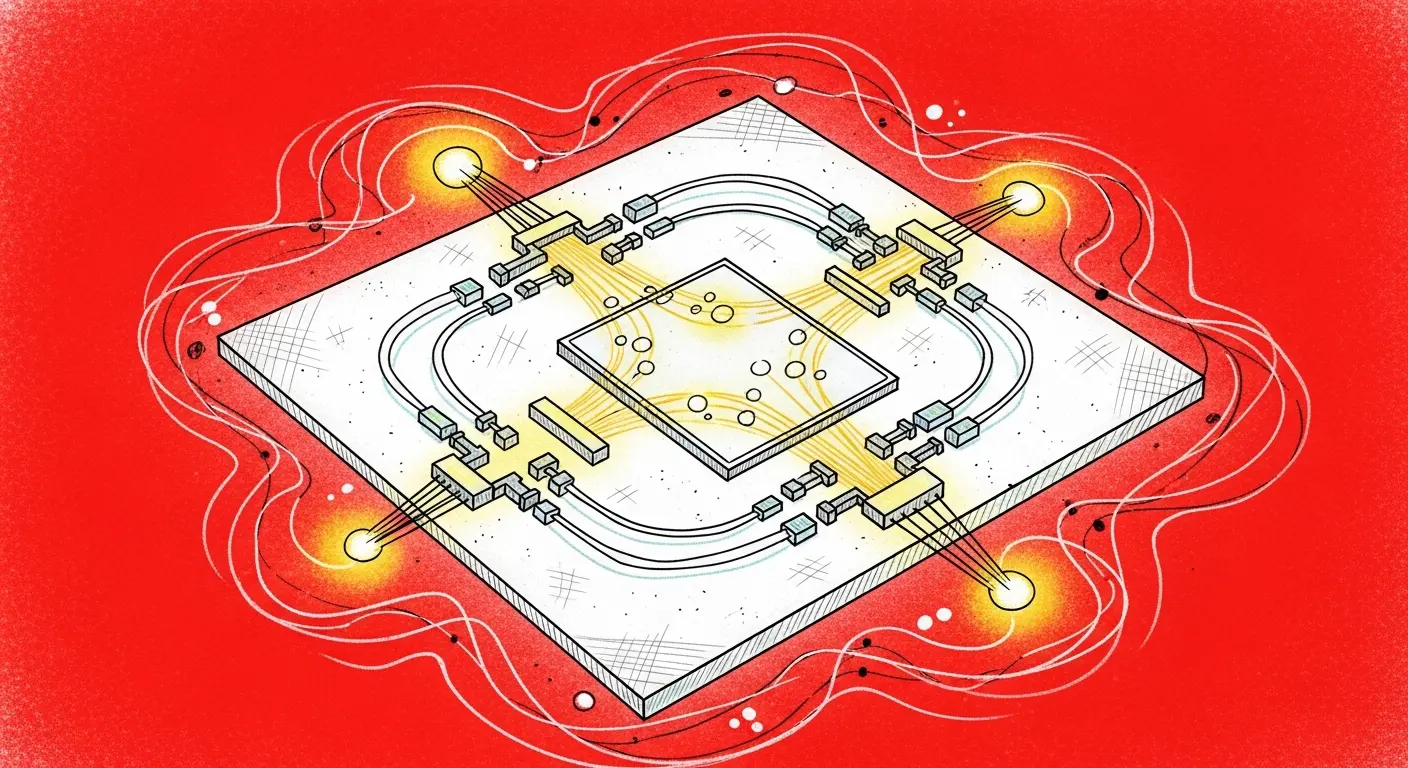
Researchers have successfully built a superconducting quantum circuit capable of recreating the subtle quantum tunneling of protons, a process fundamental to life itself, including within the structure of human DNA. The team, from Yale, Google, and the University of California-Santa Barbara, engineered the device with adjustable barrier height and asymmetry to precisely study this phenomenon, which allows particles to pass through energy barriers they classically shouldn’t overcome. “Our system is so clean and controllable that we could resolve very subtle quantum tunneling effects with it that were unknown to us,” said co-first author Rodrigo Cortiñas, now at Google Quantum AI in Santa Barbara, California. This advance offers a new avenue for research into areas like solar fuels, pharmaceuticals, and materials, providing a cleaner way to model complex chemical reactions previously reliant on approximation.
Superconducting Circuit Simulates Quantum Proton Tunneling
Researchers have successfully simulated quantum proton tunneling using a specially constructed superconducting quantum circuit, demonstrating the potential to model processes fundamental to life. This research specifically recreated how protons shift within DNA base pairs, a critical mechanism in biological systems like photosynthesis and DNA formation. The circuit’s design allows researchers to adjust conditions governing tunneling, enabling detailed observation of subtle quantum behaviors. This level of control addresses a longstanding challenge in chemical and biological research, where isolating single variables is often difficult and expensive; as co-first author Max Schäfer noted, “When scientists study chemical and biological reactions, it is often hard, slow, and expensive to tune one part of the problem without changing many other things at the same time.” The research, originating from the labs of Nobel laureate Michel Devoret and chemist Victor Batista, revealed unexpected mechanisms in quantum proton transfer, including oscillating activation rates and the dramatic impact of even slight imbalances in circuit barriers. “Parking the protons in the right place is essential to having an accurate description of a chemical system,” Batista said, highlighting the improvement over previous studies reliant on approximations; this work promises more accurate modeling of reactions across diverse fields like chemical biology and catalysis. Researchers have successfully recreated the quantum behavior of protons, specifically the phenomenon of tunneling, within a purpose-built superconducting quantum circuit, and this achievement moves beyond theoretical quantum physics to address fundamental processes occurring within living systems.
Oscillating Activation Rates & Barrier Imbalance Revealed
The team specifically recreated proton shifting within DNA base pairs, demonstrating the relevance of quantum effects to fundamental biological mechanisms. The resulting device allows for unprecedented control over conditions governing tunneling, specifically the barrier height and asymmetry influencing proton transfer rates. The research, published in PRX Quantum, revealed unexpected intricacies in quantum proton transfer; activation rates for protonation oscillate in a discernible pattern, and even minor imbalances in the circuit’s barriers significantly impede the process. Alejandro Cros Carrillo de Albornoz added, “This project shows how interdisciplinary modern quantum research is becoming,” suggesting that platforms like this are increasingly bridging the gap between physics, chemistry, and biology.
Our system is so clean and controllable that we could resolve very subtle quantum tunneling effects with it that were unknown to us.
Source: https://news.yale.edu/2026/04/30/building-superconducting-quantum-circuit-follows-protons-go


See today’s quantum computing news on Quantum Zeitgeist for the latest breakthroughs in qubits, hardware, algorithms, and industry deals.