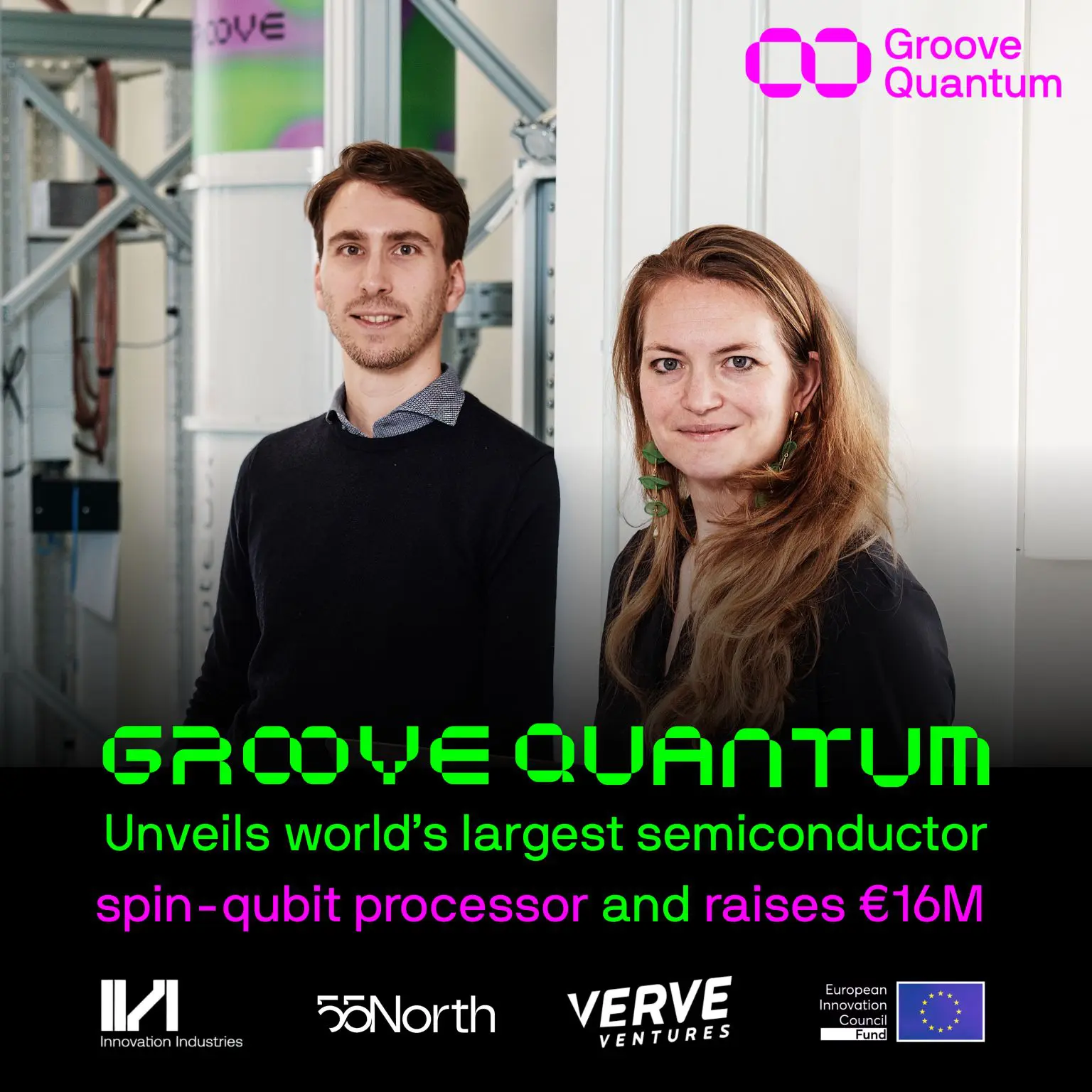
Groove Quantum has unveiled the largest semiconductor spin-qubit processor to date, boasting 18 qubits and signaling a significant leap forward in scaling this emerging quantum computing architecture. Founded a few years ago, the company secured a €16 million seed round to accelerate development of its germanium-based system, a technology it believes is crucial for building practical quantum computers. “The future is built on germanium,” states co-founder and CEO Anne-Marije Zwerver, emphasizing the company’s commitment to leveraging existing semiconductor manufacturing processes for scalability and cost reduction. Zwerver acknowledges the journey has been challenging, joking that the team of 11 has effectively earned degrees in multiple fields beyond physics; however, they’ve focused on both size and scalable operation protocols for their processor.
Qubit Germanium Processor & €16M Seed Funding Secured
Groove Quantum has achieved a significant milestone in the race to build practical quantum computers, unveiling an 18-qubit processor based on germanium, the largest semiconductor spin-qubit processor demonstrated to date. This accomplishment coincides with a €16 million seed funding round, which will accelerate the company’s scaling plans. While many quantum computing approaches rely on superconducting circuits or trapped ions, Groove Quantum is focusing on germanium, a material the company believes is uniquely suited to mass production and scalability. “The future is built on germanium,” the company asserts, signaling a commitment to this less-explored avenue of quantum hardware development. The 18-qubit processor demonstrates not only size but also inherent scalability in both the processor’s design and its operational protocols, details of which are available in a recent ArXiv pre-publication.
This focus on manufacturability is particularly noteworthy given the challenges of building and controlling large numbers of qubits. Groove Quantum accomplished this with an exceptionally lean team of just 11 people, demonstrating a high degree of capital efficiency. “It takes a lot of stubborn optimism and creativity to achieve these results with a team of just 11 people,” explained Anne-Marije Zwerver, highlighting the dedication and productivity of the group. The newly secured funding will be directed towards expanding both the company’s quantum systems and its overall operational capacity. Groove Quantum’s approach leverages existing semiconductor manufacturing processes, potentially offering a pathway to faster and more cost-effective scaling compared to other quantum technologies.
The company’s prior achievements, including a two-qubit gate with a fidelity exceeding 99% and single-qubit gates with over 99.99% fidelity, demonstrate a solid foundation of intellectual property and technical expertise. “We are thrilled to have you running with us!” said Anne-Marije Zwerver, welcoming new investors 55 North, Innovation Industries, Verve Ventures, and the EIC, European Innovation Council Fund.
Germanium Qubits Enable Scalable Semiconductor Integration
Groove Quantum’s recent unveiling of an 18-qubit processor marks a new point in semiconductor spin-qubit technology, a field currently dominated by superconducting and trapped ion approaches. While many quantum computing firms pursue increasingly complex architectures, Groove Quantum is focusing on compatibility with existing semiconductor manufacturing, a strategy intended to accelerate scalability and reduce costs. This focus on leveraging established industrial processes distinguishes their work; the company aims to bypass the need for entirely new fabrication facilities, a significant barrier to widespread quantum computer production. The company’s choice of germanium as the core material is also noteworthy, given its unique properties for qubit creation. Unlike silicon, germanium offers advantages in spin coherence, crucial for maintaining quantum information. “Germanium qubits have a high quality, small footprint and integrate seamlessly into existing semiconductor manufacturing processes, all accelerating scaling,” Anne-Marije Zwerver states, highlighting the material’s potential to overcome current limitations.
This approach builds on a foundation of prior research; in 2021, the team successfully operated the world’s first 2D grid of semiconductor qubits. This progress has been achieved with remarkable efficiency, as the company reports reaching this 18-qubit milestone with a team of only 11 people, a result of their focused approach and lean operational model. They’ve supported their expertise with intellectual property, filing numerous patent applications related to qubit performance, yield, and scalability. Recent scientific publications, including work published in Nature and Nature Nanotechnology in 2023, demonstrate their achievements in qubit fidelity and multiplexed array operation, paving the way for increasingly complex and powerful quantum processors.
99% Fidelity & Novel Qubit Control Demonstrated
Building on earlier work establishing germanium as a viable qubit material, the company has now unveiled an 18-qubit processor, the largest semiconductor spin-qubit device to date, marking a substantial increase in scale for this architecture. This achievement is particularly noteworthy given the team’s composition; the processor and associated advancements were realized by a remarkably lean group of just 11 people, highlighting an efficient approach to development. The company’s focus extends beyond simply increasing qubit count. In 2024, researchers demonstrated a novel low-power qubit control mechanism in a 10-dot array and achieved a two-qubit gate with a record fidelity exceeding 99%. This level of precision is critical for performing complex quantum calculations and minimizing errors, a persistent challenge in the field. These milestones, validated through publications in leading scientific journals like Nature and Nature Nanotechnology, underscore the team’s expertise in germanium qubit fabrication and operation.
This focus on germanium differentiates Groove Quantum from many competitors pursuing superconducting or trapped ion technologies. “We aim to unlock the full potential of quantum computing and drive innovation,” Anne-Marije Zwerver states, and the recent €16 million seed funding round is intended to accelerate these efforts by scaling both the systems and the company itself.
We demonstrated a novel low-power qubit control mechanism in a 10-dot array and achieved a two-qubit gate with a record fidelity exceeding 99%.
Science, 2024
Vandersypen, Veldhorst, & Scappucci: Founding Quantum Expertise
Groove Quantum’s rapid ascent in the quantum computing landscape is deeply rooted in the foundational expertise of its advisors; Lieven Vandersypen, Menno Veldhorst, and Giordano Scappucci represent a concentration of pioneering work in semiconductor spin qubits that directly informs the company’s germanium-based approach. These researchers actively shaped the company’s technical direction from the outset, providing a critical bridge between academic discovery and industrial scalability. Vandersypen’s group, for example, achieved several firsts, including the initial control of a single electron spin within a quantum dot and the demonstration of quantum algorithms utilizing spin qubits, accomplishments that laid much of the groundwork for current advancements. The influence of these advisors extends to a substantial body of published research; Vandersypen alone has amassed over 40,000 citations across more than 175 publications, a testament to the impact of his contributions.
This scientific pedigree is particularly relevant given Groove Quantum’s focus on germanium, a material choice that diverges from the more commonly pursued superconducting and trapped ion technologies. Scappucci and Veldhorst further bolster this expertise, having both contributed significantly to the development and understanding of germanium qubits; Veldhorst, recognized with the Christiaan Huygens prize, pioneered advanced germanium quantum systems resulting in multiple publications in Nature. This collective knowledge base has enabled Groove Quantum to not only achieve a record-breaking 18-qubit processor, but also to secure intellectual property through numerous patent applications covering qubit performance, yield, and scalability, a crucial step toward realizing practical quantum computation.
His group was the first to control a single electron spin in a quantum dot, the first to run quantum algorithms on spin qubits in quantum dots, holds the record of the largest spin qubit register in quantum dots and pioneered on-chip quantum links based on electron shuttling.
Source: https://groovequantum.com/



See today’s quantum computing news on Quantum Zeitgeist for the latest breakthroughs in qubits, hardware, algorithms, and industry deals.