

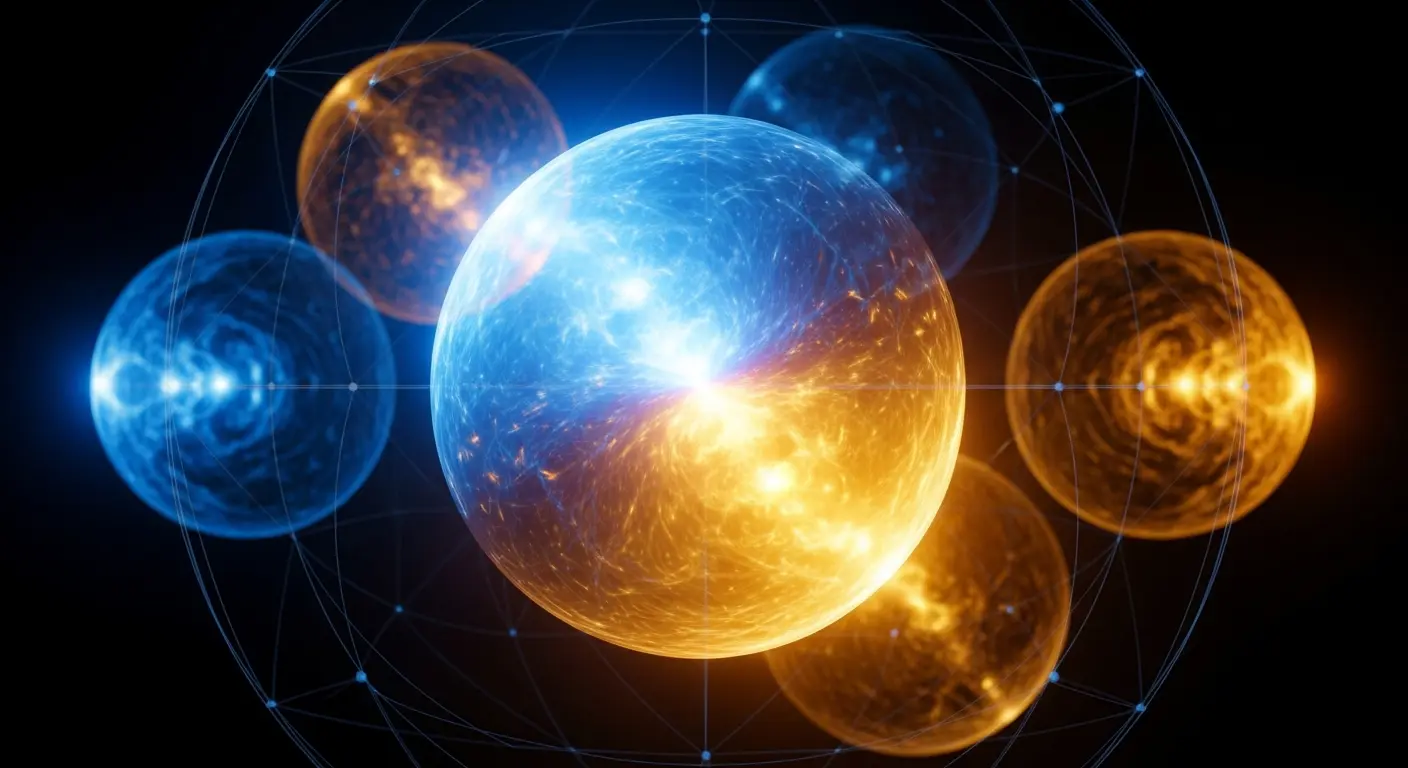
Researchers Laurens Walleghem and Carlo Cepollaro at University of York, collaborating with the Institute for Quantum Optics and Quantum Information (IQOQI), International Iberian Nanotechnology Laboratory and University of Vienna have calculated the response of an Unruh, DeWitt detector in a 2+1d spacetime that contains a BTZ black hole in a superposition of locations, utilising a Quantum Reference Frame transformation. The calculation reveals a nonclassical contribution to measurement outcome probabilities, distinguishing it from scenarios where the black hole’s position is a classical mixture. The findings highlight how singularities within the probed spectrum contribute to these differing results when compared with previous studies of mass-superposed black holes.
Location superposition yields demonstrably smoother interference patterns in black hole responses
Interference patterns were demonstrably smoothed, reducing peak prominence by a factor of approximately two compared to prior mass-superposition studies. This smoothing effect is significant because it provides a means of experimentally, or theoretically, distinguishing between a genuine quantum superposition of the black hole’s location and a classical probability distribution over multiple locations. Previous investigations into black hole superpositions primarily focused on superpositions of the black hole’s mass, a parameter related to its gravitational field strength. These studies exhibited sharper, more pronounced interference patterns in the detector response. The current work, however, explores the consequences of superposing the location of the black hole within spacetime, revealing a fundamentally different behaviour. A superposition response was previously inaccessible with sufficient clarity, but this improvement surpasses the limitations of earlier calculations which could only model black hole responses to single, classical locations. This allows for a clearer distinction between genuine quantum superpositions and classical mixtures of black hole positions, a vital step towards understanding quantum gravity. The BTZ black hole, a solution to Einstein’s field equations in three spacetime dimensions, was chosen for its mathematical tractability, simplifying the calculations without sacrificing the essential physics of the problem. The 2+1 dimensional spacetime allows for analytical solutions that would be far more difficult to obtain in the more physically realistic 3+1 dimensional case.
Utilising a Quantum Reference Frame transformation, calculations revealed that detector responses to location-superposed black holes exhibit interference fringes, signifying non-classical behaviour absent in classical scenarios. Detailed calculations show the observed smoothing arises from singularities within the spectrum of frequencies the detector is sensitive to, offering further support for theories suggesting black hole mass may be quantized. The Unruh, DeWitt detector, a theoretical construct, is used to model the interaction between a quantum field and an accelerating observer. It doesn’t physically exist but serves as a useful tool for exploring quantum phenomena in curved spacetime. The detector’s response is calculated by examining the rate at which it absorbs energy from the quantum field. The observed interference fringes arise from the superposition of the detector’s response in different locations, analogous to the interference patterns observed in the double-slit experiment. The presence of these fringes demonstrates that the black hole is indeed in a quantum superposition, rather than simply being in one location or another. While this represents a sharp improvement in clarity, these results currently describe an idealised scenario and do not yet indicate how such superpositions could be created or sustained in a realistic astrophysical setting. The difference in pattern smoothness compared to mass superposition originates from singularities within the detector’s sensitivity range, highlighting the importance of location as a variable for quantum effects. These singularities, appearing as divergences in the mathematical calculations, are linked to the extreme curvature of spacetime near the black hole and influence the way the detector interacts with the quantum field.
Detecting quantum signals from black holes with simplified models paves the way for future work
Scientists are edging closer to understanding quantum gravity, seeking to reconcile the seemingly incompatible worlds of quantum mechanics and general relativity. The primary challenge lies in the fact that general relativity describes gravity as a smooth, classical field, while quantum mechanics describes the universe in terms of discrete, probabilistic events. A theoretical detector was used to observe subtle effects, demonstrating a way to tease out genuinely quantum behaviour from black holes. This research builds upon the established framework of quantum field theory in curved spacetime, which attempts to incorporate quantum mechanics into the context of general relativity. The Unruh effect, a related phenomenon, predicts that an accelerating observer will perceive a thermal bath of particles evens in a vacuum. The current study extends this concept to the realm of black holes, exploring how quantum effects might manifest in the vicinity of these extreme gravitational objects. However, the calculations deliberately sidestep an important complication: they ignore how the detector itself might warp the spacetime around the black hole, a phenomenon known as backreaction.
Acknowledging that these calculations presently exclude the impact of the detector on spacetime itself, backreaction does not invalidate their importance. Backreaction refers to the feedback loop where the quantum field, influenced by the detector, alters the spacetime geometry, which in turn affects the detector’s response. Including backreaction would significantly complicate the calculations, potentially requiring approximations or numerical simulations. Nevertheless, understanding backreaction is crucial for developing a complete theory of quantum gravity. An ‘Unruh-DeWitt detector’ was utilised to observe minute effects, establishing a clear theoretical pathway for identifying genuinely quantum signals emanating from black holes. By isolating this quantum behaviour in a simplified model, scientists can now focus on incorporating the complexities of backreaction in future research, refining the approach incrementally. The Quantum Reference Frame transformation, a mathematical tool altering an observer’s perspective, demonstrated that the detector behaves as if it too is in a superposition within a classical spacetime, allowing for the observation of minute energy fluctuations and providing a foundation for more complex models incorporating the effects of spacetime distortion. This transformation effectively shifts the problem from dealing with a superposition of spacetimes to dealing with a detector in a superposition, simplifying the mathematical analysis. Future work will likely involve exploring the effects of different detector trajectories, investigating the influence of different black hole parameters, and ultimately, attempting to incorporate the effects of backreaction to obtain a more realistic and complete picture of quantum gravity.
The research demonstrated a nonclassical contribution to detector outcome probabilities when observing a black hole in a superposition of locations. This indicates that it is possible to theoretically distinguish between a black hole genuinely in a superposition and a classical mixture of black holes at different positions. Researchers utilised an Unruh-DeWitt detector and a Quantum Reference Frame transformation to achieve this, simplifying the analysis by treating the detector as being in a superposition instead. The authors intend to explore the impact of detector trajectories and black hole parameters, and ultimately incorporate the effects of backreaction in future studies.
👉 More information
🗞 Particle detector in a position-superposed black hole spacetime
🧠 ArXiv: https://arxiv.org/abs/2604.11897



See today’s quantum computing news on Quantum Zeitgeist for the latest breakthroughs in qubits, hardware, algorithms, and industry deals.



