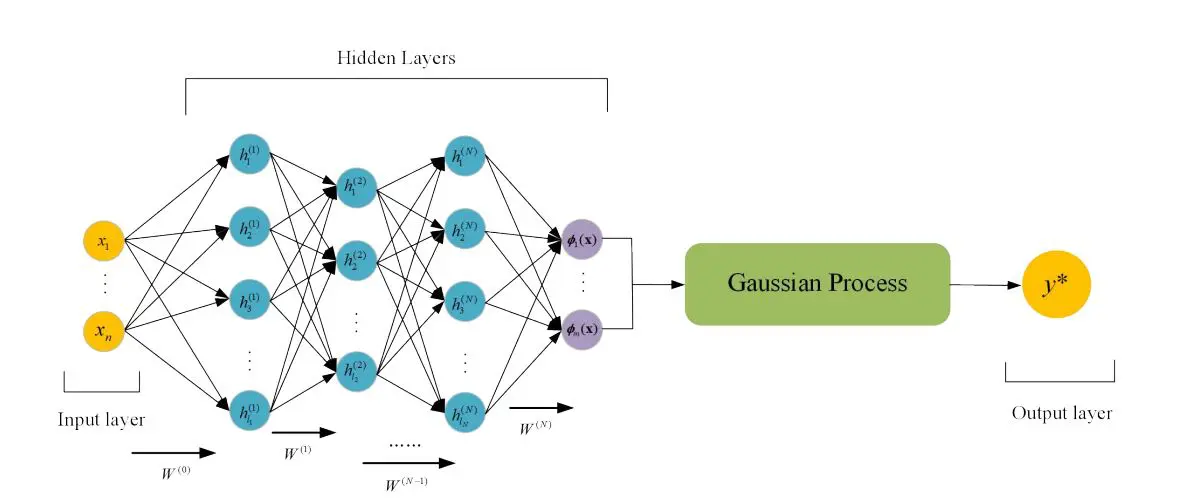
Predicting turbulent flows presents a longstanding challenge in fluid dynamics, demanding immense computational resources due to the complex, nonlinear nature of these systems. Han Li, Yutong Lou from Tongji University, and Dunhui Xiao from Tongji University, have now developed a new approach that leverages the power of quantum machine learning to dramatically improve the efficiency of turbulence modelling. Their work introduces a hybrid quantum-classical framework which combines established techniques for dimensionality reduction with a novel deep kernel learning method enhanced by quantum computation. This innovative architecture achieves significantly improved predictive accuracy with far fewer parameters and substantially faster training speeds compared to traditional methods, paving the way for scalable, real-time fluid modelling on future quantum computers, despite current limitations in hardware.
Quantum Machine Learning for Turbulent Flow Reduction
This research details a new approach to modeling turbulent flows using quantum machine learning, aiming to create simplified, computationally efficient simulations. Traditional methods struggle with the complexity of turbulence, requiring immense computing power. This study explores integrating quantum algorithms with reduced-order modeling techniques, specifically proper orthogonal decomposition and kernel methods, to overcome these limitations. The core idea is to leverage quantum computation to handle the high-dimensional data and complex patterns inherent in turbulent flows. The team investigates using quantum algorithms, such as Quantum Principal Component Analysis, to perform proper orthogonal decomposition more efficiently and extract more informative flow characteristics.
They also explore quantum kernel methods, which employ quantum algorithms to construct and evaluate kernel functions, potentially capturing the nonlinear dynamics of turbulence more effectively. Physics-Informed Quantum Neural Networks are utilized to improve model accuracy and reliability. This research offers the potential for significantly reduced computational costs, enabling faster simulations and predictions of turbulent flows. By improving accuracy and enhancing generalization, the method promises to better capture complex flow dynamics and predict behavior in unseen scenarios. The ability to effectively process large datasets is another key benefit, bridging the gap between fluid mechanics, reduced-order modeling, and quantum machine learning.
Quantum Enhanced Turbulence Prediction with Machine Learning
Scientists have developed a novel framework for predicting turbulent flows, combining machine learning, computation, and fluid dynamics modeling. This innovative approach utilizes reduced-order modeling techniques, specifically combining quantum proper orthogonal decomposition with quantum-enhanced deep kernel learning, addressing limitations in traditional turbulence simulations by efficiently reconstructing flows and accelerating the process. Quantum proper orthogonal decomposition employs quantum circuits to perform efficient eigenvalue decomposition, allowing for faster identification of dominant coherent structures within the turbulent flow. The team harnessed quantum-enhanced deep kernel learning, exploiting quantum entanglement and nonlinear mappings to enhance kernel expressivity and improve the accuracy of dynamic prediction. Experiments on benchmark turbulent flows demonstrate the efficacy of this new architecture, achieving significantly improved predictive accuracy at reduced model ranks. The innovative method delivers training speeds up to ten times faster and reduces the number of parameters required, validated using current noisy intermediate-scale quantum hardware, highlighting the potential for future scalability.
Quantum Turbulence Prediction Accelerated by Hybrid Framework
Scientists have achieved a breakthrough in turbulence prediction by developing a hybrid quantum-classical framework that significantly accelerates simulations and reduces computational demands. The work integrates quantum proper orthogonal decomposition with quantum deep kernel learning to overcome limitations inherent in classical turbulence modeling, demonstrating a ten-fold reduction in training time for basis construction while simultaneously reducing the number of parameters required. This advancement stems from the exploitation of quantum unitary transformations within quantum proper orthogonal decomposition, enabling the generation of high-fidelity orthogonal bases with minimal parameters. Simultaneously, quantum deep kernel learning leverages entanglement and nonlinear gates to explicitly encode turbulent complexity, utilizing enhanced quantum feature maps to capture critical vortex dynamics, including stretching and tilting. The architecture incorporates a hybrid optimization strategy, combining classical gradient descent with quantum approximate optimization, to ensure robust and accurate time-evolution prediction. Measurements confirm that this combined approach unlocks unprecedented capability in capturing high-dimensional nonlinearities and transient phenomena, establishing a computational blueprint for future fault-tolerant quantum computers.
Fast, Accurate Turbulence Prediction via Deep Learning
This research presents a novel framework for predicting turbulent flows, integrating machine learning with fluid dynamics modeling and reduced-order modeling techniques. By combining proper orthogonal decomposition with enhanced deep kernel learning, the team achieved faster-than-real-time turbulence prediction, significantly improving predictive accuracy while reducing model complexity and training time. Demonstrations on benchmark turbulent flows showed that the new method attains comparable accuracy to classical approaches, but with training speeds up to ten times faster and a substantial reduction in the number of parameters required. The team further investigated the theoretical advantages of their quantum-enhanced deep kernel learning approach, demonstrating that it exhibits more stable convergence during training due to the bounded nature of quantum feature maps. Numerical experiments confirmed this, showing consistently lower errors compared to classical deep kernel learning models as the amount of training data increased, paving the way for scalable, real-time fluid modeling on future computers.
🗞 Quantum machine learning for efficient reduced order modelling of turbulent flows
🧠 ArXiv: https://arxiv.org/abs/2511.18552