Superconducting cavities are essential components in many quantum technologies, but minimising energy loss within these structures remains a significant challenge. Takaaki Takenaka, Takayuki Kubo, and Imran Mahoob, along with colleagues at NTT, Inc. and the High Energy Accelerator Research Organization (KEK), now demonstrate a three-dimensional niobium coaxial cavity that achieves exceptionally low energy loss, reaching the single-photon level below 20 millikelvin. This breakthrough stems from a novel mid-temperature annealing process which appears to create a stable, low-loss oxide layer on the cavity surface, maintaining performance even after repeated use and exposure to air. The team’s results represent a substantial advance in materials science and fabrication techniques, potentially paving the way for more robust and efficient superconducting quantum devices.
High-Field Losses and Flux Penetration Mechanisms
This body of research explores the fundamental limits of superconducting radio frequency (SRF) cavities and investigates the factors that degrade their performance at high accelerating gradients. A central theme is understanding the origins of ‘Q disease’, where cavities experience increased energy loss, caused by magnetic fields penetrating the superconducting niobium and becoming trapped within the material. Researchers employ magneto-optical imaging to visualize this vortex behavior and develop techniques to expel or mitigate trapped flux. The quality of the niobium surface is also critical, as defects and impurities act as nucleation sites for flux penetration and reduce the critical field at which superconductivity is lost.
Extensive studies focus on the formation and behavior of the oxide layer on the niobium surface, investigating oxygen diffusion and its impact on cavity performance, alongside ‘two-level system’ losses related to defects within the material. Optimization of material preparation and surface treatment, employing techniques like electropolishing, chemical polishing, and various baking processes, aims to remove contaminants and improve the oxide layer. Researchers are also exploring advanced techniques, including surface coatings and nanostructuring, to modify the niobium’s properties and increase its critical field, while investigating alternative materials such as copper coated with niobium. Diagnostic tools, like magneto-optical imaging and synchrotron X-ray photoelectron spectroscopy, are crucial for characterizing the cavity surface and understanding the loss mechanisms, driven by large-scale projects and collaborations at facilities like KEK and DESY. Theoretical modeling and simulation play a vital role in understanding oxygen diffusion, calculating superheating fields, and predicting field-dependent nonlinear surface resistance.
Niobium Cavity Fabrication and Quality Factor Measurement
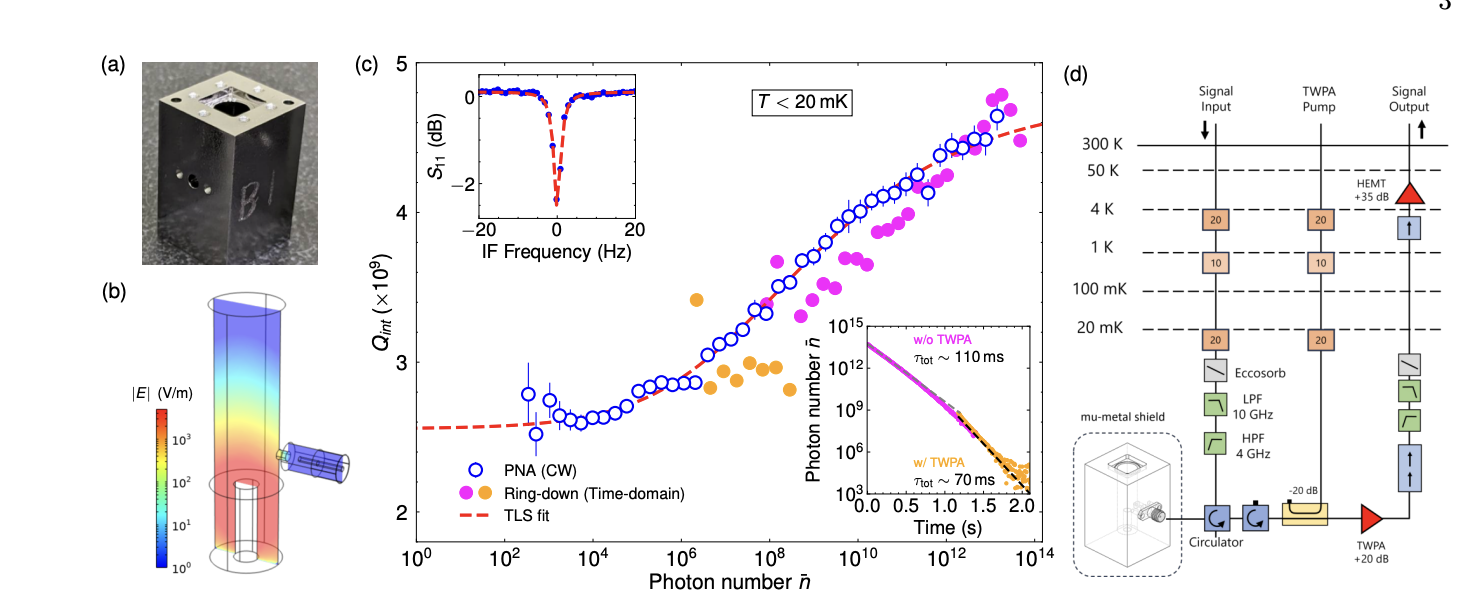
Scientists have developed a precise fabrication and characterization process for high-quality niobium cavities intended for quantum applications. Starting with high-conductivity niobium, they machine quarter-wave coaxial stub cavities and subject them to a carefully controlled surface treatment involving buffered chemical polishing, high-temperature baking, and a final light polish. A key innovation involves exploring mid-temperature annealing to minimize surface resistance. Cavity performance is evaluated using both frequency-domain and time-domain measurements, conducted at extremely low temperatures within a dilution refrigerator. Measurements of the reflection coefficient and ring-down decay times allow researchers to extract the internal quality factor and demonstrate the reliability of the results, enabling the achievement of exceptionally low-loss cavities suitable for demanding quantum applications.
Record Q-Factor Achieved in Niobium Cavities
Researchers have achieved a remarkable breakthrough in superconducting cavity design, demonstrating an internal quality factor exceeding 3 × 10 9 at the single-photon level and millikelvin temperatures. This performance was realized in a three-dimensional niobium quarter-wave coaxial cavity subjected to a novel mid-temperature annealing process, representing a significant advancement over previously reported values. The team meticulously fabricated cavities from high-conductivity niobium and optimized the cavity geometry to minimize conductor losses. Experiments reveal that this mid-temperature annealing process not only delivers exceptionally high quality factors but also maintains this performance with remarkable stability, even after multiple cooldown cycles and exposure to air. This stability is attributed to the formation of stable, low-loss niobium oxides on the cavity surface, and the breakthrough does not rely on complex techniques typically used in superconducting radio-frequency cavities, making it readily compatible with existing niobium-based superconducting qubit fabrication processes.
High Q Cavities Enable Longer Coherence Times
This research demonstrates significant advances in the performance of niobium coaxial cavities, crucial components in superconducting quantum devices. Scientists achieved remarkably high internal quality factors, exceeding 3 × 10 9 , through a surface treatment inspired by techniques used in superconducting radio frequency cavities, representing a substantial leap forward and enabling longer coherence times and enhanced performance in quantum circuits. The method involves a carefully controlled process of buffered chemical polishing and mid-temperature annealing, which effectively reduces material loss within the cavity. Notably, these cavities maintain their exceptional performance even after multiple thermal cycles and brief exposure to air, addressing a long-standing challenge in niobium cavity design. Analysis indicates that the treatment promotes the formation of stable niobium oxides on the cavity surface, contributing to the observed reduction in energy loss and suggesting a pathway towards more robust and reliable superconducting quantum platforms.
🗞 Three-Dimensional Niobium Coaxial Cavity with second Lifetime
🧠 ArXiv: https://arxiv.org/abs/2510.01819



See today’s quantum computing news on Quantum Zeitgeist for the latest breakthroughs in qubits, hardware, algorithms, and industry deals.