Rydberg atoms arranged in carefully designed geometries offer exciting possibilities for exploring complex quantum phenomena, and recent research demonstrates unprecedented control over these systems. Robin C. Verstraten from Utrecht University, Ivo H. A. Knottnerus from the University of Amsterdam, and colleagues, including Yu Chih Tseng and Vinicius Zampronio, investigate the behaviour of these atoms when trapped in a fractal pattern. Their work reveals that arranging the atoms in a specific fractal geometry, a Sierpinski gasket, leads to a surprising result: the ability to control individual spin-flips within the system. This precise control allows researchers to trigger a cascade of phase transitions and opens new avenues for manipulating quantum states, potentially impacting future technologies and offering a powerful platform for quantum information processing.
Rydberg atoms trapped by optical tweezers have become a versatile platform for emulating lattices with different geometries. Within these lattices, long-range interacting spins give rise to fascinating phenomena, ranging from complex many-body physics to quantum simulation. The ability to precisely control the interactions between these atoms offers a unique opportunity to investigate fundamental questions in condensed matter physics and quantum information science. This research builds upon recent advances in trapping and manipulating individual Rydberg atoms, allowing for the creation of highly configurable and controllable quantum systems.
Rydberg Atoms in Fractal Optical Tweezers
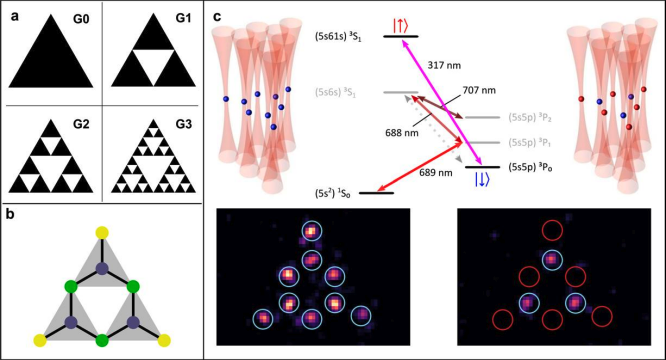
Researchers are building a platform for quantum simulation using arrays of individually controlled Rydberg atoms trapped in optical tweezers. A key innovation is the use of fractal geometries, specifically Sierpinski gaskets and carpets, as the arrangement for the atoms. These lattices possess unique properties that can be exploited to create novel quantum states and explore new physics, introducing interesting constraints and symmetries. The goal is to create and characterize specific spin configurations within the fractal lattice, with a particular interest in antiferromagnetic states. The research involves using optical tweezers to trap and arrange individual atoms in the desired fractal lattice.
Rydberg atoms, excited to a high-energy state, exhibit strong interactions crucial for creating the desired spin states. Lasers manipulate the atoms’ internal states and control the strength of their interactions, while microwave control drives transitions between spin states. High-resolution imaging determines the spin state of each atom in the lattice. Sophisticated theoretical calculations, including exact diagonalization, variational mean field, and quantum Monte Carlo, predict the system’s behaviour and interpret experimental results. A custom algorithm, SIM-GRAPH, simplifies calculations for the fractal lattices.
The researchers successfully created and characterized complex spin states in the fractal lattices, including antiferromagnetic states with specific patterns. The fractal geometry influences the system’s behaviour, leading to unique properties and constraints on the possible spin states. The SIM-GRAPH algorithm effectively simplifies calculations for the fractal lattices, enabling the study of larger systems. They demonstrated excellent agreement between theory and experiment at low interaction strengths, validating their theoretical models and experimental techniques. This work represents a significant step forward in quantum simulation, demonstrating the feasibility of using programmable matter to study complex quantum phenomena. The use of fractal lattices opens up new possibilities for exploring novel quantum states and discovering new physics. The agreement between theory and experiment validates the theoretical models used to describe the system, providing confidence in their predictive power.
Fractal Geometry Reveals Unique Quantum Phases
Researchers have demonstrated remarkable control over many-body quantum systems by trapping single strontium atoms in a fractal geometry using optical tweezers, specifically arranging them in a Sierpiński gasket. This innovative approach allows for the emulation of a transverse-field Ising model with long-range van der Waals interactions, revealing surprising quantum phenomena not observed in traditional lattice structures. Experiments and theoretical calculations confirm the emergence of phases where spins flip one-by-one. This delocalization enables unprecedented control over a cascade of phase transitions within the many-body system, offering a pathway to manipulate quantum states with high precision. Measurements of magnetization and von Neumann entropy reveal several distinct regimes where these delocalized spin-flips occur, highlighting the system’s complex quantum properties. This research expands the possibilities for utilizing Rydberg atoms in quantum information processing.
Fractal Lattice Enables Controlled Quantum Spin Flips
This research demonstrates that arranging interacting atoms in a specific fractal geometry, a Sierpinski gasket, leads to unusual and controllable quantum behaviour. Researchers successfully created this fractal lattice using optical tweezers to trap individual atoms and then studied the resulting interactions between them. Unlike typical magnetic materials, the system exhibits phase transitions driven by individual atoms flipping their spin, rather than collective changes across the material. This level of agreement between theory and experiment validates the understanding of this complex system and highlights the potential for further exploration. While the current work focuses on a specific fractal geometry, the principles demonstrated could be extended to other fractal designs and potentially to other types of interacting quantum systems.
🗞 Control of single spin-flips in a Rydberg atomic fractal
🧠 ArXiv: https://arxiv.org/abs/2509.03514
See today’s quantum computing news on Quantum Zeitgeist for the latest breakthroughs in qubits, hardware, algorithms, and industry deals.