The quest for scalable quantum computers faces significant hurdles in building and maintaining stable qubits, and even minor fabrication defects can disrupt quantum computations. Oscar Higgott, Benjamin Anker, and Matt McEwen, all from Google Quantum AI, alongside Dripto M. Debroy, propose a method to overcome these challenges specifically within hexagonal qubit layouts, an increasingly promising architecture for quantum processors. Their research demonstrates that even with broken qubits or couplers, these hex-grid surface codes maintain performance, effectively reducing the required circuit distance for reliable computation. This breakthrough removes a critical obstacle to building large-scale quantum computers using hexagonal qubit grids, paving the way for more robust and practical quantum hardware.
Hexagonal Surface Codes With Fault Tolerance
Exploring Hexagonal Designs for Stable Qubits
Exploring Hexagonal Codes for Stable Qubit Grids
Quantum error correction is essential for building practical quantum computers. Surface codes, a promising approach to error correction, are typically implemented using a grid of qubits. Recent research explores the benefits of arranging these qubits in a hexagonal grid, which offers potential advantages in connectivity and scalability. However, building large-scale quantum computers requires addressing the inevitable presence of faulty qubits or connections during manufacturing. This work introduces a method for handling these defects within hexagonal grid surface code architectures, building upon a technique called LUCI. The team demonstrates that even with a broken qubit or connection, the system’s ability to correct errors is only minimally affected, reducing the circuit distance by just one unit. This advancement removes a critical obstacle to implementing hexagonal qubit grids in hardware for large-scale quantum error correction.
Dynamic Error Correction Adapts to Hardware Defects
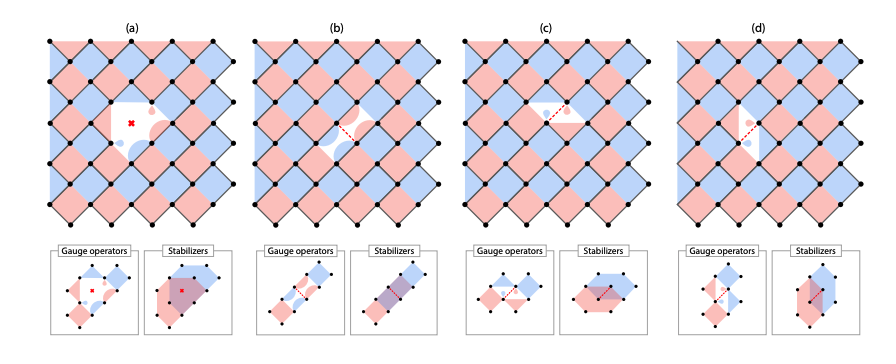
Quantum computers are incredibly sensitive to noise, which introduces errors during computation. Quantum error correction protects quantum information, and surface codes are a leading candidate for practical implementation. Real-world quantum hardware isn’t perfect, and qubits or the connections between them can fail. This research focuses on dynamically adapting error correction schemes to bypass these defective components and maintain reliable computation. The team builds upon a technique called LUCI, which allows the error correction code to be adjusted locally to work around defective components. They introduce additional measurements to enhance LUCI’s effectiveness, creating a more robust system. The method is tested against scenarios involving broken qubits and broken connections, demonstrating its ability to minimize the impact of hardware defects.
Tolerating Physical Defects in Qubit Grids
Tolerating Manufacturing Defects in Quantum Systems
Hexagonal Qubit Layout Tolerates Manufacturing Defects
Recent research demonstrates a significant advancement in the design and error correction of quantum computers using a hexagonal grid layout for qubits. Traditionally, building these systems requires each qubit to be connected to four neighbors, but this work shows that a hexagonal arrangement, needing only three connections per qubit, can achieve comparable performance. This simplification dramatically reduces the hardware complexity, paving the way for more scalable quantum processors. A major hurdle for hexagonal grid architectures has been dealing with inevitable defects during manufacturing, such as broken qubits or faulty connections.
The team developed an improved method, building upon the existing LUCI framework, to handle these imperfections without severely compromising the system’s ability to correct errors. Their approach minimizes the impact of these defects, reducing the effective circuit distance by only one unit when a qubit or connection fails. Simulations using a realistic model of quantum noise demonstrate that this new method maintains high performance even with broken components, with only a small increase in error rate.
Advanced Frameworks for Broken Quantum Components
Advanced Error Correction for Broken Components
Defect Tolerance in Hexagonal Surface Codes
This work presents a method for managing faulty qubits and connections within hexagonal grid surface code architectures, extending the LUCI framework to address a key challenge in hardware implementation. The researchers demonstrate that their approach maintains circuit performance even with broken components, reducing the circuit distance by one for isolated qubit or coupler failures. This is achieved by strategically handling defects, offering a viable path towards building large-scale quantum computers with reduced hardware demands. The findings are significant because hexagonal grid layouts require fewer components and simpler connections than traditional qubit arrangements, potentially improving scalability.
Broad Applicability Across Surface Code Designs
Broad Applicability Across Surface Code Architectures
However, existing methods for handling fabrication defects were incompatible with this architecture; this research removes that roadblock. While the improvement is more substantial for hex-grid circuits, the method also offers benefits for standard four-coupler surface codes. The authors acknowledge that future work should investigate performance with realistic models of fabrication defects and explore the possibility of removing the worst-performing devices to further optimize results. This research motivates the use of hexagonal grid architectures and represents a step towards practical, fault-tolerant quantum computation.
🗞 Handling fabrication defects in hex-grid surface codes
🧠 ArXiv: https://arxiv.org/abs/2508.08116