Quantum key distribution (QKD) offers fundamentally secure communication by leveraging the laws of quantum mechanics, promising resilience against increasingly sophisticated cyber threats. Recent advances focus on enhancing both the range and data transmission rates of these systems, with multi-dimensional entanglement proving a particularly promising avenue for improvement. George Claudiu Crisan, Antoine Henry, and colleagues report on the development of a multi-dimensional frequency-bin entanglement-based quantum key distribution network, detailed in their article, ‘Multi-dimensional frequency-bin entanglement-based quantum key distribution network’. The research, conducted at the Centre de Nanosciences et de Nanotechnologie, CNRS, Universit´e Paris Saclay, alongside collaborators from ST Micro Electronics SAS and Telecom Paris, Institut Polytechnique de Paris, demonstrates a competitive communication range utilising qudits – quantum digits with dimensions greater than the standard qubit – and lays the foundation for scalable, high-capacity quantum communication networks deployed over existing fibre optic infrastructure.
Quantum networks represent a transformative technology poised to revolutionise secure communication and expand the capabilities of interconnected devices across vast distances. Researchers are actively developing these networks, focusing on leveraging the unique properties of quantum mechanics to achieve unprecedented levels of security and efficiency. A key innovation driving this progress is the utilisation of high-dimensional quantum states – known as qudits – which offer significant advantages over traditional qubit-based systems in terms of information density and resilience to noise. This approach promises to overcome limitations inherent in current communication infrastructure and unlock new possibilities for secure data transmission, distributed computing, and advanced sensing applications.
Current quantum key distribution (QKD) protocols, while offering provable security, often face challenges related to transmission distance and key generation rates. These limitations stem from the inherent fragility of qubits and the losses incurred during transmission through optical fibres. To address these issues, scientists are exploring the use of qudits, which encode information in higher-dimensional quantum systems, allowing for greater information capacity and improved robustness against environmental disturbances. By encoding multiple bits of information within a single qudit, researchers can significantly increase the key generation rate and extend the communication range of QKD systems.
This research harnessed the potential of high-dimensional quantum
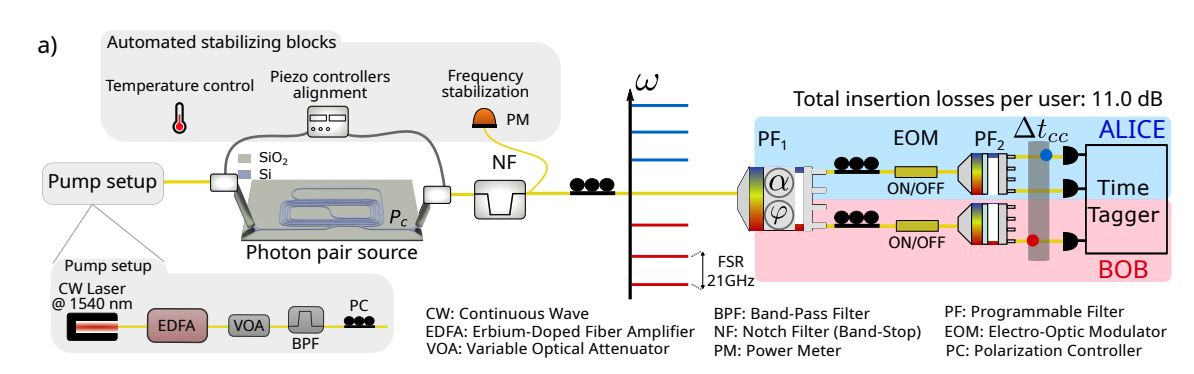
This research harnessed the potential of high-dimensional quantum states, specifically qudits, to develop a multi-dimensional frequency-bin entanglement-based key distribution network. This network leverages the unique properties of qudits to enhance communication schemes and connect multiple users over large areas, offering a pathway towards more secure and efficient data transmission. The system utilises frequency encoding to access these qudits at telecom wavelengths, enabling compatibility with existing fibre optic infrastructure and facilitating seamless integration into current communication networks. Readily available fibered devices were used, minimising the need for specialised hardware and reducing the overall cost of implementation.
The system generates Bell states of dimension d=2 (qubits) and d=3 (qutrits) via spontaneous four-wave mixing within a low free spectral range silicon microresonator. This process creates entangled photon pairs, which serve as the fundamental building blocks of the QKD system. The silicon microresonator provides a compact and efficient platform for generating high-quality entangled photons, enabling the creation of a stable and reliable quantum communication link.
Information is manipulated by tuning the source via pump power, optimising signal processing with a coincidence window size, and encoding qudits (d=2 or 3) using a single-fibered hardware setup based on Fourier-transform pulse shaping and frequency multiplexing. This allows for dynamic switching between qubit and qutrit encoding, offering a significant advantage by allowing the network to adapt to changing conditions and optimise performance for different interconnection lengths.
Secure key rates of up to 80 frequency modes were achieved, resulting in 21 stable communication channels maintained for over 21 hours, demonstrating the stability and reliability of the approach. This high degree of multiplexing allows for increased communication capacity and efficient utilisation of the available bandwidth.
This demonstrates a competitive communication range within a multi-dimensional entanglement-based key distribution network, paving the way for larger dimensionality implementations deployed on metropolitan fibre links. By harnessing the advantages of high-dimensional entanglement and leveraging off-the-shelf fibered devices, a promising pathway towards building secure and efficient quantum communication networks for future applications is provided.
This research contributes to the growing field of
This research contributes to the growing field of quantum communication by demonstrating the feasibility and advantages of utilising high-dimensional entanglement for enhancing the performance of QKD systems. By overcoming the limitations of traditional qubit-based systems, a step towards the development of practical and scalable quantum networks capable of supporting a wide range of applications – including secure data transmission, distributed computing, advanced sensing, and the creation of a quantum internet – is taken.
The development of quantum networks necessitates a multidisciplinary approach, combining expertise in quantum optics, photonics, information theory, and network engineering. Active collaboration with researchers from various institutions is ongoing to address the challenges associated with building and deploying quantum networks, including developing efficient sources of entangled photons, improving the performance of single-photon detectors, and designing robust quantum communication protocols.
Future research directions include exploring higher-dimensional entanglement schemes, developing more efficient quantum repeaters, and integrating quantum networks with existing classical communication infrastructure. Investigation into the use of quantum networks for applications beyond secure communication, such as distributed quantum computing and quantum sensing, is also underway. These advancements will further unlock the potential of quantum technology, paving the way for a quantum future.
🗞 Multi-dimensional frequency-bin entanglement-based quantum key distribution network
🧠 DOI: https://doi.org/10.48550/arXiv.2507.00972


See today’s quantum computing news on Quantum Zeitgeist for the latest breakthroughs in qubits, hardware, algorithms, and industry deals.