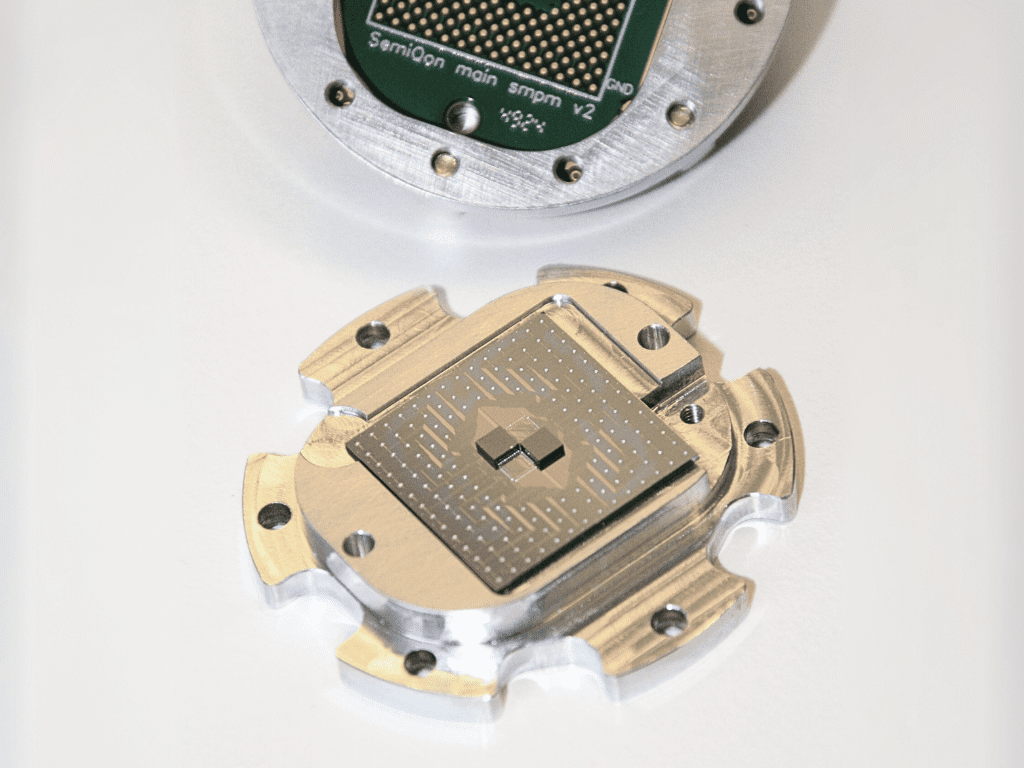
SemiQon has demonstrated the large-scale characterisation of quantum dot qubits utilising its cryogenically optimised CMOS (complementary metal-oxide-semiconductor) transistor, initially unveiled in late 2024. This development addresses a core challenge in scaling quantum computing by enabling integrated circuits capable of simultaneously addressing hundreds of qubit devices within a single cryogenic cooling stage. The company achieved this by employing FDSOI (fully depleted silicon-on-insulator) silicon-28 substrates for both qubits and interfacing circuits, facilitating the collection of large-scale statistical data necessary for understanding qubit performance at scale. SemiQon’s technology aims to integrate densely packed silicon qubits with on-chip readout solutions, reducing the need for extensive cabling and room-temperature electronics, and is currently undergoing validation with research partners and early customers.
Cryogenic CMOS Transistor Development & Large-Scale Quantum Dot Qubit Characterisation
SemiQon demonstrates large-scale characterisation of quantum dot qubits utilising its cryogenically optimised CMOS transistor technology, addressing a core challenge in scaling quantum computing systems – the efficient control and readout of numerous qubits. The company integrates control electronics directly onto the same chip as the qubits, within the cryostat – the ultra-cold environment essential for qubit operation, enabling a more compact and efficient system architecture. This innovative approach promises to simplify the complex engineering required to build and operate future quantum processors. Reducing power consumption remains central to SemiQon’s design, with the cryo-CMOS transistor achieving a 100-fold reduction, minimising heat load within the cryostat and simplifying cooling requirements.
The utilisation of FDSOI silicon-28 substrates forms a key element of SemiQon’s strategy, facilitating the acquisition of large-scale statistical datasets and moving beyond the industry’s historical focus on single-device performance metrics. This material supports the fabrication of both qubits and interfacing circuits, ensuring compatibility and minimising performance discrepancies. Understanding variations across a large ensemble of qubits is essential for reliable system-level operation. By understanding the statistical distribution of qubit characteristics, SemiQon can optimise circuit design and improve the overall yield of functional quantum processors.
SemiQon’s recent demonstrations extend beyond single-qubit analysis, enabling the assessment of hundreds of quantum dot qubits on a single chip, a significant advancement in the field of quantum integrated circuits. Integrating control and readout electronics directly onto the same silicon substrate as the qubits minimises signal degradation and latency, improving the accuracy and speed of qubit control. This large-scale characterisation is crucial for identifying and mitigating performance variations across the qubit array, ensuring the overall system operates reliably.
Currently, SemiQon focuses on developing cryo-compatible packaging for these integrated circuits, a necessary step towards practical implementation and ensuring long-term reliability within the extreme temperature environment of the cryostat. Validated chips undergo testing at both SemiQon’s facilities and those of its research partners and early customers, accelerating the development and deployment of quantum integrated circuits. This collaborative approach allows for real-world feedback and validation of the technology.
Validation of these packaged chips extends beyond in-house testing, with collaborative efforts providing crucial feedback on real-world performance and identifying potential areas for improvement. By working closely with research partners and early customers, SemiQon can refine its designs and address any challenges that arise during integration and operation. This external validation process accelerates the development cycle and ensures that SemiQon’s technology meets the demands of emerging quantum computing applications.
The interplay between circuit design, materials selection, and packaging technology is paramount for building scalable and dependable quantum processors. SemiQon’s use of FDSOI silicon-28 for both qubits and interfacing circuits simplifies this integration, reducing material mismatches and improving overall system reliability. This holistic approach ensures that all components work together seamlessly, maximising performance and minimising the risk of failure. By minimising power consumption, SemiQon reduces the complexity and cost associated with building and operating quantum processors.
More information
External Link: Click Here For More