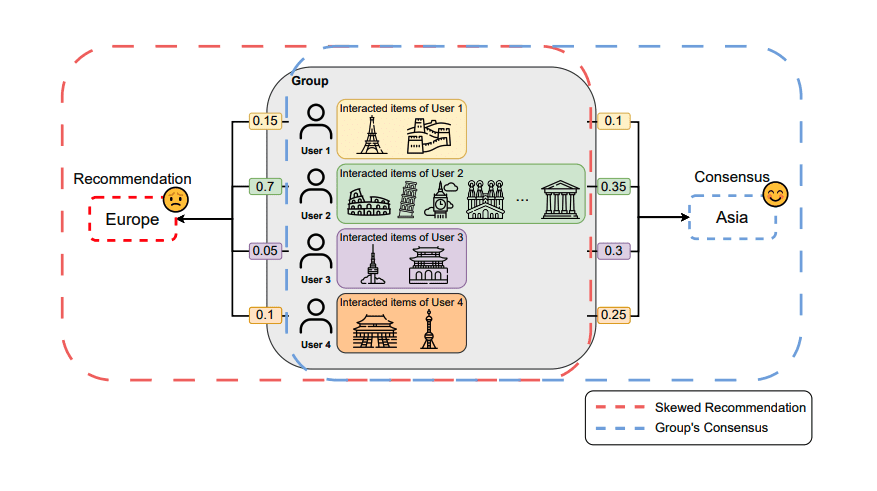
On April 18, 2025, researchers Soyoung Kim, Dongjun Lee, and Jaekwang Kim published Consensus-aware Contrastive Learning for Group Recommendation, introducing a novel approach to enhance group recommendation systems by addressing challenges in capturing consensus and balancing individual preferences.
Group recommendation systems face challenges in capturing consensus in small groups and balancing individual preferences with overall performance. To address this, CoCoRec introduces a consensus-aware contrastive approach using a transformer encoder to model intra-group dynamics and reduce overfitting from high-frequency interactions. Experiments on four datasets show CoCoRec consistently outperforms state-of-the-art methods in both individual and group recommendation tasks, demonstrating the effectiveness of its approach.
In today’s digital landscape, recommendation systems are integral to platforms like Netflix, Spotify, and Amazon, guiding users’ choices seamlessly. However, when it comes to group recommendations—such as suggesting movies for friends or playlists for a team—the complexity escalates significantly. Traditional methods often struggle to balance individual preferences with the dynamics of group interactions, leading to suboptimal outcomes.
Recent advancements in deep learning have introduced innovative solutions to this challenge. Researchers have developed a novel approach that leverages neural networks and attention mechanisms to enhance group recommendation systems. This method focuses on capturing individual user preferences while also considering the social dynamics within groups, thereby improving the accuracy and relevance of recommendations.
The system operates by first aggregating individual preferences through neural networks, which can process vast amounts of data efficiently. Attention mechanisms are then employed to weigh these preferences dynamically, allowing the model to focus on the most relevant aspects for each group member. This approach not only personalizes recommendations but also accounts for the nuanced interactions within groups.
Experiments conducted with this new method have demonstrated significant improvements in performance metrics such as precision and recall compared to existing models. By better aligning recommendations with user preferences and group dynamics, the system achieves higher satisfaction levels among users.
The implications of this research are substantial for both industry and academia. For businesses, it offers a more effective tool for enhancing user experience and engagement. For researchers, it opens new avenues in understanding complex social interactions through machine learning. However, challenges remain. The computational costs associated with training deep learning models can be high, and scalability across diverse group sizes and contexts requires further exploration. Addressing these issues will be crucial for the widespread adoption of this technology.
In conclusion, integrating deep learning into group recommendation systems represents a significant step forward in personalization and social dynamics handling. While challenges persist, the potential benefits are clear, promising more satisfying and cohesive recommendations for groups in various settings. As research continues, we can expect further refinements that will make these systems even more effective and user-friendly.
👉 More information
🗞 Consensus-aware Contrastive Learning for Group Recommendation
🧠 DOI: https://doi.org/10.48550/arXiv.2504.13703