
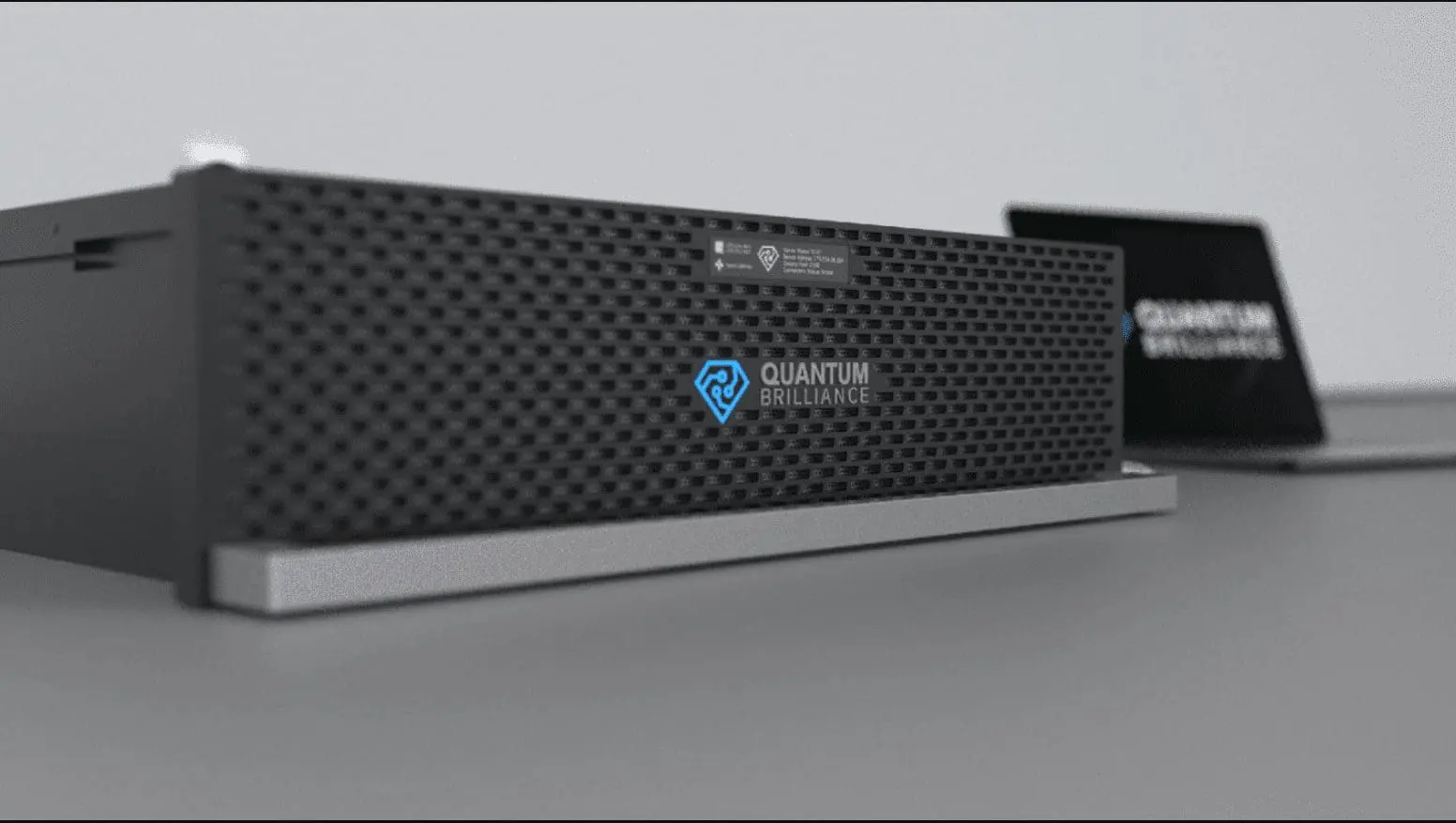
In a recent announcement from scientists in Australia, a recent innovation is set to enable RT or (Room Temperature) Quantum Computers. The first Room Temperature Quantum Computer is in the last stages of development. It is set to be installed at the Pawsey Supercomputing Centre in Perth and will come online later this year (2021).
Quantum Brilliance represents the future of quantum computing.
ANU Vice-Chancellor Professor Brian Schmidt
Unlike many superconducting Quantum Computers from the likes of IBM and Rigetti, which require massive refrigeration, the device, said to be around the size of a lunchbox, does not need this level of refrigeration – which is not only costly but bulky. Researchers at The Australian National University (ANU) have invented the groundbreaking technology used in the new computer. They are a driving force of the spin-out company Quantum Brilliance, which seeks to commercialize the next-generation device.
Collaboration between the Pawsey Centre in Perth and Quantum Brilliance see Australian industry leaders and researchers develop bleeding-edge quantum applications that can impact areas such as machine learning, logistics, defense, aerospace, and drug development.
As Australia’s national university, ANU is committed to creating the technologies and industries of tomorrow, today. This work is vital to ensuring the future prosperity of our nation and the world,
ANU VICE-CHANCELLOR PROFESSOR BRIAN SCHMIDT
Quantum computers promise a new era in ultra-secure networks, AI, and numerous applications. It therefore makes sense that researchers explore the new horizon emerging, which is Quantum Computing. The spin-out is a welcome release from the Australians, competing often against the might of North America and China. The diamond-based technology is unique and can allow customers to run quantum computers themselves. The team provides them with tools to explore how quantum can help create new capabilities and applications. Quantum Brilliance, founded and led by ANU physicists Dr Marcus Doherty and Dr Andrew Horsley, uses synthetic diamonds to create quantum microprocessors.
…the new computer will transform industries in Australia and around the world.
Dr Horsley, CEO of Quantum Brilliance
The Super Computing Centre, Pawsey, and Quantum Brilliance join forces with other Australian industry leaders and researchers as part of Pawsey’s Quantum Pioneer Program. The aim is to develop cutting-edge quantum applications in machine learning, logistics, defense, aerospace, quantum finance, and quantum research. Read more from Quantum Brilliance and ANU.
Quantum Brilliance is a company that operates in the field of quantum computing. Their main focus is on developing quantum computing hardware that can operate at room temperature, which is a significant departure from the traditional approach requiring near-absolute zero temperatures. This innovation could make quantum computing more accessible and easier to integrate into everyday computing infrastructure.
Products by Quantum Brilliance
Quantum Brilliance’s flagship product is a quantum accelerator based on synthetic diamonds, which is designed to function at room temperature and can be used alongside classical computers. This product aims to bring quantum computing capabilities to a wider range of environments, from data centers to space applications, without the need for complex cooling systems.
Significance of the Technology
The use of synthetic diamonds is critical to the product’s unique value proposition. Diamonds have quantum properties that can be harnessed to perform calculations in ways that are fundamentally different from classical computers. By using defects in synthetic diamonds known as nitrogen-vacancy centers, Quantum Brilliance’s technology leverages these properties to perform quantum computations without extreme cooling requirements such as that required by superconducting qubits.
Future Implications
The development of room-temperature quantum computing hardware is seen as a major step towards the democratization of quantum computing technology. If successful, it could lead to the widespread deployment of quantum computers in a variety of settings and industries, potentially revolutionizing fields such as medicine, logistics, finance, and artificial intelligence.