

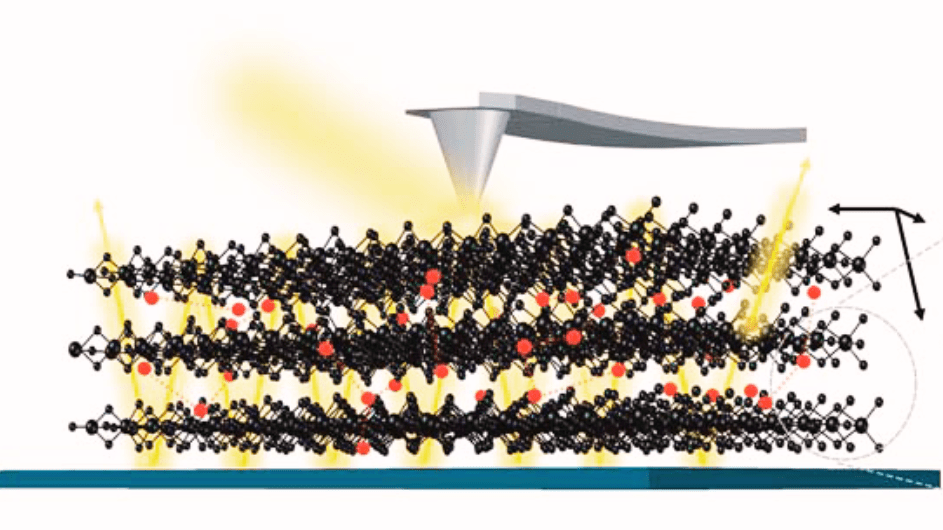
Columbia University researchers have identified unusual optical properties in molybdenum oxide dichloride (MoOCl2), a bad metal known for poor electrical conductivity but unique quantum characteristics. The material exhibits anisotropic behavior, acting as a metal in one direction and an insulator in another, leading to the emergence of hyperbolic plasmon polaritons. These quasiparticles hold promise for advancing optical technologies such as super-resolution microscopy and telecommunications. The findings were published in Science on February 13, 2025, with contributions from researchers at Columbia, the Flatiron Institute, and the National Renewable Energy Laboratory.
Bad Metals and Their Unique Electronic Properties
Bad metals are a class of materials where electrons exhibit strong correlations, leading to unique electronic properties that deviate from conventional metallic behavior. These materials are characterized by poor electrical conductivity despite their delocalized electrons, making them intriguing candidates for studying quantum phenomena.
In molybdenum oxide dichloride (MoOCl2), researchers have identified hyperbolic plasmon polaritons—quasiparticles resulting from the coupling of photons and electrons. These polaritons propagate in hyperbolic wavefronts, enabling sub-diffractional light manipulation, which is valuable for applications such as advanced microscopy and telecommunications.
The anisotropic electronic structure of MoOCl2, where it behaves as a metal in one direction and an insulator in another, facilitates the emergence of these plasmonic modes. This directional dependence arises from strong electron correlations, a hallmark of bad metals, creating a unique environment for hyperbolic plasmons.
Experimental techniques like angle-resolved photoemission spectroscopy (ARPES) have revealed scattering patterns linked to charge density waves influenced by MoOCl2’s anisotropic properties. These findings suggest that the material’s electronic structure could be harnessed for practical optical applications, including high-resolution imaging and efficient data transmission.
The independent confirmation of these results by researchers at the Italian Institute of Technology in Milan underscores their validity. This discovery challenges conventional perceptions of bad metals as merely poor conductors, highlighting their potential in quantum technologies and advanced optics.
Replication Efforts and Future Directions
Bad metals are materials characterized by strong electron-electron interactions, leading to unique electronic properties that deviate from conventional metallic behavior. These materials exhibit poor electrical conductivity despite their delocalized electrons, making them intriguing for studying quantum phenomena.
In molybdenum oxide dichloride (MoOCl2), researchers have identified hyperbolic plasmon polaritons—quasiparticles resulting from the coupling of photons and electrons. These polaritons propagate in hyperbolic wavefronts, enabling sub-diffractional light manipulation, which is valuable for applications such as advanced microscopy and telecommunications.
The anisotropic electronic structure of MoOCl2, where it behaves as a metal in one direction and an insulator in another, facilitates the emergence of these plasmonic modes. This directional dependence arises from strong electron correlations, a hallmark of bad metals, creating a unique environment for hyperbolic plasmons.
Experimental techniques like angle-resolved photoemission spectroscopy (ARPES) have revealed scattering patterns linked to charge density waves influenced by MoOCl2’s anisotropic properties. These findings suggest that the material’s electronic structure could be harnessed for practical optical applications, including high-resolution imaging and efficient data transmission.
The independent confirmation of these results by researchers at the Italian Institute of Technology in Milan underscores their validity. This discovery challenges conventional perceptions of bad metals as merely poor conductors, highlighting their potential in quantum technologies and advanced optics.
More information
External Link: Click Here For More


