

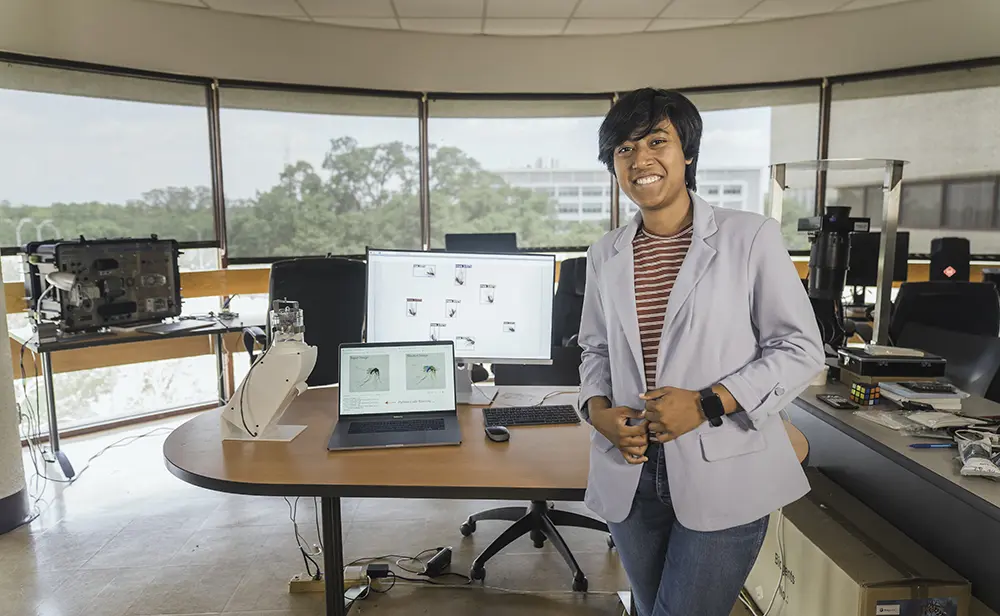
Farhat Azam of the University of South Florida, alongside a faculty-led research team, has developed an artificial intelligence-enabled smart mosquito trap designed for species-specific identification of disease vectors. The device operates by luring mosquitoes to a capture surface, whereupon a digital image is acquired and transmitted to a cloud-based analytical platform. Employing artificial intelligence algorithms, the system classifies captured specimens, distinguishing between species with a particular focus on identifying the 2. 5% of mosquito species known to act as vectors for 78 human pathogens, including those responsible for diseases such as malaria, West Nile virus, Zika virus, yellow fever, and dengue. Successful identification triggers automated alerts to both the trap operator and relevant public health authorities, facilitating targeted surveillance and intervention strategies; Azamalgamating Azam’s masters research completed in 2023 with ongoing doctoral studies in computer science at USF.
Personal Motivation
Farhat Azam’s impetus for developing an artificial intelligence-enabled smart mosquito trap stems directly from a personal encounter with the debilitating effects of dengue fever. In 2019, during a particularly virulent outbreak in Southeast Asia – which recorded a peak of 658,000 cases, representing the highest incidence on record – both of Azam’s parents contracted the disease. While Azam herself was infected, her comparatively younger age conferred a degree of immunological resilience, mitigating the severity of her symptoms; her parents, however, experienced a life-threatening illness, profoundly influencing her academic trajectory. This experience catalysed a shift towards utilising computational expertise to address public health challenges associated with vector-borne diseases.
Azam subsequently enrolled at the University of South Florida (USF), completing a Master’s degree in Computer Science in 2023 and is currently pursuing doctoral studies in the same discipline, commencing her research affiliation with the university in 2021. Her academic focus has centred on the application of machine learning and computer vision techniques to improve disease surveillance and control. The development of the smart mosquito trap is a direct outcome of this research, undertaken in collaboration with a faculty-led team at USF, leveraging expertise in entomology, engineering, and data science. This collaborative approach is crucial, given the multidisciplinary nature of the problem and the need for accurate species identification.
The core innovation lies in the device’s ability to discriminate between mosquito species, a critical factor in effective mosquito disease identification and targeted intervention strategies. While approximately 3,500 mosquito species exist globally, only 2. 5% are known vectors for the 78 pathogens capable of causing human disease. The trap operates by employing attractants to lure mosquitoes onto a sticky surface, where a high-resolution camera captures an image of the captured insect. This image is then transmitted to a cloud-based server where sophisticated artificial intelligence algorithms, trained on extensive datasets of mosquito morphology, analyse the visual characteristics to determine the species with a high degree of accuracy.
Upon identification of a disease-carrying species, the system triggers an alert, notifying both the trap owner and relevant local public health authorities. This real-time data transmission allows for rapid response and targeted interventions, such as localised spraying or increased surveillance, potentially mitigating outbreaks before they escalate. The system’s efficacy relies on the continuous refinement of the AI algorithms through ongoing data collection and validation, ensuring adaptability to regional variations in mosquito populations and the emergence of new vector species. This proactive approach represents a significant advancement over traditional mosquito surveillance methods, which are often labour-intensive and rely on manual identification.
Disease Detection
Farhat Azam, currently a doctoral student in computer science at the University of South Florida (USF), has been instrumental in developing an AI-enabled trap that rests upon a confluence of computer vision, machine learning, and cloud computing. Alongside a faculty team, Azam has engineered a system wherein a physical trap integrates with a sophisticated analytical pipeline. The trap itself employs attractants to lure mosquitoes, subsequently capturing them on a sticky substrate. A high-resolution camera, integrated within the trap housing, then captures images of the captured insects, initiating the digital analysis phase.
These features, encompassing morphological characteristics such as wing venation patterns, leg structures, and body shape, are then used to classify the insects as vectors for human pathogens; the precision of this classification is paramount. The cloud infrastructure provides the computational resources necessary for both the training and deployment of these complex AI models. Image data is uploaded from trap owners and local authorities, fostering a multidisciplinary approach to mosquito disease identification and control.
More information
External Link: Click Here For More


