

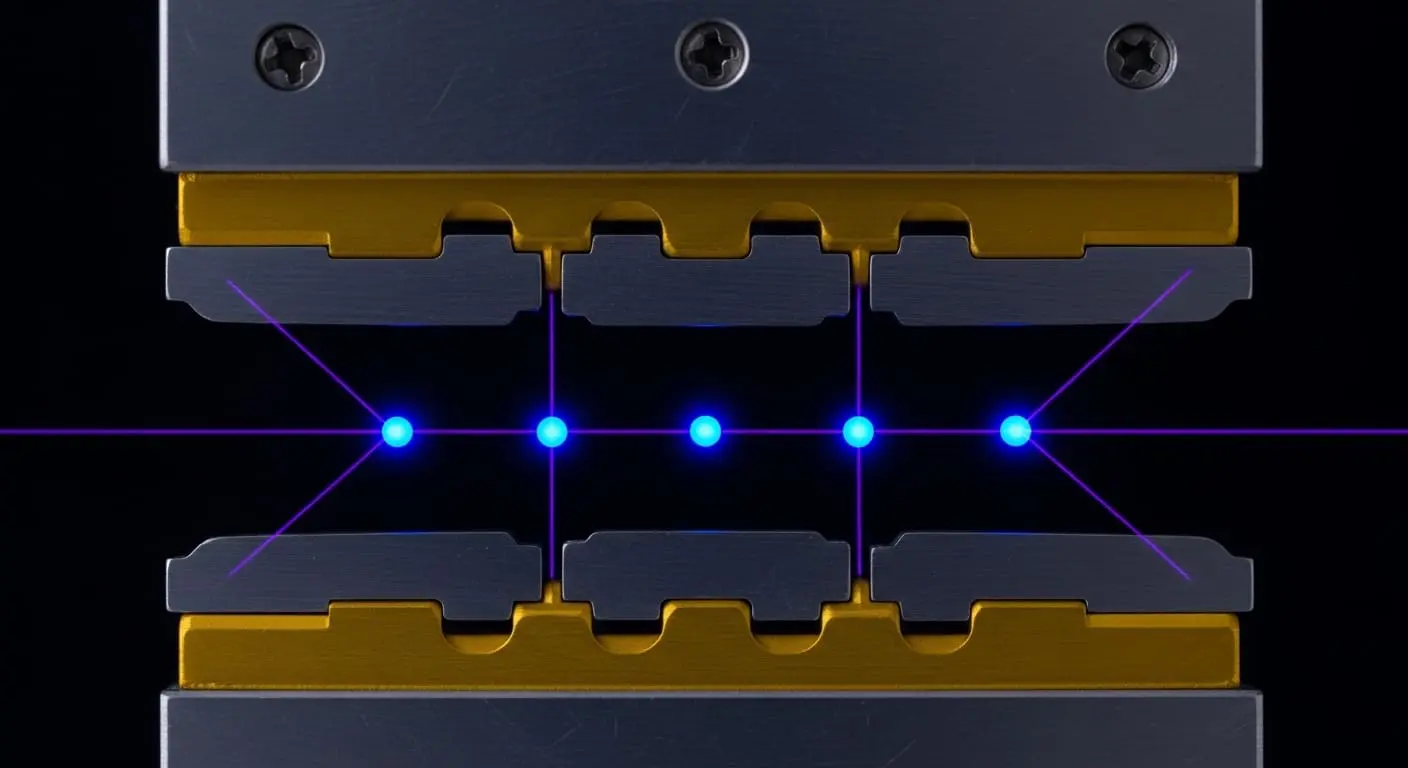
Researchers at the University of Sindh, Qirat Iqbal and Altaf Hussain Nizamani, have detailed a new surface Paul trap design that facilitates ultra-sensitive magnetic field detection and precise measurement of magnetic field gradients with sub-millimeter resolution. This innovative design incorporates multiple trapping regions, enabling comprehensive magnetic field mapping across diverse zones and representing a significant advancement in ion manipulation and confinement through a novel chip architecture. These sensors offer enhanced precision across a broad signal range, extending from static DC fields to radiofrequencies in the 100s of MHz, with sensitivities reaching picotesla and sub-picotesla levels. The system provides a key set of tools for surpassing the limitations of current sensor capabilities and opens avenues for applications demanding high-resolution magnetic field analysis.
Enhanced magnetic field sensitivity through multi-region surface Paul trap design
A novel Surface Paul Trap design achieves a magnetic field gradient sensitivity of 100 pT/ Hz √, representing a considerable advance over earlier methods previously limited to sensitivities above this level. This improvement is attributable to the precise control afforded by trapping individual ions and leveraging their quantum mechanical properties. The ability to detect weaker magnetic signals, previously masked by noise, thereby broadens opportunities for more accurate measurements in disciplines such as materials science, biomedicine, and fundamental physics research. Multiple trapping regions are incorporated into the design to permit detailed mapping of magnetic fields across varied areas, a function not readily available in single-region traps. Each region independently confines ions, allowing for parallel measurements and a substantial increase in mapping speed and resolution. A lone trapped ion demonstrated a sensitivity of 4 pT/ Hz √ for alternating-current magnetic fields reaching up to the MHz range, and this figure could be enhanced by employing a greater number of ions within the trap, effectively increasing the signal-to-noise ratio. Microwave decoupling is utilised in the design, allowing for swift frequency adjustment and negating the requirement for substantial magnetic shielding commonly needed by other magnetometers like Superconducting Quantum Interference Devices (SQUIDs), which achieve 0.08 fT sensitivity at 423kHz but necessitate complex cryogenic cooling and shielding. Sub-millimeter spatial resolution is also enabled by the Surface Paul Trap design, crucial for comprehensive magnetic field mapping; vapour cell technologies, for instance, provide sensitivities as low as 1 pT but lack comparable precision and spatial resolution. The Surface Paul Trap operates on the principle of confining charged particles, in this case, ions, using oscillating electric fields, creating a ‘trap’ where the ions can be held stable for extended periods. The ions’ internal quantum states are then exquisitely sensitive to external magnetic fields, allowing for precise measurements. The trap’s surface design facilitates miniaturisation and integration into larger sensing systems.
Resolving the trade-off between precision, scalability and engineering complexity
Simulations indicate unprecedented spatial resolution in magnetic field mapping, however, experimental validation via microfabrication is essential to substantiate these anticipated sensitivities and presents considerable engineering hurdles. Creating the micro- and nano-scale structures required for the Surface Paul Trap necessitates advanced fabrication techniques, such as deep reactive-ion etching and thin-film deposition. Maintaining the ultra-high vacuum environment required for ion trapping also presents a significant challenge. Vapour cell technologies offer a readily scalable and relatively straightforward pathway to magnetic field detection, prompting consideration of whether the complexity inherent in trapped ion systems justifies the gains in resolution for broad, practical implementation. While vapour cells are less sensitive and precise, their simplicity and lower cost make them attractive for applications where absolute accuracy is not paramount. The platform’s capabilities extend beyond two-dimensional mapping, with ongoing research concentrating on three-dimensional mapping to reveal even deeper insights into spin dynamics and advanced materials. This involves stacking multiple layers of traps or employing more complex electrode geometries to probe magnetic fields in all three spatial dimensions. Electric fields confine individual ions within these Surface Paul Traps, addressing the growing requirement for sensors able to detect minute magnetic variations in materials science and microfabrication. Applications include characterising the magnetic properties of novel materials, detecting defects in integrated circuits, and performing high-resolution magnetic imaging of biological samples. While such precision is not universally required across all applications, progress within these fields is stimulating the demand for more sensitive detection techniques. The ability to measure magnetic fields at the picotesla and sub-picotesla levels opens up possibilities for detecting extremely weak magnetic signals emanating from biological systems, potentially leading to new diagnostic tools and a better understanding of fundamental biological processes. Furthermore, the tuneability of the sensor to frequencies of interest and its ability to function as a lock-in frequency detector enhance its versatility and applicability to a wider range of sensing scenarios.
This research successfully demonstrates a new design for Surface Paul Traps, enabling the use of trapped ions to detect magnetic fields with picotesla to sub-picotesla sensitivity. The innovative chip architecture features multiple trapping regions, allowing for high-resolution mapping of magnetic fields at sub-millimeter scales. This level of precision is valuable for characterising materials, detecting defects in microfabrication, and potentially imaging biological samples. Current work focuses on extending this technology to three-dimensional magnetic field mapping for even greater insight into complex systems.
👉 More information
🗞 Scalable surface ion trap design for magnetic quantum sensing and gradiometry
🧠 DOI: https://doi.org/10.1016/j.physo.2024.100208


See today’s quantum computing news on Quantum Zeitgeist for the latest breakthroughs in qubits, hardware, algorithms, and industry deals.



