Top 50 Quantum Computing Terms You Need to Know
The essential vocabulary for understanding the quantum era
Quantum computing is reshaping the boundaries of what computers can do, but the field comes with its own dense vocabulary. Whether you are an investor evaluating quantum companies, a developer exploring quantum SDKs, or simply curious about the technology, these 50 terms form the conceptual core you need to navigate the quantum landscape with confidence.
Qubit
A qubit, short for quantum bit, is the basic unit of quantum information. Unlike a classical bit, which can be either 0 or 1, a qubit can exist in a superposition of both states simultaneously. The state of a qubit is represented as a linear combination of the basis states |0⟩ and |1⟩, with complex coefficients called amplitudes. Qubits can be implemented using various physical systems, such as the spin of an electron, the polarisation of a photon, or the energy levels of a superconducting circuit.
Superposition
Superposition is a fundamental principle of quantum mechanics which states that a quantum system can exist in multiple states simultaneously until a measurement is made. In quantum computing, superposition allows qubits to represent both 0 and 1 at the same time, enabling the exploration of many computational paths in parallel. It is one of the key properties that gives quantum computers their potential advantage over classical machines.
Entanglement
Entanglement is a phenomenon where two or more quantum particles become correlated in such a way that their quantum states cannot be described independently, even when separated by large distances. Measuring the state of one particle instantaneously determines the state of the other. Entanglement is a crucial resource in quantum computing, enabling quantum teleportation, superdense coding, and many quantum algorithms.
Quantum Gate
A quantum gate is a basic operation on one or more qubits, analogous to a classical logic gate. Quantum gates are unitary transformations that manipulate the quantum state of qubits and are the building blocks of quantum circuits. Common examples include the Hadamard gate, which creates superposition, the CNOT gate, which creates entanglement, and the Pauli gates (X, Y, Z), which perform rotations on the Bloch sphere.
Quantum Circuit
A quantum circuit is the most widely used model for describing a quantum computation. It represents a sequence of quantum gates, measurements, and resets applied to a set of qubits. Quantum circuits are drawn with horizontal lines for qubits and boxes for gates, and the order of gates determines the sequence of operations. Most quantum programming languages and SDKs use the circuit model.
Decoherence
Decoherence is the loss of quantum information in a qubit caused by its unwanted interaction with the surrounding environment. It is the primary obstacle to building practical quantum computers, as it destroys the fragile superposition and entanglement states that quantum algorithms depend on. Minimising decoherence through better hardware, cryogenic cooling, and error correction techniques is one of the central engineering challenges of the field.
Quantum Error Correction (QEC)
Quantum error correction is a set of techniques that protect quantum information from errors caused by decoherence and noise. QEC works by encoding a single logical qubit across multiple physical qubits so that errors can be detected and corrected without destroying the encoded information. Codes such as the surface code are considered among the most promising paths to fault-tolerant quantum computing.
Fault-Tolerant Quantum Computing
Fault-tolerant quantum computing is the ability to perform reliable computations even in the presence of hardware errors and noise. It is achieved through quantum error correction codes and carefully designed protocols that prevent errors from propagating uncontrollably. Reaching fault tolerance is widely regarded as the critical milestone that will unlock the full potential of quantum computers for complex, commercially relevant problems.
NISQ (Noisy Intermediate-Scale Quantum)
NISQ describes the current generation of quantum computers, which have tens to hundreds of qubits but are not yet fault-tolerant. NISQ devices are characterised by relatively high error rates and limited coherence times. Despite these constraints, they are valuable for exploring quantum algorithms, running hybrid quantum-classical workloads, and demonstrating early quantum advantage on specific problems.
Quantum Supremacy / Quantum Advantage
Quantum supremacy (also called quantum advantage) is the point at which a quantum computer performs a computational task that is practically infeasible for the most powerful classical supercomputers. Google first claimed this milestone in 2019 using its Sycamore processor on a random circuit sampling task. Demonstrating quantum advantage on commercially meaningful problems remains an active area of research and competition.
Shor’s Algorithm
Shor’s algorithm is a quantum algorithm that can factor large numbers exponentially faster than the best known classical algorithms. Developed by Peter Shor in 1994, it has profound implications for cryptography because widely used public-key systems such as RSA rely on the difficulty of factoring. Shor’s algorithm is a major driver behind the development of post-quantum cryptography.
Grover’s Algorithm
Grover’s algorithm is a quantum search algorithm that finds a target item in an unsorted database of N entries in O(√N) time, providing a quadratic speedup over the O(N) required classically. It works by iteratively amplifying the probability amplitude of the desired state. Grover’s algorithm has broad applications in optimisation, machine learning, and database searching.
Quantum Annealing
Quantum annealing is an optimisation technique that uses quantum fluctuations to find the global minimum of an objective function. The system starts in a superposition of all possible solutions and gradually evolves towards the optimal one. Quantum annealing is the approach used by D-Wave Systems and is primarily applied to combinatorial optimisation, logistics, and machine learning problems.
Superconducting Qubit
A superconducting qubit is a type of qubit built from superconducting circuits, typically incorporating Josephson junctions as nonlinear elements. Operated at millikelvin temperatures in dilution refrigerators, superconducting qubits are the platform used by Google, IBM, and Rigetti, among others. The transmon qubit is the most widely deployed variant, offering a good balance of coherence time and insensitivity to charge noise.
Trapped-Ion Quantum Computing
Trapped-ion quantum computing uses individual ions confined in electromagnetic traps as qubits. Quantum gates are implemented with precisely controlled laser or microwave pulses. Trapped-ion systems have demonstrated the longest coherence times and highest gate fidelities of any qubit platform, with companies such as IonQ and Quantinuum leading commercialisation efforts.
Quantum Volume
Quantum volume is a metric introduced by IBM to quantify the overall capability of a quantum computer. It accounts for the number of qubits, their connectivity, gate error rates, and measurement fidelity. A higher quantum volume indicates a more capable device. While useful for benchmarking, quantum volume is just one of several metrics used to evaluate quantum hardware performance.
Quantum Key Distribution (QKD)
Quantum key distribution is a method for establishing a shared secret key between two parties with security guaranteed by the laws of physics rather than computational assumptions. Protocols such as BB84 and E91 exploit quantum properties to detect any eavesdropping attempt. QKD is one of the most mature quantum technologies and is already deployed in commercial networks.
Post-Quantum Cryptography
Post-quantum cryptography (also called quantum-resistant or quantum-safe cryptography) refers to cryptographic algorithms designed to be secure against attacks by both classical and quantum computers. With Shor’s algorithm threatening current public-key systems, standards bodies such as NIST have been developing and standardising post-quantum algorithms based on lattice problems, hash functions, and error-correcting codes.
Variational Quantum Eigensolver (VQE)
VQE is a hybrid quantum-classical algorithm for finding the ground state energy of a quantum system. A quantum computer prepares a parameterised trial state while a classical optimiser tunes the parameters to minimise the energy. VQE is one of the most promising near-term algorithms, with applications in quantum chemistry, materials science, and drug discovery.
Quantum Teleportation
Quantum teleportation is a protocol that transfers an unknown quantum state from one location to another using shared entanglement and classical communication, without physically moving the particle itself. It is a fundamental building block for quantum networks, distributed quantum computing, and the future quantum internet. Quantum teleportation has been experimentally demonstrated over distances exceeding 1,000 kilometres via satellite.
Bloch Sphere
The Bloch sphere is a geometrical representation of the state of a single qubit. Any pure qubit state can be visualised as a point on the surface of a unit sphere, where the north pole represents |0⟩ and the south pole represents |1⟩. Quantum gates correspond to rotations on the Bloch sphere, making it an invaluable tool for understanding and visualising single-qubit operations.
Hadamard Gate
The Hadamard gate is one of the most important single-qubit quantum gates. It transforms the basis state |0⟩ into an equal superposition of |0⟩ and |1⟩, and vice versa. The Hadamard gate is ubiquitous in quantum algorithms, appearing at the start of many circuits to create the initial superposition that enables quantum parallelism.
CNOT Gate (Controlled-NOT)
The CNOT gate is a fundamental two-qubit gate that flips the state of a target qubit if and only if the control qubit is in the |1⟩ state. It is the standard gate for creating entanglement between qubits and, together with single-qubit rotations, forms a universal gate set capable of implementing any quantum computation.
Quantum Measurement
Quantum measurement is the process of extracting classical information from a quantum system. Upon measurement, a qubit in superposition collapses to one of its basis states (|0⟩ or |1⟩) with a probability determined by the square of the corresponding amplitude. Measurement is irreversible and fundamentally alters the quantum state, which is why quantum algorithms must be carefully designed around when and how measurements are performed.
Quantum Parallelism
Quantum parallelism is the ability of a quantum computer to evaluate a function on many inputs simultaneously by exploiting superposition. When a function is applied to qubits in superposition, it effectively computes the result for all possible input combinations at once. Extracting useful information from this parallelism requires clever algorithm design, such as the interference techniques used in Shor’s and Grover’s algorithms.
Quantum Interference
Quantum interference is the process by which the probability amplitudes of quantum states combine, either reinforcing one another (constructive interference) or cancelling out (destructive interference). Quantum algorithms rely heavily on interference to amplify the probability of correct answers and suppress incorrect ones. Without interference, there would be no way to extract a computational advantage from superposition alone.
Logical Qubit
A logical qubit is a fault-tolerant qubit encoded across multiple physical qubits using a quantum error correction code. While a single physical qubit is highly susceptible to errors, a logical qubit can tolerate noise and decoherence, allowing reliable computation. The overhead required to create a single logical qubit from physical qubits varies by code but can range from hundreds to thousands of physical qubits.
Physical Qubit
A physical qubit is the actual hardware component that stores quantum information, such as a superconducting circuit, a trapped ion, or a photon. Physical qubits are imperfect and subject to noise, decoherence, and gate errors. When qubit counts are reported by hardware companies, they typically refer to physical qubits rather than the much smaller number of logical qubits that those physical qubits can encode.
Surface Code
The surface code is a leading quantum error correction code that arranges physical qubits in a two-dimensional grid with nearest-neighbour interactions. It has a relatively high error threshold, meaning it can tolerate physical error rates of around 1%, making it compatible with current hardware. The surface code is widely considered the most practical path to fault-tolerant quantum computing, and is a focus of development at Google and IBM, among others.
Quantum Noise
Quantum noise refers to the unwanted disturbances that affect qubits during computation, including bit-flip errors, phase-flip errors, and depolarising noise. Noise arises from imperfect gates, environmental interactions, and crosstalk between qubits. Understanding and characterising noise is essential for developing error mitigation strategies and for designing quantum error correction codes that can operate effectively on real hardware.
Gate Fidelity
Gate fidelity is a measure of how closely a real quantum gate operation matches the ideal operation it is intended to perform. A fidelity of 1.0 (or 100%) means the gate is perfect, while lower values indicate errors. Two-qubit gate fidelities are typically the bottleneck in quantum hardware, and achieving fidelities above 99.9% is widely regarded as necessary for scalable fault-tolerant quantum computing.
Coherence Time
Coherence time is the duration for which a qubit can maintain its quantum state before decoherence destroys the stored information. It is typically characterised by two timescales: T1, the energy relaxation time, and T2, the dephasing time. Longer coherence times allow more quantum gate operations to be performed before errors accumulate, making coherence time one of the most important hardware specifications.
Dilution Refrigerator
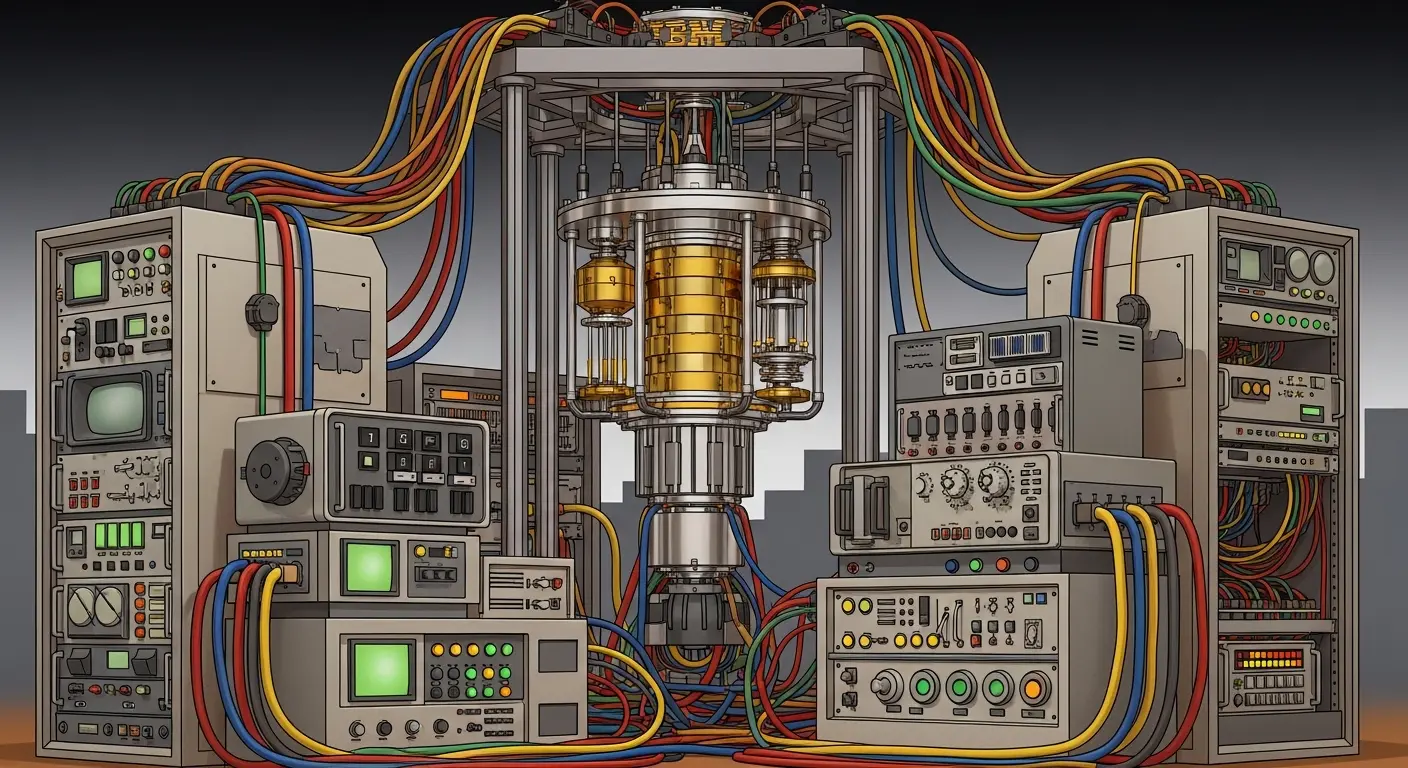
A dilution refrigerator is a cryogenic device that cools superconducting quantum processors to temperatures of around 10 to 20 millikelvin, colder than outer space. It works by exploiting the mixing properties of helium-3 and helium-4 isotopes. The distinctive gold chandelier-like structures featured in many quantum computing photographs are the internal wiring stages of dilution refrigerators.
Photonic Quantum Computing
Photonic quantum computing uses photons (particles of light) as qubits, manipulating their properties such as polarisation, path, or time of arrival. Photonic systems have the advantage of operating at room temperature and being naturally suited to quantum networking. Companies such as PsiQuantum and Xanadu are pursuing photonic approaches, with Xanadu’s Borealis system being among the first to demonstrate quantum advantage using photons.
Topological Qubit
A topological qubit is a theoretical type of qubit that encodes information in the global properties of exotic quasiparticles called anyons, making it inherently resistant to local sources of noise. Microsoft has been the primary commercial champion of this approach, pursuing Majorana-based topological qubits. If realised at scale, topological qubits could dramatically reduce the overhead needed for quantum error correction.
Neutral Atom Quantum Computing
Neutral atom quantum computing uses individual atoms held in place by arrays of focused laser beams called optical tweezers. Qubits are encoded in the electronic states of the atoms, and entangling gates are performed by exciting atoms to high-energy Rydberg states. This approach offers excellent scalability, with companies such as QuEra, Pasqal, and Atom Computing demonstrating systems with hundreds of qubits.
Quantum Approximate Optimisation Algorithm (QAOA)
QAOA is a hybrid quantum-classical algorithm designed to find approximate solutions to combinatorial optimisation problems. It alternates between applying a problem-specific operator and a mixing operator on a quantum circuit, with classical optimisation used to tune the parameters. QAOA is one of the leading candidates for demonstrating practical quantum advantage on optimisation problems in the NISQ era.
Quantum Machine Learning
Quantum machine learning is an interdisciplinary field that combines quantum computing with machine learning techniques. It encompasses quantum-enhanced classical ML (using quantum computers to speed up training or inference), classical ML applied to quantum systems (using neural networks to optimise quantum circuits), and entirely new quantum learning models such as quantum kernel methods and parameterised quantum circuits.
Quantum Simulation
Quantum simulation is the use of a controllable quantum system to model the behaviour of another quantum system that is too complex to simulate classically. This was the original motivation proposed by Richard Feynman in 1982 for building quantum computers. Quantum simulation has near-term applications in chemistry, materials science, and condensed matter physics, where accurately modelling molecular interactions could lead to breakthroughs in drug design and new materials.
Quantum Chemistry
Quantum chemistry is one of the most anticipated application areas for quantum computing. Classical computers struggle to accurately simulate the quantum mechanical behaviour of molecules beyond a certain size, but quantum computers are naturally suited to the task. Potential applications include drug discovery, catalyst design, battery development, and nitrogen fixation, all of which depend on understanding molecular interactions at the quantum level.
Quantum Internet
The quantum internet is a proposed network that would connect quantum devices using quantum communication channels, enabling the distribution of entanglement over long distances. It would support applications such as secure communication via QKD, distributed quantum computing, and blind quantum computing. Key enabling technologies include quantum repeaters, quantum memories, and satellite-based quantum links.
Quantum Repeater
A quantum repeater is a device that extends the range of quantum communication by overcoming photon loss in optical fibres. Unlike classical repeaters that amplify signals, quantum repeaters use entanglement swapping and quantum error correction to relay quantum states without measuring and destroying them. Developing practical quantum repeaters is one of the key challenges in building a global-scale quantum network.
Quantum Software Development Kit (SDK)
A quantum SDK is a programming framework that allows developers to write, simulate, and run quantum algorithms. Leading examples include IBM’s Qiskit, Google’s Cirq, Amazon’s Braket SDK, and Quantinuum’s TKET. These tools provide high-level abstractions for building quantum circuits, transpiling them to specific hardware, and executing them on simulators or real quantum processors via the cloud.
Quantum Cloud Computing
Quantum cloud computing provides remote access to quantum hardware over the internet, allowing researchers, developers, and enterprises to run quantum programs without owning a quantum computer. Major platforms include IBM Quantum, Amazon Braket, Microsoft Azure Quantum, and Google Quantum AI. Cloud access has been instrumental in democratising quantum computing and building a global developer community.
Hybrid Quantum-Classical Computing
Hybrid quantum-classical computing is an approach that combines quantum processors with classical computers to solve problems collaboratively. The quantum processor handles the parts of a computation where it has an advantage, while the classical computer manages optimisation loops, data processing, and control flow. Most near-term quantum algorithms, including VQE and QAOA, follow a hybrid architecture.
Quantum Error Mitigation
Quantum error mitigation is a collection of techniques that reduce the impact of noise on quantum computation without the full overhead of quantum error correction. Methods include zero-noise extrapolation, probabilistic error cancellation, and measurement error mitigation. Error mitigation is particularly important in the NISQ era, where full error correction is not yet feasible but improved accuracy is still needed for useful results.
Quantum Sensing
Quantum sensing exploits quantum effects such as superposition and entanglement to achieve measurement sensitivities beyond what is possible with classical devices. Applications include atomic clocks, magnetometers for medical imaging, gravimeters for geological surveys, and inertial navigation systems. Quantum sensing is one of the most commercially mature branches of quantum technology, with products already on the market.
Transmon Qubit
The transmon is a type of superconducting qubit designed to reduce sensitivity to charge noise by operating in a regime where the Josephson energy greatly exceeds the charging energy. Developed at Yale in 2007, the transmon has become the workhorse qubit for most superconducting quantum computing platforms, including those of IBM, Google, and Rigetti. Its relatively simple fabrication and good coherence properties have made it the dominant superconducting qubit architecture.
Quantum Random Number Generator (QRNG)
A quantum random number generator uses inherently random quantum processes, such as photon detection or vacuum fluctuations, to produce true random numbers. Unlike classical pseudorandom number generators, which are deterministic, QRNGs provide randomness guaranteed by the laws of physics. QRNGs are commercially available and are used in cryptography, gaming, scientific simulation, and security applications.
Quantum Roadmap
A quantum roadmap is a strategic plan published by a quantum computing company or research institution outlining its milestones, technical goals, and timelines for achieving practical quantum computing. Major roadmaps include IBM’s plan to reach 100,000 qubits by 2033, Google’s journey to a useful error-corrected quantum computer, and Microsoft’s milestones for topological qubits. Roadmaps help investors, partners, and the research community assess progress and set expectations for the technology.