

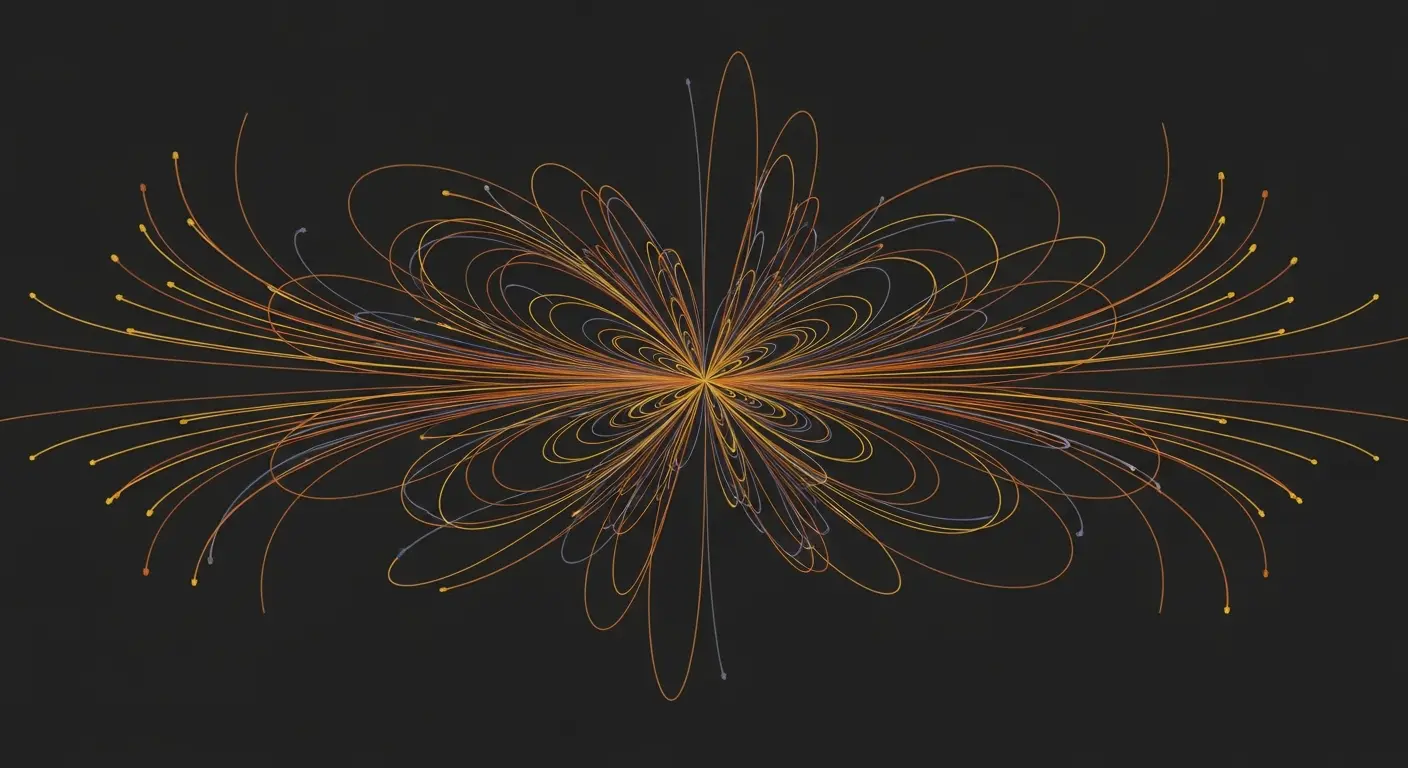
Roman Ovsiannikov and colleagues at Akhiezer Institute for Theoretical Physicsin collaboration with U.S. Army DEVCOM Army Research Laboratory, University of Massachusetts, Karazin Kharkiv National University, Massachusetts Institute of Technology and Tulane University have shown that amplifier performance improves with carefully tailored driving signals. Their research, detailed in arXiv:2601.03407, reveals that using a drive composed of harmonics sharply increases amplification rates, achieving a 40% improvement with a square wave drive and a 22% improvement using only four harmonics. This optimisation of parametric driving represents a key step towards more sensitive and effective quantum signal amplification, with potential implications for diverse fields including quantum computing and metrology.
Harmonic drive optimisation delivers substantial gains in quantum amplifier performance
A 40% increase in amplification rate has been realised within a hybrid non-degenerate parametric amplifier, a substantial leap beyond previous sinusoidal driving methods. This performance boost stems from a precisely tailored drive signal resembling a square wave, overcoming limitations previously hindering sensitive quantum signal amplification. Conventional amplifiers struggled to efficiently boost these weak signals without introducing excessive noise, a critical issue in quantum systems where preserving coherence is paramount. The hybrid amplifier leverages the interaction between a microwave mode and an ensemble of nitrogen-vacancy (NV) centres, exploiting their spin properties for amplification. Non-degenerate parametric amplification, unlike its degenerate counterpart, allows for amplification of signals without introducing significant quantum noise, making it particularly suitable for quantum applications. The initial sinusoidal drive, while functional, proved suboptimal in fully utilising the amplifier’s potential.
Numerical optimisation revealed that this harmonic drive, composed of multiple frequencies, sharply outperforms simpler approaches, enabling a level of control previously unattainable in these hybrid microwave-spin systems. Recent advances in hybrid non-degenerate parametric amplifiers have been built upon, achieving a 40% increase in amplification rate through a novel drive signal design. The optimisation process involved systematically varying the amplitude and phase of different harmonic components within the drive signal, using computational algorithms to identify the configuration that maximises amplification. Limiting the drive to four harmonic frequencies still yielded a striking 22% amplification improvement, highlighting the strong nature of this new technique and paving the way for more effective quantum technologies. This suggests that even a relatively simple harmonic drive can provide significant benefits, reducing the complexity of implementation while still achieving substantial performance gains. The choice of four harmonics was not arbitrary; it represents a balance between increased complexity and diminishing returns in amplification performance.
This substantial improvement was realised by employing a drive signal closely resembling a square wave, a departure from traditional sinusoidal methods which previously limited the amplification of delicate quantum signals due to unwanted noise. Detailed numerical modelling demonstrated that this harmonic drive, comprising multiple frequencies, sharply outperforms simpler alternatives; even restricting the drive to four harmonic frequencies still delivered a 22% amplification boost. These findings confirm the strong nature of the technique and its potential for enhancing quantum information processing. Analysis of the optimal control revealed its spectral composition contained multiples of the sum and difference of the cavity and spin frequencies, suggesting a predictable and potentially tunable system. Specifically, the drive signal’s frequency components were found to be closely aligned with these sum and difference frequencies, indicating a resonant interaction between the microwave cavity, the NV-centre ensemble, and the applied drive. This resonance is crucial for efficient parametric amplification, allowing for the transfer of energy from the drive signal to the amplified signal with minimal loss.
Square-wave microwave driving enhances nitrogen-vacancy centre amplification efficiency
The quest for more sensitive quantum devices hinges on amplifying extraordinarily weak signals without compounding them with unwanted noise. Utilising a hybrid system combining microwave technology with nitrogen-vacancy (NV) centres, tiny imperfections within diamond that behave as controllable spin systems, a 40% increase in amplification rate has been achieved. The optimisation process itself presents a challenge, however; while numerical modelling strongly suggests a square-wave drive is superior, translating these simulations into a functioning device demands exceptional control over both the microwave signals and the delicate NV-centre ensembles. NV centres possess unique quantum properties, including long coherence times and optical addressability, making them ideal candidates for quantum information processing and sensing. However, their weak interaction with electromagnetic fields necessitates the use of amplification techniques to enhance signal detection.
Nitrogen-vacancy centres, atomic-scale defects in diamond, offer a promising platform for quantum sensors and computers, and improving their signal-to-noise ratio is therefore vital. Numerical modelling consistently outperforms current methods by up to 40 per cent, demonstrating substantial potential for signal amplification. The modelling employed sophisticated algorithms to simulate the interaction between the microwave drive, the NV-centre ensemble, and the cavity, allowing researchers to explore a vast parameter space and identify the optimal drive signal configuration. Nevertheless, even with the complexities of implementing a true square-wave drive, these findings are significant for quantum technology development. Generating a perfect square wave is practically difficult; the research demonstrates that even approximations, utilising a limited number of harmonics, yield substantial improvements.
Optimised microwave drives and nitrogen-vacancy centres, atomic imperfections within diamonds acting as controllable spin systems, have demonstrated a 40% increase in signal amplification. This advance utilises a hybrid system, parametrically driving the spin ensemble for enhanced sensitivity. A tailored drive signal in hybrid quantum systems significantly enhances amplification performance. Building blocks of more complex waves, harmonics, optimise a microwave-spin amplifier utilising nitrogen-vacancy centres, atomic-scale defects within diamonds, moving beyond conventional sinusoidal drives. Achieving a 40% improvement in amplification rate, this approach suggests a pathway towards more sensitive detection of quantum signals and prompts investigation into the precise relationship between drive signal complexity and overall system efficiency. Future research will focus on experimentally verifying these numerical predictions and exploring the limits of this technique, potentially leading to even higher amplification rates and more robust quantum devices. The ability to finely tune the harmonic content of the drive signal could also enable the development of adaptive amplification schemes, tailored to specific signal characteristics and noise environments.
Researchers demonstrated a 40% increase in the amplification rate of a microwave signal using a hybrid system of a microwave cavity and an ensemble of nitrogen-vacancy centres within diamond. This improvement stems from employing a more complex, harmonic-rich drive signal instead of a standard sinusoidal wave. The findings suggest that optimising the shape of the drive signal is crucial for enhancing the sensitivity of quantum devices. The authors intend to experimentally confirm these results and further investigate the connection between drive signal complexity and system performance.
👉 More information
🗞 NV-ensemble enabled microwave/NV parametric amplifier with optimal driving
🧠 ArXiv: https://arxiv.org/abs/2604.11643



See today’s quantum computing news on Quantum Zeitgeist for the latest breakthroughs in qubits, hardware, algorithms, and industry deals.



