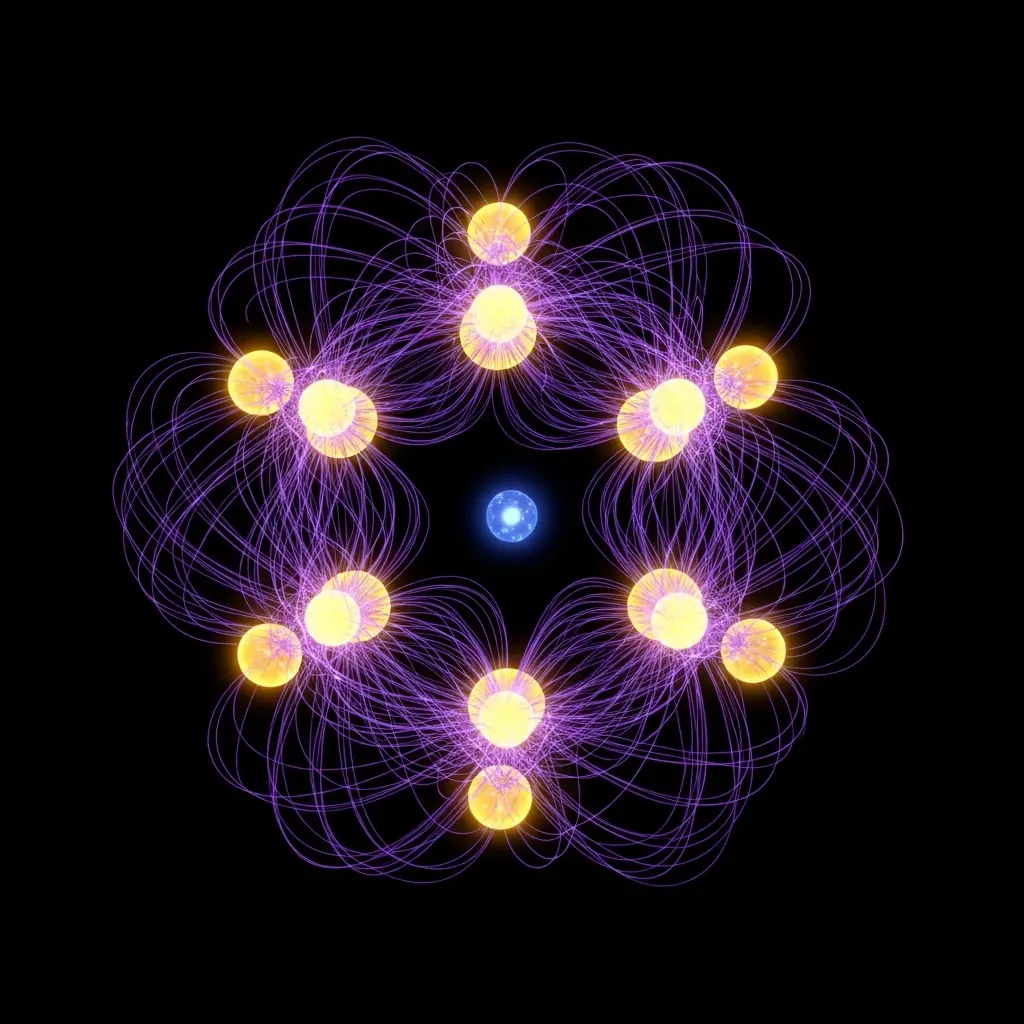
Scientists are beginning to unravel the mysterious forces at play within complex molecules formed from matter and antimatter. Mohammad Goli from Nicolaus Copernicus University, Dario Bressanini from Università dell’Insubria, and Shant Shahbazian et al. demonstrate that the attraction between two positronium-hydrogen (PsH) molecules arises from a unique correlation between positrons, a phenomenon not captured by standard molecular modelling. Their research, detailed in this paper, identifies this interaction as a “super” van der Waals bond, significantly stronger than typical dispersion forces and offering a new understanding of how matter and antimatter can combine to form stable, albeit unusual, molecular structures? This discovery could reshape our understanding of molecular interactions and potentially inform future research into exotic forms of matter.
Quantum Positron Correlations Stabilise Hydrogen-Positronium Dimer Binding energies
Investigating the Stabilizing Forces in (PsH)₂
Scientists have recently demonstrated the theoretical existence of (PsH)₂, a molecular complex formed by the interaction of two PsH atoms, each a stable combination of hydrogen and positronium, but the underlying physical mechanism remained unclear. This study reveals that the stabilizing force between these units is fundamentally rooted in the quantum correlations between the two positrons, with a lesser contribution from electron-positron correlations.
The researchers proved that this interaction cannot be explained by standard mean-field calculations, nor by models focusing solely on electron-electron correlations, highlighting its unique nature. Accordingly, the bond between PsH units, termed a two-positron gluonic bond, emerges only when matter and antimatter particles are bound in a common state, distinguishing it from conventional two-positron covalent bonds found in pure antimatter molecules.
Classified within established bonding frameworks, this gluonic bond resembles a dispersion interaction, resulting in a van der Waals complex. However, the remarkably high bond dissociation energy, significantly exceeding that of typical van der Waals complexes of comparable size, indicates an unusually strong interaction.
For this reason, the team proposes that (PsH)₂ is best described as a “super” van der Waals complex, stabilized by a “super” van der Waals bond. Analysis of the potential energy curve using the diffusion quantum Monte Carlo method revealed an equilibrium bond length of 6.3 Bohr and a bond dissociation energy of 62 kJ.mol⁻¹ for the one-positron gluonic bond in H₂eH⁻.
Evaluating Correlation Effects in Dimer Bonding
Multi-component Hartree-Fock calculations with a high-quality basis set recovered approximately 88% of this bond dissociation energy, suggesting that correlation effects, while present, are not the primary driving force behind this bond. Furthermore, structural analysis using the multi-component quantum theory of atoms in molecules methodology revealed a homonuclear system composed of two equivalent atoms, each centered on a proton and containing, on average, two electrons and half a positron. This work establishes a new understanding of bonding in matter-antimatter mixtures, opening avenues for exploring novel molecular systems with potentially unique properties and applications in fields such as fundamental physics and materials science.
Computational determination of the PsH dimer bonding characteristics is challenging
Advanced Quantum Methods for Bond Characterization
Scientists investigated the bonding mechanism between two PsH atoms, revealing a unique interaction driven by positron correlations. The study pioneered the use of diffusion quantum Monte Carlo (DMC) methods to derive the potential energy curve for (PsH)2, establishing an equilibrium bond length, eR, of approximately 6.0 Bohr and a bond dissociation energy (BDE) of 27 kJ.mol-1.
Researchers meticulously calculated zero-point corrected BDE values, finding them to be around 24 kJ.mol-1, further refining the understanding of the bond’s strength. To dissect the contributions to bonding, the team employed multi-component Hartree-Fock (MC-HF) calculations with aug-cc-pVQZ hydrogenic basis sets, achieving MC-HF/[QZ:QZ] energies.
At this level, the computed eR was 8.3 Bohr with a BDE of only 1 kJ.mol-1, highlighting the inadequacy of this method to capture the full interaction. The research then harnessed the power of MC-QTAIM partitioning methodology to analyze the structural characteristics of both the one- and two-positron bonds, revealing a homonuclear diatomic system for (PsH)2 composed of slightly deformed, charge-neutral PsH atoms.
Further analysis involved two-component interacting quantum atoms (TC-IQA) energy decomposition analysis, pinpointing electrostatic stabilization as the primary bonding force in the one-positron case. Scientists then disentangled the contributions of kinetic and Coulombic operators to the dissociation energies at inter-proton distances of (PsH)2 DMC, using Table 1 to summarise their findings.
This detailed decomposition revealed that, unlike the one-positron bond, the two-positron gluonic bond is fundamentally driven by correlation-related effects, demonstrating a “super” van der Waals interaction significantly stronger than typical dispersion interactions. The approach enables a classification of this bond as a unique type of stabilizing interaction, distinct from conventional covalent or van der Waals bonding.
Positron correlation drives enhanced bonding in the PsH dimer, resulting in a stable complex
Scientists have demonstrated the existence of a novel type of chemical bond, termed a “super” van der Waals bond, within the (PsH)2 molecular complex, composed of two PsH units. The research reveals that the stabilizing mechanism of this interaction is primarily encoded in correlations between the two positrons, with a lesser contribution from electron-positron correlations.
Experiments showed that this bond cannot be accurately described using traditional mean-field or electron-correlation models. The team measured the dissociation energies (DEs) at inter-proton distances of 6.0 and 8.0 Bohr, revealing key contributions from various Hamiltonian operators. At 6.0 Bohr, the total dissociation energy for H+e− + H was calculated to be 1136 kJ.mol-1, while for (PsH)2 it was 1741 kJ.mol-1.
At 8.0 Bohr, these values were 785 kJ.mol-1 and 1311 kJ.mol-1, respectively. Analysis of these energies demonstrated that the sum of purely electronic contributions remains remarkably similar between the two species, approximately -433 kJ.mol-1 at 6.0 Bohr and -334 kJ.mol-1 at 8.0 Bohr for H+e− + H, and -440 kJ.mol-1 and -330 kJ.mol-1 for (PsH)2.
Results demonstrate that the electron-positron interaction (epV) provides the major positive contribution to the dissociation energy, representing the origin of the gluonic bonding mechanism. Notably, the addition of a second positron to H+e− + H significantly enhances the magnitude of epV at both distances.
However, this is counteracted by increases in destabilizing terms, ppV and p nuc V−, leading to a small bond dissociation energy for (PsH)2 at the MC-HF level. Further investigation using a VMC/HL wavefunction revealed a bond dissociation energy of approximately 3 kJ.mol-1, with errors of 33% longer equilibrium bond length and recovering only 11% of the exact bond dissociation energy.
Measurements of the correlation energy (corr E) showed that it accounts for only 4-6% of the total correlation energy of (PsH)2 near the equilibrium bond length, becoming the sole contributor to the dissociation energy at larger inter-proton distances. This confirms that interatomic correlations are the exclusive origin of the two-positron gluonic bond and dominate the interaction between PsH atoms at extended distances.
Positron correlation defines strength of super van der Waals complex formation
Scientists have demonstrated that the interaction between two PsH (hydrogen-positronium) atoms is driven primarily by correlations between the two positrons, with a lesser contribution from electron-positron correlations. This stabilizing mechanism cannot be captured by standard Hartree-Fock calculations or models focusing solely on electron-electron correlation, highlighting the unique nature of the bond formed between PsH units.
The researchers term this a “two-positron gluonic bond”, distinguishing it from conventional covalent bonds found in pure antimatter molecules. The study reveals that this gluonic bond, while classified as a dispersion interaction similar to van der Waals forces, is remarkably strong, leading the authors to propose the term “super” van der Waals complex to describe (PsH)2.
Detailed analysis using variational Monte Carlo and diffusion Monte Carlo methods showed that interatomic correlations are the dominant factor governing the bond dissociation energy, particularly at equilibrium and longer inter-proton distances. Further investigation with second-order many-body perturbation theory indicated that positron-positron correlations contribute most significantly to the overall interaction energy, exceeding the contributions from electron-electron and electron-positron correlations.
The authors acknowledge that disentangling the precise contributions of each correlation type is challenging due to the complexities of correlation partitioning schemes in multi-component systems. They suggest future research could focus on refining computational methods to more accurately separate these contributions and further elucidate the nature of the gluonic bond. This work establishes a fundamental understanding of bonding in systems combining matter and antimatter, demonstrating a novel interaction mechanism and providing a basis for exploring more complex molecular systems involving positronium.
🗞 The two-positron gluonic bond as a manifestation of “super” van der Waals interactions
🧠 ArXiv: https://arxiv.org/abs/2601.23275



See today’s quantum computing news on Quantum Zeitgeist for the latest breakthroughs in qubits, hardware, algorithms, and industry deals.