

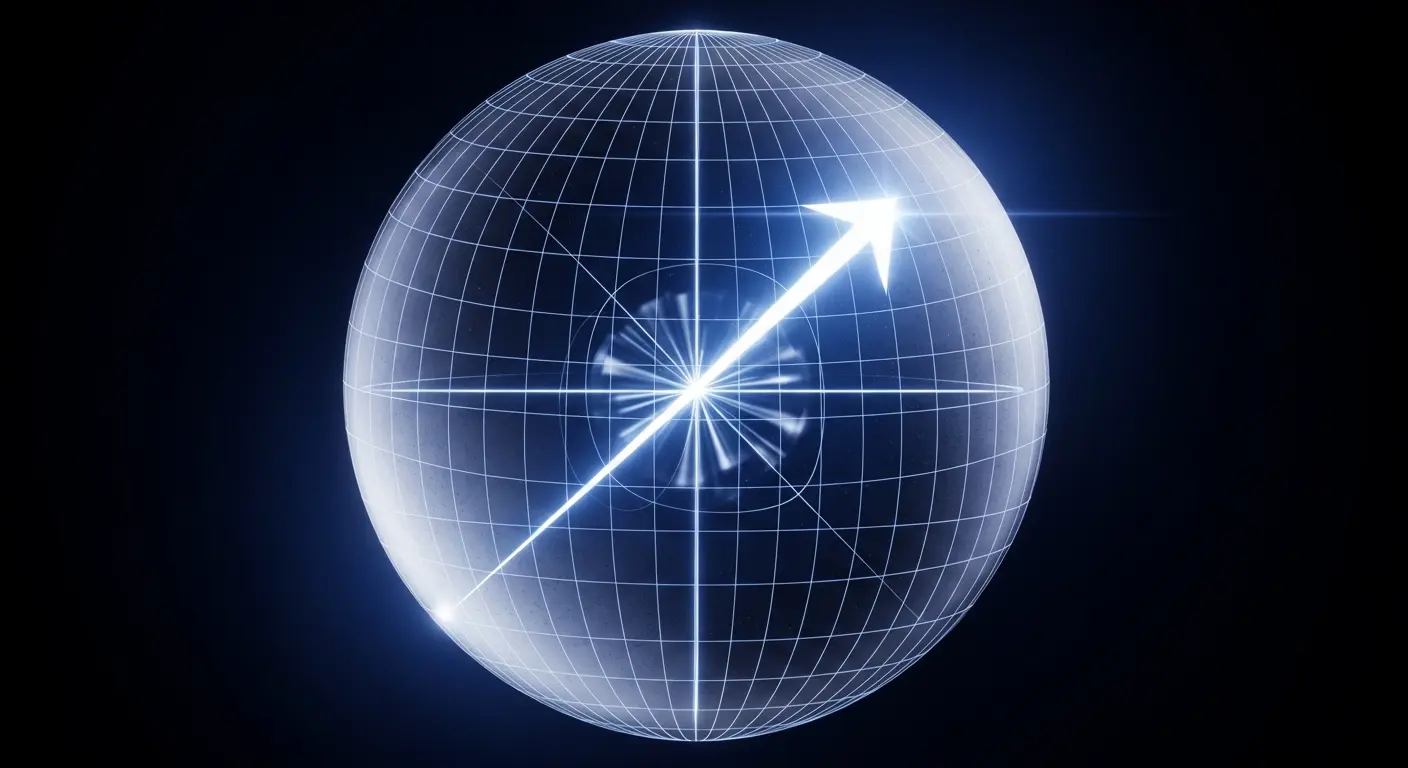
Scientists are investigating a new class of multipartite quantum states, termed threshold entanglement (TE) states, to further understanding of entanglement distribution within quantum networks. Albert Rico and colleagues at University of Siegen in collaboration with Autonomous University of Barcelona and University of Gdańsk demonstrate the existence of these states for four and seven qubits and define limits on the average entanglement they must possess between four and nine qubits. Their approach, utilising semidefinite programming, not only defines the potential existence of TE states but also refines existing knowledge regarding the purity of both pure and absolutely separable states, proving that TE states of eight qubits cannot exist. The research suggests these states can harbour substantial entanglement and ‘magic’, key resources for achieving quantum advantage in computation.
Definitive eight-qubit limit established for threshold entanglement using semidefinite programming
Entanglement measures now reach a lower bound of 2−⌊n/2⌋ for pure state marginals, representing a substantial improvement over previous methods unable to disprove the existence of seven-qubit states. This advancement was achieved by employing semidefinite programming relaxations, a powerful mathematical technique used to simplify complex optimisation problems. Semidefinite programming reformulates the original problem into a form solvable by efficient algorithms, providing a tractable approach to analysing high-dimensional quantum states. The team leveraged this technique to rigorously prove that threshold entanglement (TE) states, which are multipartite quantum states forcing separation in smaller subsystems, cannot exist for eight qubits. This proof relies on demonstrating that the necessary conditions for entanglement, as defined by the TE criteria, are violated when attempting to construct an eight-qubit TE state.
Establishing this limit is important because it defines the maximum scale for implementing these states in quantum technologies, something prior work lacked. The absence of TE states beyond seven qubits has significant implications for quantum network design and the distribution of entanglement resources. Quantum networks rely on the ability to share entanglement between distant nodes, and understanding the limitations of state scalability is crucial for practical implementation. Analysis of TE states reveals they can accommodate significant amounts of both entanglement and magic, resources essential for achieving quantum advantage in computing. Entanglement, a fundamental quantum phenomenon, allows for correlations between qubits that are impossible in classical systems. ‘Magic’, in this context, refers to the resource needed to perform universal quantum computation, exceeding the capabilities of classical algorithms. A sample of four-qubit TE states exhibited an average magic value of approximately 2.013, while seven-qubit TE states displayed an average magic of around 4.98, comparable to Haar-random states, which represent the maximum possible amount of magic for a given number of qubits. This suggests that TE states, while limited in scalability, can be highly resourceful in terms of both entanglement and magic.
However, these results currently focus on pure states and do not yet demonstrate the scalability required to build practical, fault-tolerant quantum computers utilising these resources. Pure states are idealised quantum states, while real-world quantum computers are susceptible to noise and decoherence, leading to mixed states. Scientists have now determined that threshold entanglement (TE) states cannot exist for eight qubits, building on previous findings which demonstrated their existence for four and seven qubits. Combining semidefinite programming relaxations allowed for tighter bounds on the purity of quantum states, benefiting broader quantum information science. The work highlights the complex interplay between entanglement and purity, offering insights into how ‘mixed’ a quantum state is and refining existing methods for its assessment. Purity is a measure of how close a quantum state is to being a pure state, and understanding its relationship with entanglement is crucial for characterising and optimising quantum states for various applications.
Defining the maximum size of threshold entanglement informs future quantum state development
Establishing a firm limit of eight qubits for threshold entanglement (TE) states feels less like a breakthrough and more like encountering a wall. Demonstrating TE’s existence in smaller systems is valuable, but the abrupt termination raises questions about its scalability and practical utility; scientists acknowledge that demonstrating existence beyond seven qubits remains elusive. This contrasts sharply with approaches to quantum secret sharing, where researchers continually push the boundaries of qubit numbers, albeit with different entanglement requirements. Quantum secret sharing relies on distributing a secret among multiple parties, and the entanglement requirements are different from those of TE states, allowing for larger systems to be realised. The fundamental difference lies in the criteria for entanglement; secret sharing prioritises correlations between specific qubits, while TE states enforce separation in all marginal subsystems.
The techniques used to reach this conclusion refine methods for assessing entanglement itself, despite the work identifying eight qubits as a current barrier. Defining a limit to how entanglement can be shared within quantum systems represents a key advance for building future quantum networks. This research introduces ‘threshold entanglement’ (TE) states, a specific arrangement of interconnected quantum bits where smaller groupings must operate independently. Proving their existence for four and seven qubits simultaneously demonstrated their impossibility with eight qubits, a definitive boundary previously unknown. The concept of ‘threshold’ refers to the requirement that any subsystem of half or fewer qubits must be separable, meaning it cannot exhibit entanglement itself. This stringent condition limits the scalability of TE states but also provides a unique resource for certain quantum information processing tasks. Further research will focus on exploring alternative entanglement structures and developing methods to overcome the limitations imposed by the eight-qubit barrier, potentially through the use of error correction or more complex state designs.
The implications of this work extend beyond the immediate limitations of TE states. The refined techniques for analysing quantum state purity and entanglement can be applied to a wider range of quantum systems, contributing to the development of more robust and efficient quantum technologies. Understanding the fundamental limits of entanglement distribution is crucial for realising the full potential of quantum computation and communication, and this research represents a significant step towards that goal. The ability to precisely characterise and control entanglement resources will be essential for building scalable and fault-tolerant quantum computers, paving the way for breakthroughs in fields such as medicine, materials science, and artificial intelligence.
Researchers demonstrated the existence of ‘threshold entanglement’ (TE) states for four and seven qubits, but proved they cannot exist with eight. This finding establishes a limit to how entanglement can be distributed within quantum systems and refines existing methods for assessing entanglement purity. The study delimits the average entanglement TE states must possess, offering a clearer understanding of their scalability. The authors intend to explore alternative entanglement structures to potentially overcome the established eight-qubit barrier.
👉 More information
🗞 Threshold entanglement sharing: quantum states with absolutely separable marginals
🧠 ArXiv: https://arxiv.org/abs/2604.13169


See today’s quantum computing news on Quantum Zeitgeist for the latest breakthroughs in qubits, hardware, algorithms, and industry deals.



