The pursuit of energy-efficient computation drives innovation in numerous fields, and researchers continually explore alternatives to traditional computing architectures. Hikaru Wakaura from QuantScape Inc, and colleagues, address this challenge by investigating the potential of reservoir computing, a method known for its low energy consumption and ability to handle large datasets. Their work introduces a novel approach, the Reservoir Generative Adversarial Network, or Reservoir GAN, which combines the strengths of reservoir computing with the generative power of GANs to improve accuracy. The team demonstrates that this software-based improvement significantly outperforms conventional GANs, neural networks, and standard reservoir computers in generating handwritten digits and monochrome images, offering a promising path towards more efficient and accurate machine learning.
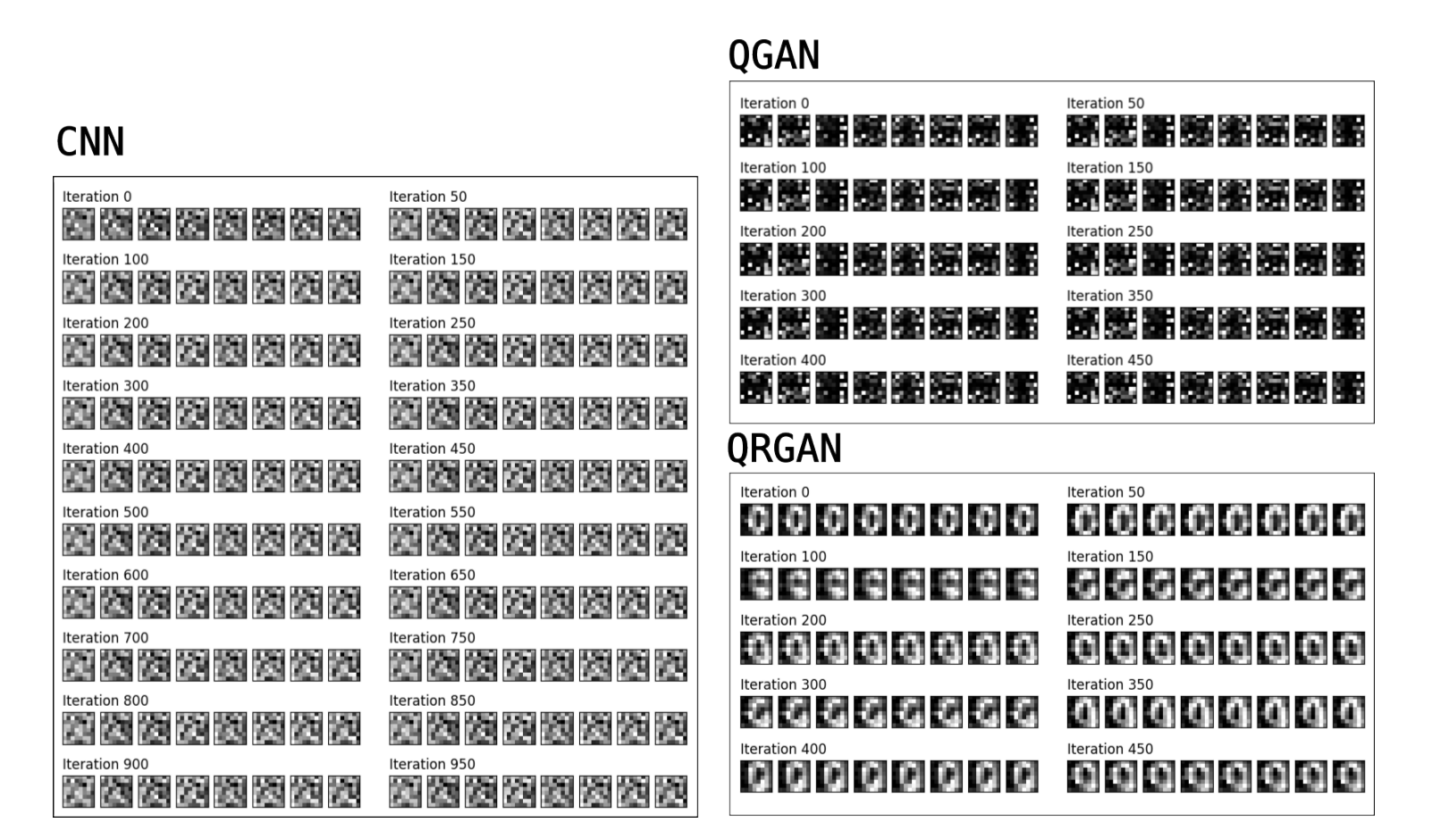
Quantum Reservoir Computers possess no limit on the size of input data, yet their accuracy currently restricts practical applications, and improvement efforts largely focus on software innovation. Recognizing that many quantum algorithms struggle with accuracy on today’s limited-scale quantum devices, they focused on refining the software itself. GANs function as a competitive process between two networks: a generator that creates data and a discriminator that evaluates its authenticity. The core innovation lies in using the Quantum Reservoir Computer as the generator within this GAN framework, allowing the system to learn and refine its data generation capabilities through the adversarial process, effectively boosting the accuracy of the Quantum Reservoir Computer. This dynamic interaction enables the QRGAN to generate more complex and realistic data than either a standalone Quantum Reservoir Computer or a traditional GAN. The team demonstrated the effectiveness of QRGAN by training it to generate handwritten digits and monochrome images, using established datasets for evaluation. The team demonstrated QRGAN’s capabilities by training it to generate handwritten digits and images from the CIFAR10 dataset, showing it consistently outperforms both standard GANs, classical neural networks, and even quantum GANs in generating realistic outputs. When generating the digit zero, for example, QRGAN produced images that more closely resembled natural handwriting, even with a limited number of training iterations.
This improvement is particularly noticeable when comparing the generated images to those produced by quantum GANs. Further testing revealed that QRGAN’s performance is also sensitive to the type of loss function used during training, with a cross entropy loss function yielding more stable results and generating digits that closely matched the input data. The researchers also explored QRGAN’s ability to generate more complex images, training it on pictures of deer and frogs from the CIFAR10 dataset. The system successfully learned to generate these images, demonstrating its versatility beyond simple digit generation. The team demonstrates that this new architecture surpasses the performance of traditional GANs, classical neural networks, and standard reservoir computers in generating data, specifically handwritten digits and images from the CIFAR10 dataset. By employing a reservoir computer as the generator within a GAN framework, the researchers achieve improved accuracy in data generation. This study contributes to the growing field of quantum machine learning by offering a software-based enhancement to reservoir computing, a technique known for its potential to reduce energy consumption compared to conventional methods. While acknowledging the limitations of current reservoir computing accuracy, this work presents a viable path toward practical applications through algorithmic innovation. Future research could explore the application of Reservoir GAN to more complex datasets and investigate its potential for use in diverse machine learning tasks, building on the demonstrated improvements in data generation capabilities.