

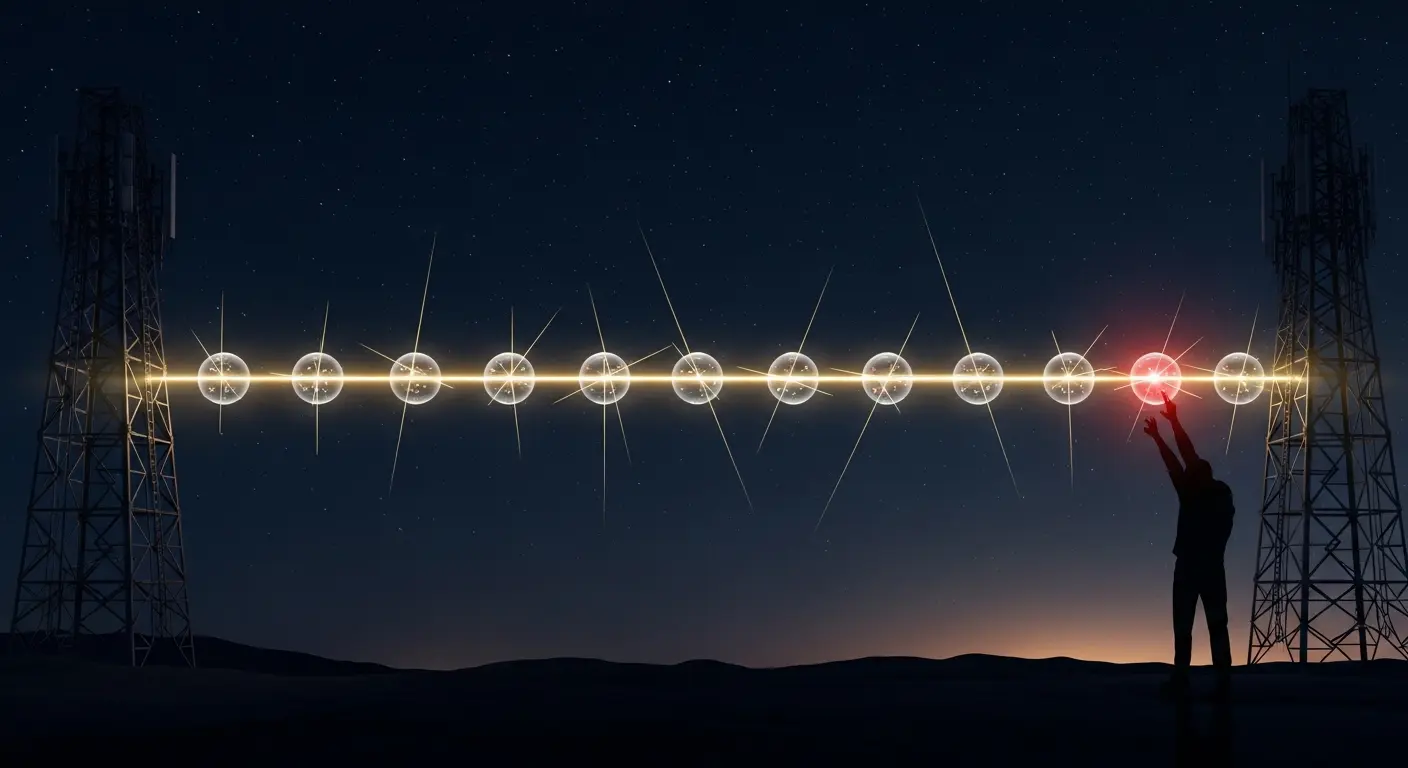
A new receiver interface models atmospheric turbulence’s impact on free-space quantum polarization links by extending static models into the temporal domain. Heyang Peng and colleagues at the University of Luxembourg model key parameters, including phase field, beam displacement, and scintillation, as stochastic processes, generating a dynamic receiver interface. Results from a weak-turbulence case demonstrate effective depolarization on the order of 10⁻³ and near-unity coherence for the polarization branch, while the detection branch exhibits stronger fluctuations and a longer correlation time. Static parameterisations are inadequate for accurately characterising turbulent quantum links, and this interface provides a vital set of tools for receiver-side characterisation, with potential applications in measurement-device-independent quantum key distribution.
Dynamic receiver modelling mitigates atmospheric turbulence in quantum key distribution
Effective depolarization in turbulent free-space quantum polarization links has now been reduced to as low as 10⁻³, a substantial improvement over previous static models, which struggled to achieve values below 10⁻². This breakthrough crosses a key threshold for reliable quantum key distribution, as signal degradation previously limited secure communication distances. Researchers at the University of Luxembourg developed a receiver interface that dynamically accounts for temporal variations in phase, beam displacement, and scintillation, phenomena describing how light waves are distorted as they travel through the atmosphere, by modelling atmospheric turbulence as slow-time stochastic processes.
The new interface generates time-dependent descriptors for signal depolarization, coherence, and detection, offering a far more accurate representation of real-world quantum communication channels. The significance of this reduction in depolarization lies in its direct impact on the quantum bit error rate (QBER), a critical parameter determining the security and feasibility of QKD systems; lower depolarization translates directly to lower QBER, extending the maximum achievable transmission distance. Prior static models, based on averaged atmospheric conditions, failed to capture the full extent of temporal fluctuations, leading to overestimations of signal quality and underestimations of potential losses.
A sharp advance in free-space quantum communication has been achieved with depolarization reduced to as low as 10⁻³. This improvement stems from a new receiver interface, which models atmospheric turbulence as slow-time stochastic processes, accurately capturing how light distorts during transmission. Previous systems struggled to surpass depolarization rates of 10⁻².
The University of Luxembourg team also found that effective coherence remained close to unity in weak turbulence, indicating minimal signal distortion, while detection branches exhibited longer correlation times and stronger fluctuations. These descriptors, generated by the interface for signal depolarization, coherence, and detection, can be aggregated for key-rate analyses in downstream applications such as measurement-device-independent quantum key distribution (MDI-QKD), allowing for a more precise characterisation of quantum channels. MDI-QKD, in particular, benefits from accurate channel characterisation, as it mitigates detector side-channel attacks, enhancing the overall security of the system.
However, current figures assume stationary statistics over a limited observation window and do not yet account for the complexities of a full protocol-layer key-rate analysis needed for practical implementation. The observed longer correlation times in the detection branch suggest that the receiver can maintain signal integrity for a more extended period, potentially reducing the need for frequent recalibration and improving system stability. The team employed a leading-order approach to model the temporal evolution of these parameters, simplifying the complex atmospheric dynamics while retaining sufficient accuracy for receiver-side characterisation.
Modelling dynamic atmospheric effects improves quantum signal reception
Free-space quantum communication is receiving increasing focus, as a technology promising secure data transmission but vulnerable to atmospheric disturbances. This new receiver interface offers a more realistic way to model how quantum signals degrade as they travel through turbulence, moving beyond simplistic static assumptions. An important question remains regarding its performance under more severe conditions, such as those encountered during adverse weather or over longer distances.
The atmospheric turbulence considered here is characterised by the refractive index structure parameter, Cn², which quantifies the strength of the turbulence; the current model operates effectively under weak turbulence conditions, where Cn² is relatively low. Extending the model to strong turbulence regimes will require incorporating higher-order statistical effects and potentially employing more computationally intensive simulation techniques.
Its development represents a significant step forward for free-space quantum communication systems, acknowledging that this receiver interface was tested under weak turbulence. Current methods often treat atmospheric distortions as constant, a simplification that fails to capture the reality of fluctuating signals; this new model accounts for those temporal changes.
A receiver interface has been developed to better simulate how quantum signals weaken during transmission through atmospheric turbulence, a key challenge for secure communication. The traditional approach of assuming static atmospheric conditions neglects the inherent time-varying nature of turbulence, leading to inaccuracies in predicting signal quality and limiting the performance of QKD systems. This new interface addresses this limitation by explicitly modelling the temporal evolution of key atmospheric parameters.
By accounting for the fluctuating nature of turbulence, the new model moves beyond static assumptions, modelling beam displacement and scintillation as evolving processes. The development of a slow-time receiver interface fundamentally alters how atmospheric turbulence impacts free-space quantum communication, treating atmospheric distortions as evolving stochastic processes rather than assuming static conditions.
Modelling phenomena such as phase field and scintillation, the rapid changes in brightness of a signal, as random fluctuations, the interface generates dynamic descriptors for signal quality, including depolarization and coherence. The phase field represents the accumulated optical path difference due to atmospheric turbulence, while scintillation describes the intensity fluctuations caused by interference effects.
This approach reveals behaviours previously hidden by static models, offering a more accurate characterisation of quantum links and enabling improved receiver-side analysis. The interface effectively simulates the receiver plane, accounting for the effects of atmospheric turbulence on the received quantum signal and providing crucial parameters for optimising receiver performance and maximising secure communication rates. Further research will focus on validating the model under more realistic atmospheric conditions and integrating it into a complete QKD system for field testing.
The research demonstrated that atmospheric turbulence significantly impacts free-space quantum links by creating time-varying distortions. This is important because previous models treated these conditions as static, leading to inaccurate predictions of signal quality. The developed receiver interface models atmospheric parameters as evolving stochastic processes, revealing behaviours not captured by static approaches and providing more accurate descriptors of signal coherence and depolarization. The authors intend to validate this model with further testing in realistic atmospheric conditions and integration into a QKD system.
👉 More information
🗞 A Slow-Time Receiver Interface for Turbulent Free-Space Quantum Polarization Links
🧠 ArXiv: https://arxiv.org/abs/2604.18127


See today’s quantum computing news on Quantum Zeitgeist for the latest breakthroughs in qubits, hardware, algorithms, and industry deals.



