

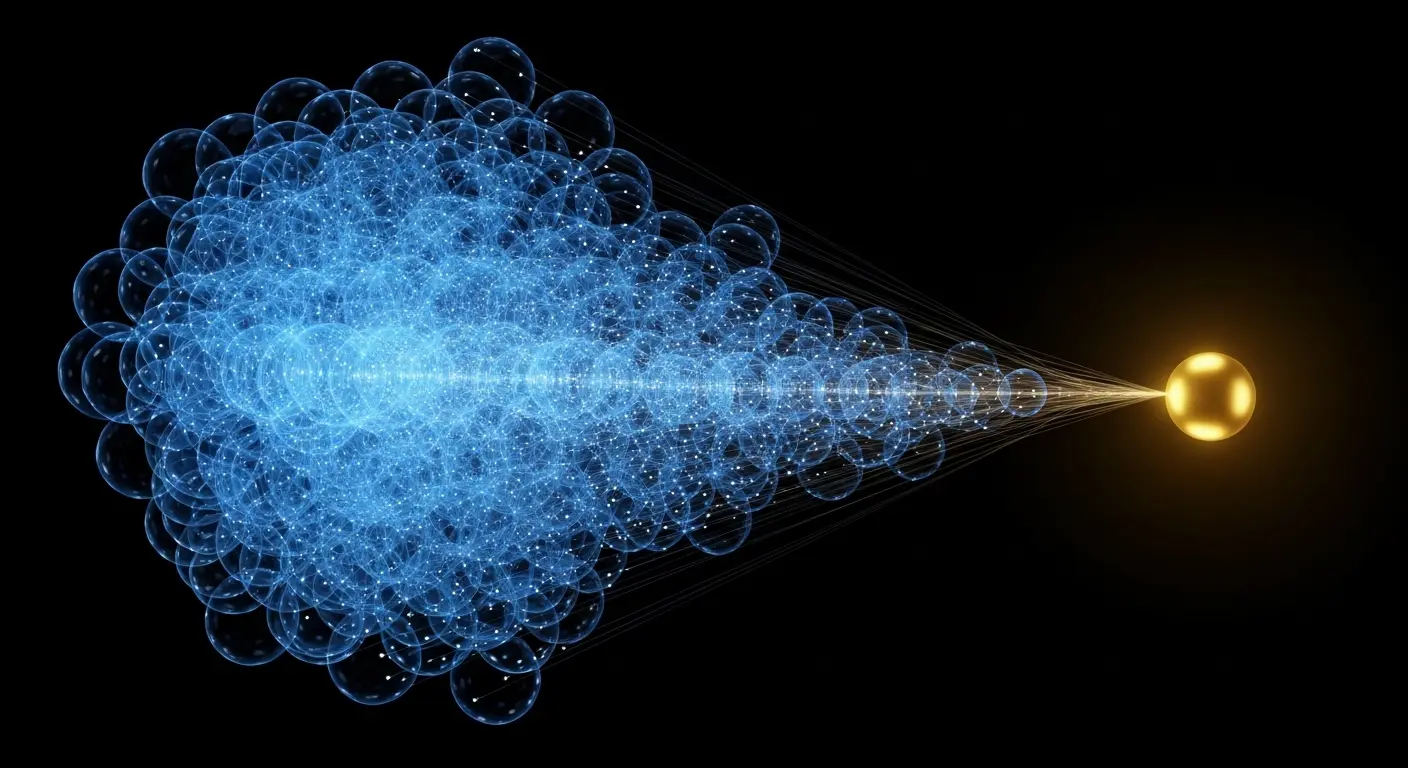
Scientists at RWTH Aachen University have developed a new quantum algorithm for efficiently identifying similar subgraphs within complex networks. Ruben Kara and colleagues present a method addressing the computationally challenging problem of finding a subgraph with a specified number of removed edges, while minimising the difference between its structure and a reference graph. Representing potential graph topologies using a Dicke state allows for controlled quantum transformations and, when combined with amplitude estimation, delivers a polynomial speedup over classical brute-force search algorithms. The method’s applicability is demonstrated using examples from electric power grids, and it shows potential for calculating energy functionals related to network structure.
Quantum algorithm accelerates subgraph isomorphism via Laplacian distance minimisation
A polynomial speedup has been achieved in identifying similar subgraphs within complex networks, reducing algorithmic complexity from O(N x+1/x.) for classical methods to O(√N x/x. N log log N) using this new quantum algorithm. This advancement enables the efficient analysis of networks with many nodes, a task previously intractable for all but the smallest instances. The algorithm tackles an NP-hard cardinality-constrained binary quadratic optimisation problem by minimising the Frobenius distance between the Laplacians of the original and resulting subgraphs. The Laplacian matrix, denoted as B for the reference graph and B’ for the identified subgraph, encapsulates the network’s connectivity and spectral properties, providing a robust measure of structural similarity. The Frobenius norm, ||B, B’||F2, quantifies the difference between these matrices, effectively measuring the dissimilarity between the graphs. This approach differs from traditional subgraph isomorphism techniques which often rely on exact matching, and instead focuses on finding the ‘closest’ subgraph according to this distance metric.
Immediate implications of this breakthrough extend to applications such as assessing the durability of electric power grids and optimising network topologies; detailed contingency analysis of large grids was previously computationally prohibitive. Power grid analysis requires evaluating the impact of component failures (e.g., transmission lines) on overall grid stability. The algorithm allows for rapid identification of subgraphs representing critical network sections, enabling proactive assessment of vulnerabilities and improved resilience planning. Standard test cases representing electric power grids were used to test the quantum algorithm, successfully reconstructing the Frobenius distance from measurements. Consequently, the algorithm can process complex network data and calculate energy functionals, such as quadratic forms of the Laplacians, offering additional analytical capabilities. These energy functionals can be directly related to physical quantities within the network, such as power flow and energy dissipation, providing deeper insights into network behaviour.
The algorithm requires a quantum register with a minimum of min(N, x⌈log N⌉) + log 1/ε qubits, where ‘x’ represents the number of inactive edges and ‘ε’ defines the desired precision of the solution. The parameter ‘N’ denotes the total number of edges in the reference graph. The ⌈log N⌉ term represents the ceiling of the base-10 logarithm of N, determining the number of qubits needed to represent the vertex set. The log 1/ε term accounts for the precision required in the amplitude estimation process, influencing the number of qubits needed to achieve a desired level of accuracy. The current implementation, however, relies on idealised conditions and does not yet account for the strong overhead associated with error correction in real-world quantum hardware. A Dicke state is utilised to represent the binom(N, x) possible network configurations simultaneously, accelerating calculations and sidestepping the limitations of classical, step-by-step searches. The Dicke state, a specific type of entangled quantum state, allows for the superposition of all possible subgraph topologies, enabling parallel evaluation of the Frobenius distance for each configuration.
Power grid modelling currently limits broad applicability of quantum speedup
Although this quantum algorithm offers a clear speed advantage over classical methods for identifying key subgraphs, its current validation relies heavily on established power grid models. The authors acknowledge that performance on more complex or differently structured networks remains an open question. This raises a key tension: will the observed polynomial speedup translate to real-world networks exhibiting greater heterogeneity and interdependency, or will the algorithm’s efficiency diminish as the problem scales. The specific characteristics of power grid networks, such as their relatively regular structure and limited degree distribution, may contribute to the algorithm’s current success. Applying the algorithm to networks with significantly different properties, such as social networks or biological networks, may require further optimisation and adaptation.
Traditional computers find identifying similar subgraphs within complex networks computationally intensive, particularly as the network size and the number of allowed edge removals increase. The computational cost scales exponentially with the number of nodes and edges, rendering large-scale analysis impractical. Further development could unlock quantum solutions for wider critical infrastructure challenges, extending beyond power grids to areas such as transportation networks, communication networks, and financial systems. Minimising the Frobenius distance allows quantifying similarity and pinpointing subgraphs with a defined number of removed connections, opening avenues for more efficient contingency analysis, particularly in critical infrastructure such as power grids where assessing network durability is vital. The ability to rapidly identify vulnerable subgraphs enables proactive mitigation strategies, reducing the risk of cascading failures and improving overall system reliability. The algorithm’s potential extends to network design and optimisation, allowing for the creation of more robust and efficient network topologies.
Future research will likely focus on mitigating the effects of quantum decoherence and developing more robust error correction schemes to enable practical implementation on near-term quantum devices. Exploring alternative quantum algorithms and hybrid quantum-classical approaches may also yield further performance improvements. Furthermore, investigating the algorithm’s performance on a wider range of network datasets is crucial to assess its general applicability and identify potential limitations. The successful integration of this quantum algorithm with existing network analysis tools could revolutionise the field of complex network science, enabling the analysis of previously intractable problems and unlocking new insights into the structure and function of complex systems.
The researchers developed a quantum algorithm to identify similar subgraphs within a network, addressing a computationally difficult problem. This method determines the subgraph most closely matching a reference network, even with a specified number of removed connections, by minimising the Frobenius distance between their Laplacians. The algorithm offers a polynomial speed up compared to classical approaches, potentially enabling more efficient analysis of complex networks like electric power grids. Future work intends to address quantum decoherence and explore the algorithm’s performance across diverse network datasets.
👉 More information
🗞 Quantum search algorithm for similar subgraph identification under fixed edge removal
🧠 ArXiv: https://arxiv.org/abs/2604.02027

See today’s quantum computing news on Quantum Zeitgeist for the latest breakthroughs in qubits, hardware, algorithms, and industry deals.



