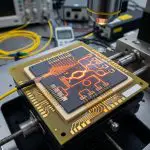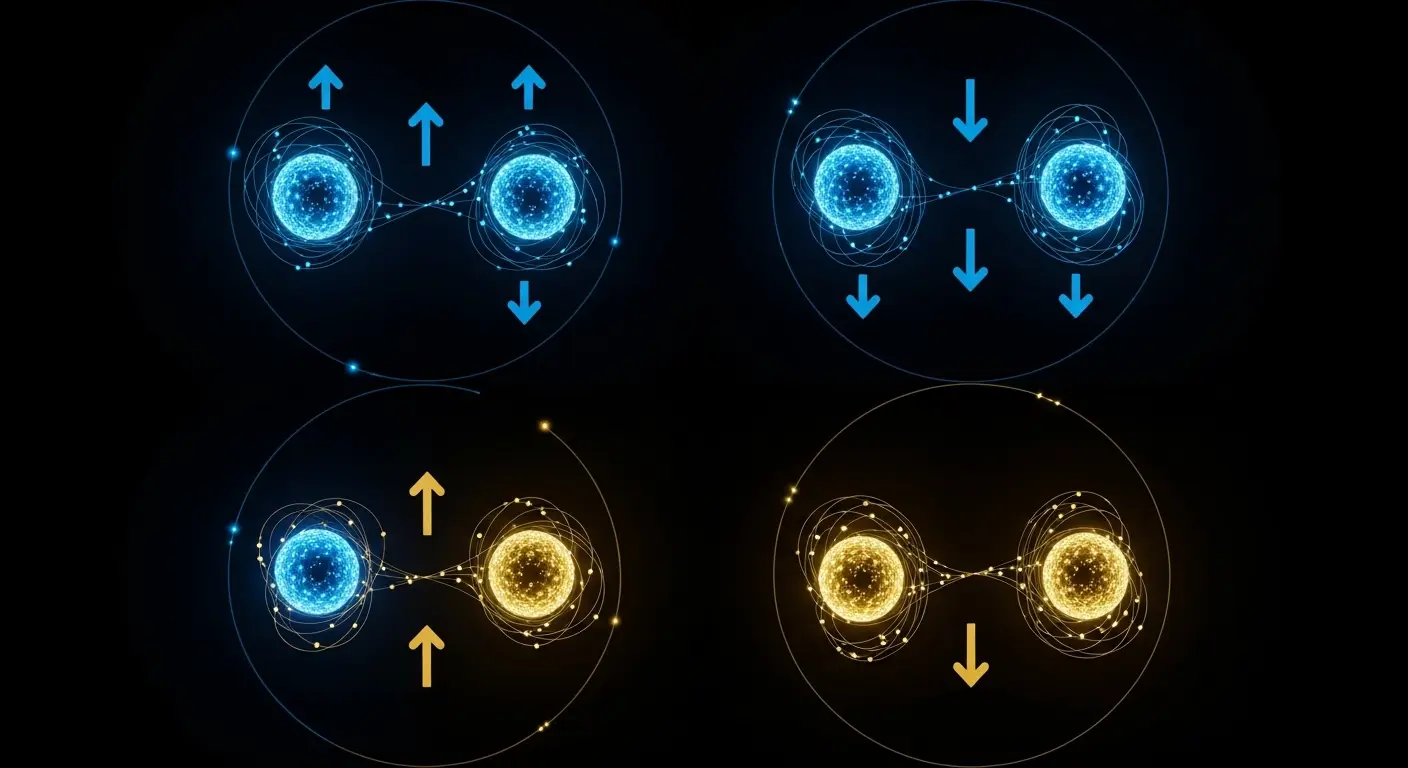
A new method for generating entangled photons, fundamental particles key for advancements in quantum technologies, has created Gayatri Thik and colleagues at Defence Institute of Advanced Technology present a compact device capable of creating all four Bell states, maximally entangled states of two photons, on demand. This on-demand generation is achieved through precise, automated control of a PPKTP crystal within a polarization Sagnac interferometer, toggling between states with movements of 122 ±14μm. The resulting source exhibits high fidelity and repeatable performance, verified through rigorous quantum state tomography and Bell state measurements, representing a sharp step towards practical and flexible quantum communication and computation.
Compact source generates switchable Bell states via precise crystal positioning
Entanglement measures now exceed previous limitations, with the system toggling between Bell states via crystal translation at intervals of just $122 \pm 14 ~\mu m$. The precision movement, previously unattainable without multiple optical components, allows for on-demand generation of all four Bell states using a single PPKTP crystal within a polarization Sagnac interferometer. An automated switching scheme, enabled by a motorized translation stage, represents a sharp advance over methods requiring extensive optical adjustments for each entangled state. Thorough testing, including quantum state tomography and Bell state measurements, confirms the strong durability and repeatability of this new compact source, delivering high-fidelity entangled photon pairs essential for quantum technologies. The significance of this lies in the simplification of entangled photon source design, moving away from bulky, complex setups towards integrated, automated systems. This is crucial for transitioning quantum technologies from laboratory demonstrations to real-world applications.
Experimentally, coincidence counts, indicating paired photons, revealed that switching between the |<math xmlns="http://www.w3.org/1998/Math/MathML" class="qz-math"><mrow><msup><mi>φ</mi><mtext>+</mtext></msup></mrow></math>\rangle and |<math xmlns="http://www.w3.org/1998/Math/MathML" class="qz-math"><mrow><msup><mi>φ</mi><mtext>-</mtext></msup></mrow></math>\rangle (and |<math xmlns="http://www.w3.org/1998/Math/MathML" class="qz-math"><mrow><msup><mi>ψ</mi><mtext>+</mtext></msup></mrow></math>\rangle and |<math xmlns="http://www.w3.org/1998/Math/MathML" class="qz-math"><mrow><msup><mi>ψ</mi><mtext>-</mtext></msup></mrow></math>\rangle) states occurred at consistent intervals of $122 \pm 14 ~\mu m$. Different spectral filters, with 2nm, 10nm, and 715nm cutoffs, also confirmed the stability of the oscillation period and demonstrated minimal impact from the source’s spectral distribution. The PPKTP (periodically poled potassium titanyl phosphate) crystal, a nonlinear optical material, is crucial to the process. Type-0 quasi-phase matching ensures efficient generation of the entangled photon pairs through spontaneous parametric down-conversion. The polarization Sagnac interferometer configuration enhances the entanglement quality and allows for the controlled switching mechanism. The use of multiple spectral filters demonstrates the robustness of the entanglement generation process against variations in the emitted photon wavelengths, a critical factor for practical applications where spectral purity may not be perfectly maintained. While the intensity remains stable within the current operating parameters, the interferometer’s geometry limits the translation range of the crystal, raising questions about scalability and integration into larger quantum networks. Researchers verified generated Bell states through projection onto a diagonal polarization basis. Placing polarizers at 45 degrees in both signal and idler arms of the interferometer allowed easy certification of the entangled states as the crystal was translated. This streamlined approach avoids the need for complex quantum state tomography, which requires sixteen measurements, but does not yet address the challenges of scaling up to multi-photon entanglement or integrating these sources into practical quantum technologies. Quantum state tomography, while computationally intensive, provides a complete characterisation of the quantum state, offering a more detailed assessment of entanglement fidelity than simple Bell state measurements.
Automated Bell state generation offers potential for scalable quantum systems
This new source of entangled photons promises a simpler route to building practical quantum devices, sidestepping the intricate alignment of multiple optical components that have long plagued the field. Producing all four Bell states, fundamental building blocks for quantum communication and computation, in a compact, automated device simplifies construction considerably, potentially lowering costs and increasing stability. Further development could unlock more complex entangled states and scalable quantum networks. The ability to generate Bell states on demand is particularly important for quantum key distribution (QKD), a secure communication protocol that relies on the principles of quantum mechanics to guarantee the confidentiality of transmitted data. Current QKD systems often require complex and bulky setups, hindering their widespread adoption. This compact source offers a pathway towards miniaturized and more practical QKD devices.
The device offers a new level of control over entangled photons, particles linked in a way that promises advances in quantum technologies. Automating the creation of all four Bell states simplifies a process traditionally requiring complex optical alignment. A motorized crystal, precisely moved within a polarization Sagnac interferometer, switches between entangled states with remarkable consistency at intervals of 122 ±14μm; this innovation is key. The implications of this precise control extend to the potential for more robust and efficient quantum communication protocols. The polarization Sagnac interferometer operates by splitting a photon into two paths that travel in opposite directions around a loop, creating a superposition of states sensitive to polarization. The PPKTP crystal, positioned within this loop, generates entangled photon pairs when pumped with a laser. By precisely controlling the crystal’s position, the relative phase between the two paths is altered, effectively switching between the different Bell states. This method offers a significant advantage over traditional approaches that rely on manipulating individual photons with waveplates and beam splitters, which are prone to errors and instability. The potential for integration with integrated photonic circuits is also significant, paving the way for highly compact and scalable quantum systems. Future research will likely focus on increasing the photon pair generation rate, improving the entanglement fidelity, and exploring the possibility of generating higher-dimensional entangled states, such as qudits, which offer increased information capacity.
The researchers successfully demonstrated a compact device capable of generating all four Bell states of entangled photons on demand. This achievement matters because it simplifies the creation of these quantum states, traditionally a complex process requiring precise optical alignment. The system utilises a motorized crystal moved within a polarization Sagnac interferometer, switching between states at intervals of 122 ±14μm with high fidelity. The authors intend to focus on increasing photon pair generation rates and improving entanglement fidelity in future work.
👉 More information
🗞 On-demand generation of all four Bell states using a single PPKTP entangled photon source
🧠 ArXiv: https://arxiv.org/abs/2604.19013


See today’s quantum computing news on Quantum Zeitgeist for the latest breakthroughs in qubits, hardware, algorithms, and industry deals.