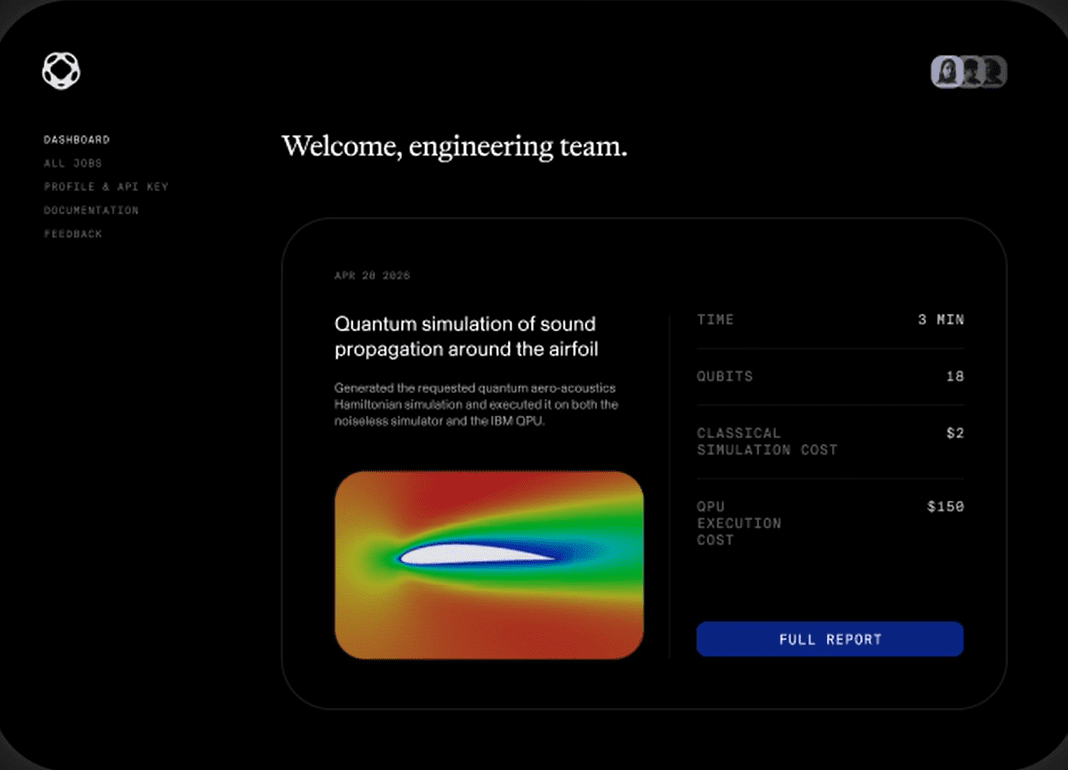
Haiqu announced the launch of the Agentic Quantum Operating System, a full-stack quantum intelligence platform designed to accelerate research and development for enterprise and scientific applications. Currently, the most significant impediment to progress isn’t access to quantum processing units, but rather the substantial time and expertise needed to formulate viable application prototypes, according to Richard Givhan, CEO and Co-founder of Haiqu. The new platform combines agentic AI with proprietary middleware to streamline the process of designing, executing, and iterating on quantum experiments, potentially reducing costs and accelerating timelines. Dr. Kristin Milchanowski, Chief AI & Quantum Officer at BMO, notes that observing research into tools like Haiqu’s middleware allows for a deeper understanding of how quantum bottlenecks might eventually be addressed.
Agentic Intelligence Automates Quantum Application Design
The company’s approach focuses on automating the often laborious process of designing and prototyping quantum experiments, a challenge that currently impedes progress for many research and development teams. Quantum development is currently slowed by the time and costs associated with application design, experiment execution, and result iteration; Haiqu’s system aims to drastically reduce these barriers. Central to the platform is agentic intelligence, built upon Haiqu’s proprietary algorithms and a curated knowledge base, which automates application design and guides users toward optimal solutions. This is coupled with the Haiqu SDK, a suite of developer tools designed to maximize performance through data loading and algorithmic optimization, and the Haiqu Runtime, an orchestration engine that streamlines application execution.
Recent internal tests demonstrated significant performance gains; a molecular dynamics simulation previously costing 30,000 and taking over nine hours was reportedly reproduced for approximately 25 in roughly 30 seconds using the Haiqu platform. Givhan stated that the bottleneck for quantum R&D teams is often not access to a QPU, but the time and expertise required to identify the right problem, structure the work, and get credible application prototypes. Dr. Kristin Milchanowski, Chief AI & Quantum Officer at BMO, said observing research into tools like Haiqu’s middleware allows for a deeper understanding of how quantum bottlenecks might eventually be addressed. This perspective aligns with observations from industry experts.
Haiqu SDK Optimizes Quantum Workflows & Error Mitigation
Haiqu’s recent launch of its Agentic Quantum Operating System signals a growing industry focus on optimizing the software layer of quantum computing. While access to quantum processing units remains a critical component, the emphasis is shifting towards tools that streamline the entire research and development process, addressing inefficiencies in application design and experimentation. Haiqu’s platform directly tackles the challenge of translating complex problems into executable quantum experiments, a process that traditionally demands significant time and specialized expertise.
This focus on error mitigation is particularly important given the inherent instability of qubits and the resulting inaccuracies in quantum computations; the SDK aims to extract more value from each quantum operation. Dr. Kristin Milchanowski, Chief AI & Quantum Officer at BMO and Founding Director of the BMO Institute for Applied Artificial Intelligence & Quantum, said observing research into tools like Haiqu’s middleware allows for a deeper understanding of how these bottlenecks might eventually be addressed. This capability extends beyond simple speed improvements. Haiqu’s system has successfully prepared simulations of the single-impurity Anderson model, a complex foundational model in condensed matter physics, and constructed a pipeline for simulating neutron-scattering experiments.
The bottleneck for quantum R&D teams is often not access to a QPU. It is the time and expertise required to identify the right problem, structure the work and get credible application prototypes.
Richard Givhan, CEO and Co-founder of Haiqu
Haiqu Platform Achieves 100x Operation Increase on Current Hardware
Haiqu is challenging conventional wisdom surrounding quantum computing limitations with a new platform demonstrating a significant leap in operational efficiency. The company announced the launch of its Agentic Quantum Operating System and reports that its software can run applications with up to 100 times more operations on current devices compared to competitors, a claim substantiated by recent internal testing. These results extend beyond molecular dynamics, with similar performance gains observed in optimization algorithms, quantum machine learning models, and probability distributions. Dr. Kristin Milchanowski, Chief AI & Quantum Officer at BMO, stated, “Observing research into tools like Haiqu’s middleware allows for a deeper understanding of how quantum bottlenecks might eventually be addressed.” This performance boost isn’t simply about faster processing; it addresses a critical bottleneck in quantum research and development. Haiqu’s full-stack platform, incorporating agentic intelligence, a dedicated SDK, and a runtime orchestration engine, aims to reduce costs, accelerate iteration, and facilitate the training of new quantum researchers, ultimately accelerating the path toward practical quantum applications.
Observing research into tools like Haiqu’s middleware allows for a deeper understanding of how these bottlenecks might eventually be addressed.
Dr. Kristin Milchanowski, Chief AI & Quantum Officer at BMO



See today’s quantum computing news on Quantum Zeitgeist for the latest breakthroughs in qubits, hardware, algorithms, and industry deals.