

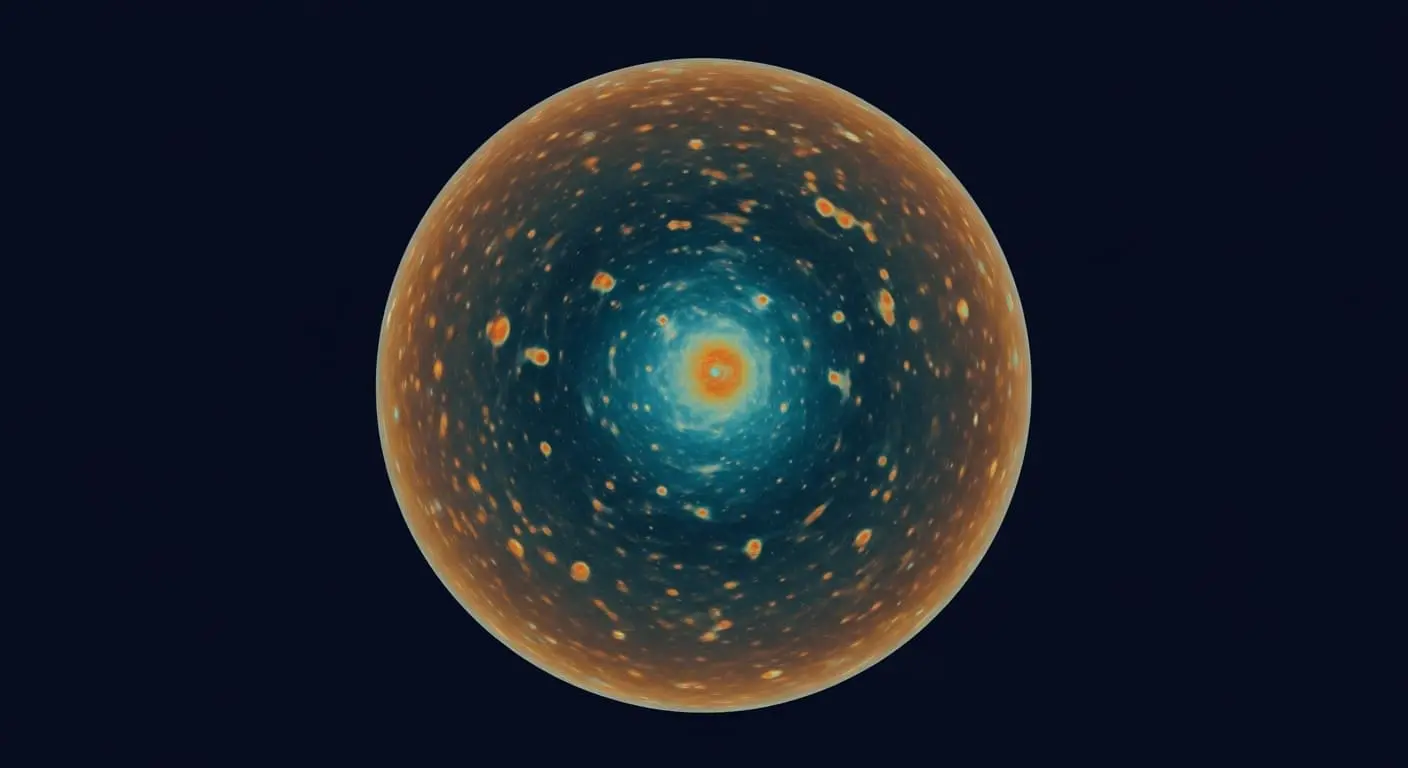
Lucas Lamata, for Nanotechnology London, investigates a previously overlooked symmetry present within both the quantum Rabi model and the Dirac equation, potentially offering solutions to fundamental problems in physics. A total symmetry principle is proposed, stating that total energy remains zero, alongside the constraint that positive energy excitations possess corresponding negative energy counterparts. This approach bypasses the need for the Dirac sea concept and may automatically resolve issues surrounding the renormalization of quantum gravity, as well as the existence of dark matter and dark energy, alongside cancelling zero-point energy. This reinterpretation of established models highlights the key role of enforcing symmetry principles in theoretical frameworks.
Mirror duality and zero total energy in quantum systems
A previously unrecognised symmetry within established quantum models proved key to this analysis. The quantum Rabi model, originally conceived as an analogy to the interaction between a two-level atom and a single mode of the electromagnetic field, and the Dirac equation, a relativistic quantum mechanical wave equation describing spin-1/2 particles such as electrons, share a characteristic: each possesses a ‘mirror dual’ symmetry where energy states appear in positive and negative pairs. The quantum Rabi model, with its Hamiltonian typically expressed as H = ωa†a + Ω(σ+ + σ-</sup), where ω represents the frequency of the field, a† and a are creation and annihilation operators, and Ω is the coupling strength, has long been a cornerstone of quantum optics due to its analytical solvability. Traditionally, physicists assumed a baseline ground state energy for these systems, a non-zero vacuum energy arising from quantum fluctuations; however, this approach instead enforced a ‘total symmetry principle’, postulating that the universe consistently maintains zero total energy. This principle isn’t simply an assertion of energy conservation, but a deeper claim about the fundamental structure of quantum states.
Treating every positive energy excitation as intrinsically linked to a corresponding negative energy excitation in a theoretical “mirror” universe effectively cancelled them out. This bypasses the need for complex theoretical constructs like the Dirac sea, a concept introduced by Dirac to accommodate negative energy solutions to the Dirac equation and avoid instability. The Dirac sea postulates a filled sea of negative energy electrons, preventing further electrons from occupying these states. This framework offers a potentially unifying framework for several outstanding problems in physics. Applying this principle to the quantum Rabi model and the Dirac equation further validated the framework, as both systems are suitable for analytical solutions and exhibit the ‘mirror dual’ symmetry where positive energy states correspond to negative counterparts. The analytical tractability of these models is crucial, allowing for rigorous mathematical demonstration of the symmetry and its consequences. This offers a potentially unifying framework addressing several persistent problems simultaneously, from the troublesome zero-point energy to the mysteries of dark matter and dark energy. The significance lies in potentially resolving these issues without invoking new particles or forces, but rather through a reinterpretation of existing quantum principles.
The zero-point energy discrepancy, a longstanding problem in physics, currently differs by 120 orders of magnitude between theoretical calculations and experimental results; this new framework proposes a mechanism to resolve this, effectively bridging a gap previously considered insurmountable. Quantum field theory predicts a substantial vacuum energy density arising from the continuous creation and annihilation of virtual particles. However, attempts to calculate this energy density based on established physical constants yield a value vastly exceeding observational limits derived from cosmological observations, such as the expansion rate of the universe. Enforcing a ‘total symmetry principle’ automatically cancels this zero-point energy, a feat impossible under previous interpretations requiring artificial constructs like the Dirac sea. The cancellation occurs because for every virtual particle with positive energy, there exists a corresponding virtual particle with negative energy in the ‘mirror’ universe, resulting in a net-zero energy contribution. Evidence from black hole radiation supports this concept, as Hawking radiation inherently creates particle-antiparticle pairs with opposing energies near the event horizon, upholding the total symmetry constraint and suggesting the black hole’s interior represents this mirror universe. The Hawking process, where quantum effects near the event horizon lead to the emission of particles, can be viewed as a manifestation of this underlying symmetry, with negative energy particles falling into the black hole to balance the emitted positive energy particles.
Mirror universes and the resolution of cosmological inconsistencies
Established quantum physics possesses a hidden symmetry that this analysis exploits, potentially resolving inconsistencies plaguing modern cosmology. This symmetry, termed ‘mirror duality’, relies on the existence of a corresponding ‘mirror universe’, a concept that immediately invites comparison with multiverse theories already struggling for empirical support. While elegantly cancelling problematic zero-point energy, the framework currently lacks concrete predictions beyond mathematical consistency, leaving its testability an open question. Further research is needed to determine if this symmetry leads to observable consequences, such as subtle deviations in the cosmic microwave background or the distribution of dark matter.
Acknowledging the need for empirical evidence beyond mathematical elegance is vital; the proposal of a ‘mirror universe’ naturally invites scepticism given existing challenges with multiverse concepts. A principle of total symmetry is established, proposing the universe consistently maintains zero net energy through a balancing mechanism. Re-examining foundational quantum physics, scientists identified a shared ‘mirror dual’ symmetry where energy states appear in positive and negative pairs. This potentially offers a unified explanation for dark matter and dark energy, suggesting these phenomena may stem from entanglement with a corresponding ‘mirror’ universe. Specifically, the observed effects attributed to dark matter and dark energy could be manifestations of interactions between particles in our universe and their ‘mirror’ counterparts, mediated by entanglement. The framework suggests that dark matter isn’t necessarily composed of new particles, but rather represents the gravitational influence of these entangled ‘mirror’ particles. Further investigation will focus on developing testable predictions based on this entanglement hypothesis, potentially through precision measurements of gravitational effects or searches for subtle correlations in cosmological data.
The research revealed a hidden symmetry within both the quantum Rabi model and the Dirac equation, suggesting a balance between positive and negative energy states. This symmetry implies the possibility of a ‘mirror universe’ where, for every particle, a corresponding ‘mirror’ particle exists with opposing energy. Scientists propose this framework could explain dark matter and dark energy not as new particles, but as gravitational effects originating from entanglement with this ‘mirror’ universe. Future work intends to develop predictions based on this entanglement, seeking observable evidence in cosmological data.
👉 More information
🗞 Mirror Dual Symmetry in Physics
🧠 ArXiv: https://arxiv.org/abs/2604.05741




See today’s quantum computing news on Quantum Zeitgeist for the latest breakthroughs in qubits, hardware, algorithms, and industry deals.



