

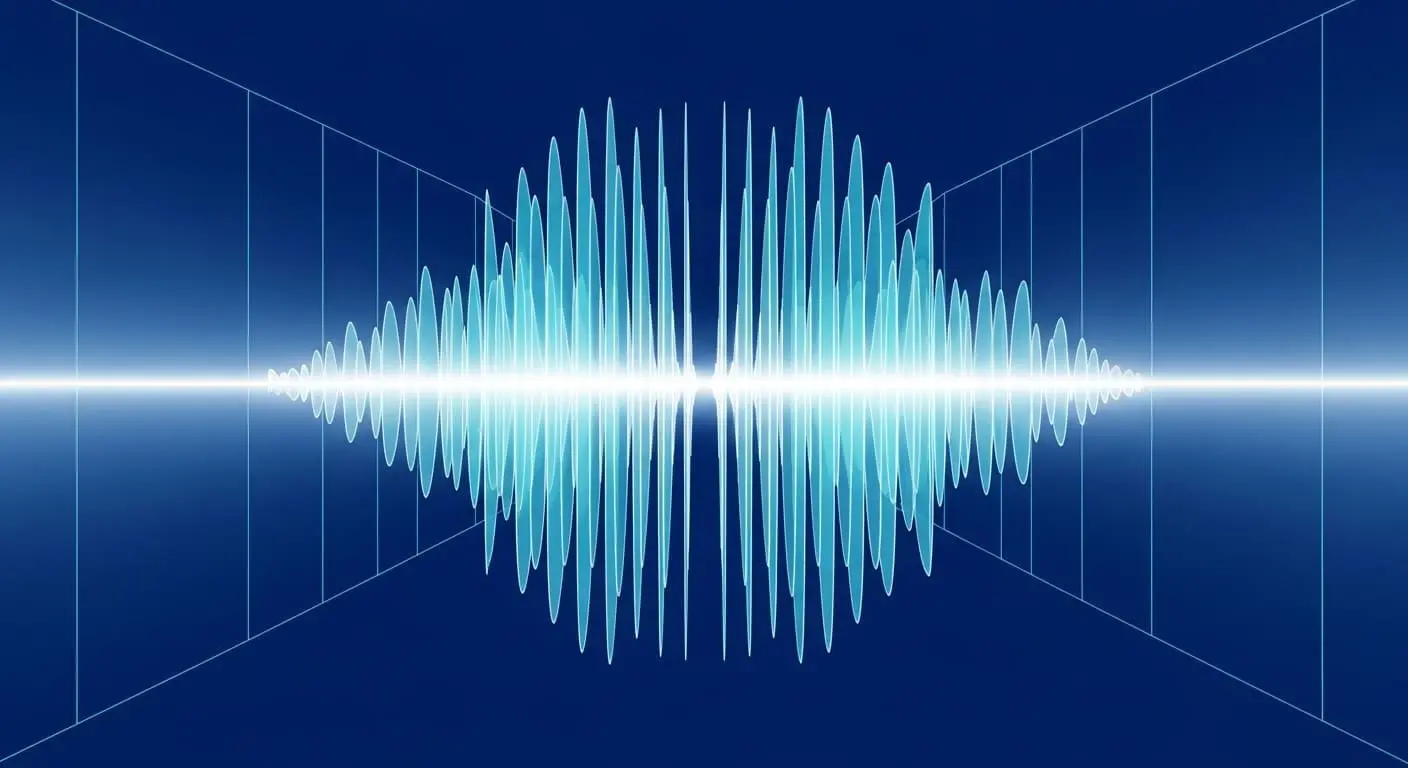
Scientists at Leibniz University, led by Changlong Zhu, have demonstrated a novel quantum memory protocol utilising coherent photon-phonon transduction in a Brillouin-active optical waveguide. This innovative approach enables the storage of optical quantum states as acoustic excitations, representing a significant advancement in the field of quantum communication and information processing. The research details a method for mapping a propagating optical quantum state onto a travelling phononic excitation, effectively storing the information within a solid-state medium and allowing for its subsequent retrieval. This circumvents limitations inherent in traditional quantum memory designs based on discrete cavity modes, offering a pathway towards scalable and broadband quantum technologies.
Acoustic phonon storage overcomes bandwidth and fidelity limitations in quantum memory
Bandwidth in this quantum memory protocol extends to hundreds of MHz, a considerable improvement over conventional cavity-based systems which are typically restricted to discrete modes and often necessitate deep cryogenic cooling, frequently to temperatures as low as 15 mK. These existing platforms have historically struggled to simultaneously achieve large bandwidth, high fidelity, and scalability, a longstanding challenge that this new protocol effectively addresses. The system leverages a Brillouin-active optical waveguide, a specifically engineered structure designed to facilitate the interaction between light and sound. This interaction allows for the translation of quantum information carried by optical photons into acoustic phonons, which are quantised units of vibrational energy, effectively sound waves at the atomic level. This translation enables storage within a distributed medium, eliminating the constraints imposed by the fixed dimensions of traditional optical cavities. Analytical modelling, alongside detailed numerical simulations, confirms the high-fidelity storage and retrieval of complex quantum states, including non-classical states such as squeezed and entangled states, under parameters closely resembling realistic experimental conditions. This validation is crucial for assessing the practical viability of the system and its potential for integration into larger quantum systems, enabling scalable platforms for quantum communication and advanced multimode quantum signal processing.
The implementation of a travelling-wave architecture is particularly noteworthy, as it allows for parallel signal processing across multiple frequencies. This capability significantly enhances the potential for performing complex quantum operations, as multiple quantum channels can be processed simultaneously. Current demonstrations, however, are conducted at sub-kelvin temperatures, necessitating further research to achieve operation at more practical temperatures. Scaling the system to operate at room temperature, alongside extending the storage times beyond milliseconds, represents a key hurdle for realising widespread practical applications. The system achieves storage and retrieval without the need for discrete optical cavities, a common limitation in earlier designs that introduced significant complexity and loss. The operational parameters employed in the experiments closely mirror those achievable in a standard laboratory setting, further bolstering the credibility and potential for replication of the results. Ongoing investigation focuses on maintaining high fidelity over extended storage periods, as mechanical imperfections within the waveguide material can dampen the acoustic signal and consequently degrade the stored quantum state. Mitigating these losses through material optimisation and improved waveguide fabrication techniques is a primary focus of current research.
Encoding quantum states via acoustic phonons in glass offers durability to decoherence
Researchers are actively pioneering new avenues for quantum data storage, a critical component in the development of secure quantum communication networks and powerful quantum computers. This work details a method of encoding quantum information onto acoustic phonons within a glass fibre, effectively sidestepping the bandwidth limitations that have plagued earlier quantum memory designs. Broadband storage, capable of handling a wide range of frequencies, is vital for facilitating complex quantum calculations and establishing robust quantum networks, and this acoustic approach offers a potentially scalable and efficient solution. The process of translating optical quantum states into acoustic excitations not only enables broadband storage but also inherently supports parallel processing capabilities, increasing the throughput of quantum information. Detailed analytical modelling and rigorous numerical simulations have confirmed the high-fidelity storage and retrieval of entangled states under conditions closely mirroring those of a real laboratory environment. This builds upon initial findings and provides a comprehensive technical validation of the approach, demonstrating its robustness and reliability. The use of acoustic phonons, as opposed to directly storing information in the optical domain, offers potential advantages in terms of decoherence, the loss of quantum information due to interaction with the environment. Acoustic phonons in solid-state materials, particularly glass, exhibit relatively long coherence times, meaning the quantum information can be preserved for a longer duration. This increased durability to decoherence is a crucial factor in enabling practical quantum technologies.
The Brillouin-active optical waveguide plays a central role in this process, acting as the interface between the optical and acoustic domains. The waveguide is designed to enhance the interaction between light and sound, maximising the efficiency of the transduction process. The pump pulse, driving the interaction, effectively creates an effective beam-splitter interaction between the optical and acoustic fields, allowing for the seamless transfer of quantum information. The choice of materials and waveguide geometry are critical parameters that influence the performance of the quantum memory, and ongoing research is focused on optimising these factors to further improve storage times and fidelity. The potential applications of this technology extend beyond quantum communication and computation, encompassing areas such as quantum sensing and metrology, where the ability to store and retrieve quantum states with high precision is paramount. Further development and refinement of this acoustic phonon-based quantum memory protocol promise to unlock new possibilities in the rapidly evolving field of quantum technologies.
The researchers demonstrated a method for storing quantum information by transferring optical quantum states onto acoustic phonons within a Brillouin-active optical waveguide. This approach offers a way to preserve delicate quantum states, as acoustic phonons in solid materials experience less decoherence than light itself. Simulations and modelling confirmed high-fidelity storage and retrieval of entangled states, with a potential memory bandwidth reaching hundreds of MHz. The authors are currently focused on optimising materials and waveguide geometry to further enhance performance and storage duration.
👉 More information
🗞 A solid-state quantum memory based on a continuous optoacoustic system
🧠 ArXiv: https://arxiv.org/abs/2604.05602



See today’s quantum computing news on Quantum Zeitgeist for the latest breakthroughs in qubits, hardware, algorithms, and industry deals.



