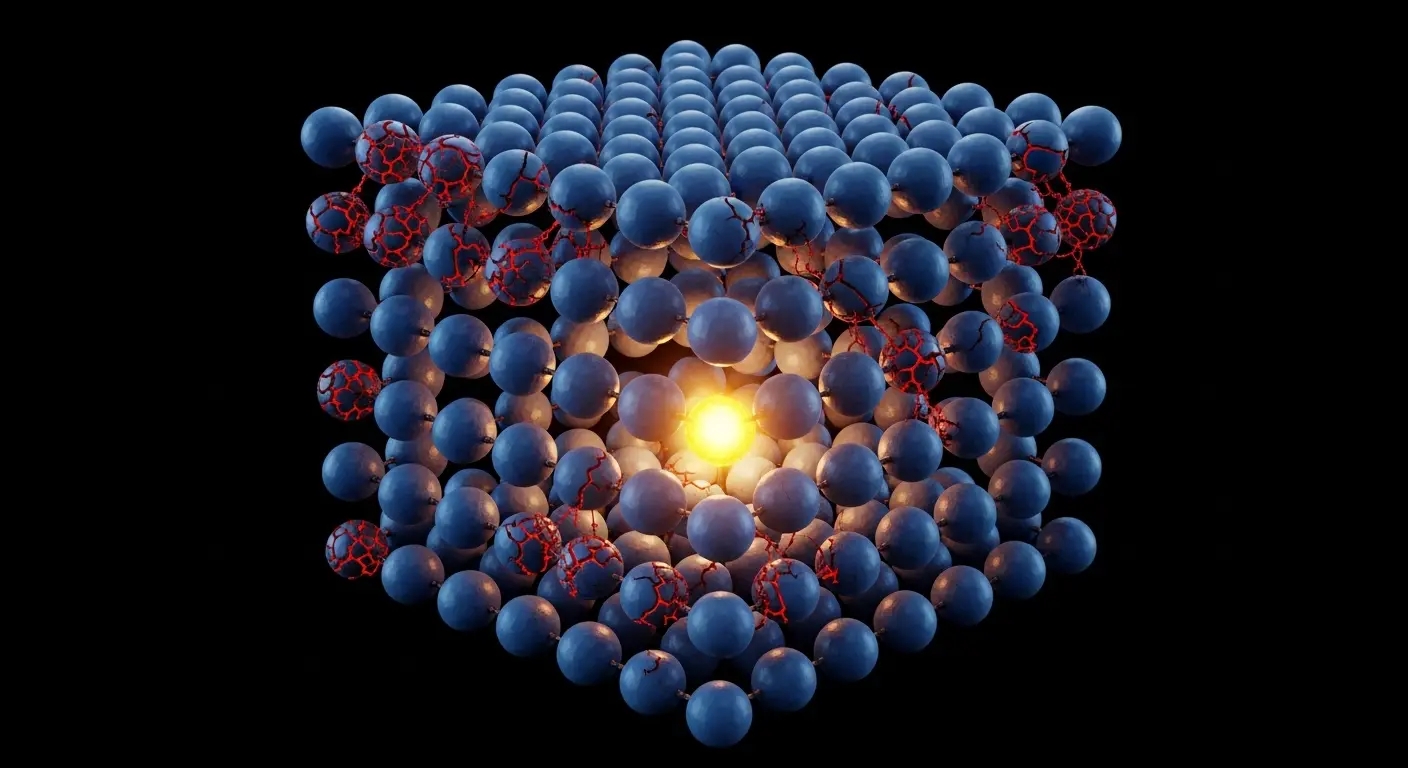
A new quantum uploading procedure accelerates the processing of data from physical experiments. Ishaan Kannan and colleagues at Harvard University demonstrate exponential speedups in both classical shadow tomography and the estimation of cubic observables, surpassing the performance of non-encoded adaptive strategies. The advance is key because it overcomes the challenge of noise when coupling a quantum processor to an experimental sample, maintaining learning efficiency even with imperfect hardware. The team validated their findings with a simulation of astronomical imaging, showing sharp reductions in the number of measurements needed to detect exoplanets, and establishing the potential of fault-tolerant quantum computation for scientific discovery.
Embedding quantum states within error-correcting codes for noise durability
Quantum uploading swiftly embeds an unknown quantum system into a protective quantum code; this is a method of protecting quantum information from errors, similar to how redundant data is used in traditional computing to ensure data integrity. This process immediately shields the quantum information, compressing any initial exposure to noise into a single, manageable step before fault-tolerant processing begins. The technique begins with a transduction stage, mapping the physical state from the experiment onto the quantum processor’s memory, followed by injecting that state into an error-correcting code, effectively creating a strong logical state
Efficiency gains are substantial when performing learning tasks on this encoded state, circumventing the typical slowdowns caused by accumulating noise during analysis. Embedding a quantum system into an error-correcting code protects information from noise during processing. First, the physical state is transduced onto the quantum processor’s memory, then injected into the code, creating a strong logical state. The chosen approach compresses initial noise exposure into a single step, allowing for fault-tolerant processing and circumventing typical slowdowns; the code distance can be arbitrarily high with constant error overhead.
Quantum uploading enhances exoplanet detection and quantum state characterisation
A new quantum uploading procedure now locates exoplanets obscured by bright stars using orders of magnitude fewer shots, a reduction from potentially billions to hundreds, in astronomical imaging. This breakthrough crosses a critical threshold previously impossible with unencoded methods, where signal detection was overwhelmed by noise from the experimental interface. Embedding an unknown quantum system into a protective quantum code circumvents the exponential degradation of learning caused by noise, achieving exponential speedups in both classical shadow tomography and estimation of cubic observables; this allows for substantially more efficient data processing from quantum experiments.
Both classical shadow tomography, a technique for reconstructing quantum states, and estimation of cubic observables, which measure specific properties of those states, benefited from this quantum uploading procedure. These tasks were completed with exponential speedups compared to strategies that do not immediately encode the quantum information, meaning the computational effort required decreases dramatically as the problem size increases. Numerical simulations within an astronomical imaging scenario revealed that locating an exoplanet obscured by starlight required orders of magnitude fewer measurements than previous methods, a reduction from potentially billions to hundreds of photon detections.
Quantum uploading safeguards delicate signals for experimental machine learning
Interfacing quantum processors with real-world experiments remains a considerable hurdle despite advances in fault-tolerant quantum computation; noise inevitably creeps in, threatening to overwhelm delicate quantum signals. A ‘quantum uploading’ procedure, embedding quantum systems within protective codes to mitigate this noise and achieve exponential speedups in learning, has now been demonstrated. However, the scalability of this uploading process to more complex systems is yet to be fully established.
Acknowledging ongoing difficulties in scaling this ‘quantum uploading’ technique to more intricate systems does not diminish its immediate importance. This work establishes a pathway to use existing fault-tolerant quantum processors for practical gains in learning from experiments, even with noisy interfaces. In particular, the demonstrated speedups in tasks like astronomical imaging and locating exoplanets show a clear application where quantum computation can outperform classical methods with significantly fewer measurements.
This presents a valuable strategy for utilising developing quantum hardware. A procedure termed quantum uploading enables exponential speedups in learning from noisy quantum experiments by embedding quantum systems within protective error-correcting codes. This approach to mitigating errors compresses initial noise into a single, constant step, unlike previous limitations imposed by noise when interfacing quantum processors with experimental systems. Demonstrating this, analysis of astronomical imaging located an exoplanet obscured by a bright star using orders of magnitude fewer measurements than unencoded methods, establishing fault-tolerant quantum computation as a beneficial tool for extracting information from quantum experiments.
The research demonstrated that embedding quantum systems within protective error-correcting codes, a process called quantum uploading, allows for exponential speedups in learning from noisy experiments. This is significant because it means existing, fault-tolerant quantum processors can be used to gain practical advantages in data analysis, despite the challenges of noisy interfaces. Specifically, the team showed this approach reduced the number of photon detections needed to locate an obscured exoplanet, offering a clear advantage over classical methods. The authors suggest this technique provides a means of leveraging current quantum hardware for improved experimental learning.
👉 More information
🗞 Exponential speedups in fault-tolerant processing of quantum experiments
🧠 ArXiv: https://arxiv.org/abs/2605.02057




See today’s quantum computing news on Quantum Zeitgeist for the latest breakthroughs in qubits, hardware, algorithms, and industry deals.