
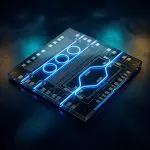
A new continuous-variable quantum key distribution (CV-QKD) system has been demonstrated by Denis Fatkhiev and collaborators at Eindhoven University of Technology. The system achieves a 1.9 Mbit/s secret key rate over 25km of standard single-mode fibre using a custom-designed monolithic silicon photonic transceiver. This represents a key step towards deployable QKD systems through the integration of electronic and photonic components.
High-performance continuous-variable QKD realised via integrated silicon photonics
A secret key rate of 1.9 Mbit/s over 25km of standard single-mode fibre represents a substantial improvement over prior continuous-variable quantum key distribution (CV-QKD) systems. These earlier systems often lacked complete transceiver implementations, hindering their practical application. This milestone crosses a key threshold for practical quantum communication, demonstrating the feasibility of integrating electronic and photonic components into a deployable system. Historically, achieving efficient polarisation multiplexing within a monolithic silicon photonic transceiver presented a significant technological challenge, requiring precise control over light propagation and polarisation states on a nanoscale. The development of integrated circuits capable of handling these delicate quantum states is crucial for scaling QKD technology beyond laboratory demonstrations.
Denis Fatkhiev and collaborators at Eindhoven University of Technology, utilised a custom-designed chip. The chip incorporates trans-impedance amplifiers and advanced digital signal processing to counteract noise and optimise performance. This compact design paves the way for more stable and scalable quantum networks, utilising continuous-variable encoding to transmit data securely. A receiver sensitivity of -24.5 dBm was also confirmed, demonstrating strong signal detection despite noise; this level is sufficient for long-distance quantum communication links. This sensitivity level is particularly noteworthy as it allows for the use of standard telecommunications infrastructure, reducing the cost and complexity of deployment. The trans-impedance amplifiers convert the weak photocurrents generated by the detectors into usable voltage signals, while the digital signal processing algorithms actively compensate for channel impairments such as fibre dispersion and attenuation.
The system employs probabilistically shaped 64-QAM modulation, a complex encoding technique that increases the amount of information transmitted per photon, and utilises a tailored digital signal processing (DSP) chain to mitigate signal degradation. Ge-on-Si photodetectors, optimised for telecommunications wavelengths (typically around 1550nm), convert optical signals into electrical signals with a quantum efficiency of 0.7. This means that 70% of incident photons are successfully detected, maximising the signal-to-noise ratio. Trans-impedance amplifiers (TIAs) are integrated into the transceiver chip, amplifying the weak photocurrents generated by the detectors and converting them into voltage signals. This reduces electronic noise to 0.34 shot noise units, a critical parameter for achieving high key rates and secure communication. Shot noise represents the fundamental limit of noise in any electronic measurement, and minimising this noise is essential for detecting the weak quantum signals.
Security analysis currently relies on a trusted noise assumption, meaning the system’s vulnerability to attacks exploiting hardware imperfections requires further investigation; future development will aim to remove this dependency. Monolithic silicon photonics enabled this advance by integrating many optical components onto a single chip, reducing size and complexity, and achieving a 1.9 Mbit/s secret key rate across 25km of standard single-mode fibre. Control of light’s properties is enabled by this approach, important for encoding information in continuous-variable quantum key distribution, or CV-QKD, which utilises characteristics like brightness and phase instead of individual particles. The system employed polarisation multiplexing, combining two separate signals on different polarisation states of light, effectively doubling the data transmission capacity and achieving a 1.9 Mbit/s secret key rate across 25km of fibre. This integration contributes to the development of smaller quantum communication devices utilising silicon photonics, potentially leading to widespread adoption of QKD technology. Silicon photonics offers advantages in terms of cost, scalability, and compatibility with existing CMOS manufacturing processes.
Silicon photonics advances quantum key distribution with speed and integration caveats
Scientists are edging closer to unhackable communication networks, and this new silicon photonics-based system offers a compelling pathway towards practical quantum key distribution. The analysis reveals a reliance on what’s known as a ‘trusted noise assumption’, despite this demonstration achieving a significant milestone in integrating quantum and electronic components. In effect, the security analysis presumes a certain level of background noise, ignoring potential vulnerabilities arising from imperfections within the hardware itself. This assumption simplifies the security proof but introduces a potential attack vector where an adversary could manipulate the noise characteristics to compromise the key exchange.
Acknowledging this reliance does not dismiss the achievement; it clarifies a known limitation in current quantum key distribution (QKD) systems. Addressing the trusted noise assumption requires more sophisticated security proofs and potentially the implementation of device-independent QKD protocols, which do not rely on assumptions about the internal workings of the devices. Integrating quantum components with conventional electronics promises smaller, cheaper, and more scalable devices, and this demonstration shows that potential. A 1.9 Mbit/s secure key rate was achieved over a 25 kilometre fibre optic cable by utilising a custom-designed silicon photonic transceiver, highlighting the potential of combining electronic and photonic components. The system uses continuous-variable quantum key distribution, or CV-QKD, a method of encoding information using properties of light, and employs a complex modulation technique to increase data transmission. Optimised signal processing and integrated components further enhance the system’s performance. CV-QKD offers advantages over discrete-variable QKD in terms of compatibility with existing telecommunications infrastructure and higher key rates, although it typically requires more complex signal processing.
The demonstrated system represents a significant step towards realising practical and secure quantum communication networks. Future research will focus on removing the trusted noise assumption, increasing the key rate, and extending the transmission distance. Further optimisation of the silicon photonic transceiver, including improved detector efficiency and lower noise amplifiers, will be crucial for achieving these goals. The development of more robust and efficient digital signal processing algorithms will also play a key role in mitigating the effects of channel impairments and maximising the performance of the system. Ultimately, the successful integration of quantum and classical technologies is essential for bringing the benefits of quantum communication to a wider audience.
The researchers successfully demonstrated a continuous-variable quantum key distribution (CV-QKD) system utilising a silicon photonic transceiver. This achievement highlights the potential of integrating quantum and electronic components for more practical quantum communication. The system attained a secret key rate of 1.9 Mbit/s over 25km of standard fibre, demonstrating compatibility with existing telecommunications infrastructure. The authors intend to focus future work on removing the trusted noise assumption, increasing the key rate and extending transmission distance through optimisation of the transceiver and signal processing.
👉 More information
🗞 Compact Continuous-Variable Quantum Key Distribution System Employing Monolithically Integrated Silicon Photonic Transceiver
🧠 ARXIV: https://arxiv.org/abs/2603.28310


See today’s quantum computing news on Quantum Zeitgeist for the latest breakthroughs in qubits, hardware, algorithms, and industry deals.