

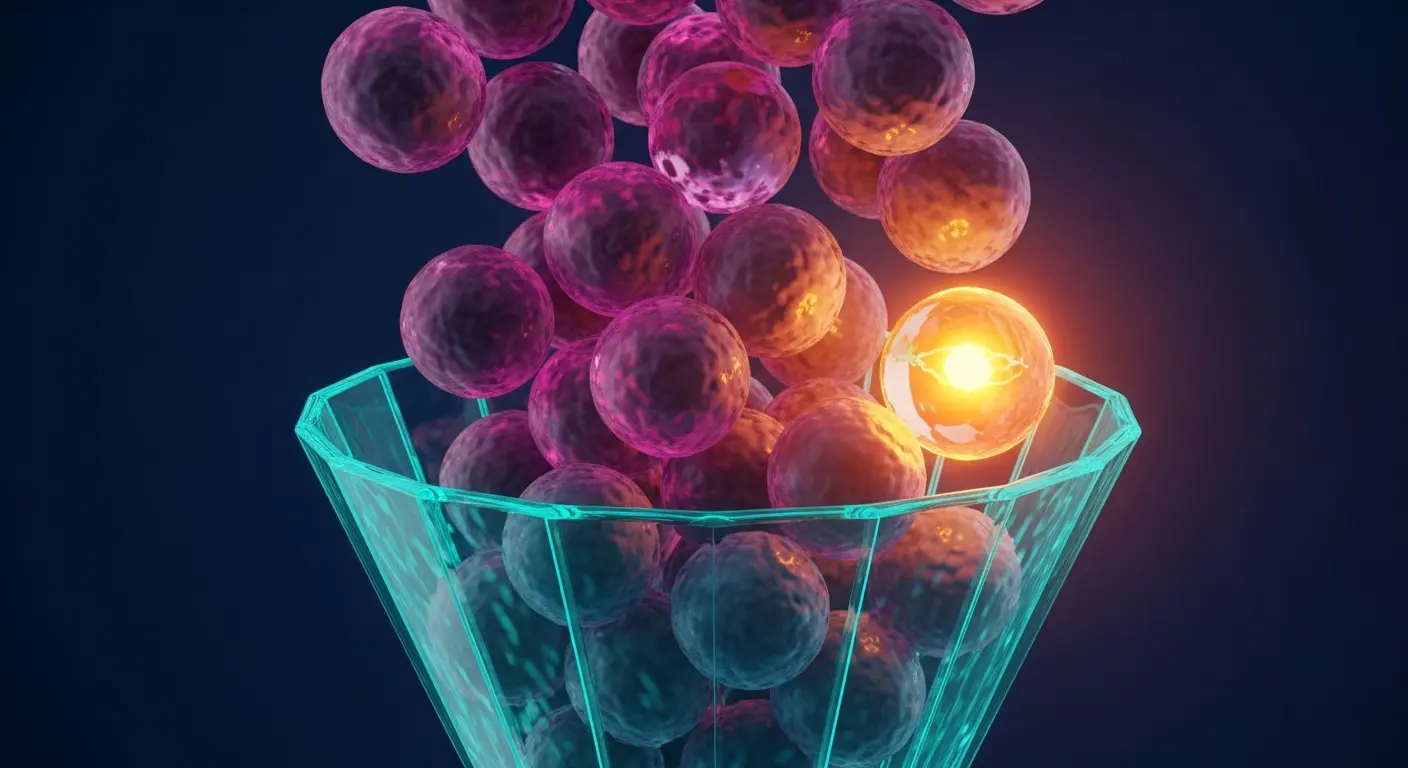
Arunaday Gupta and colleagues at The University of Texas at Dallas investigated the geometric structure underlying exact Pauli-detecting quantum codes, revealing a landscape far richer than previously understood. These codes frequently form continuous families, challenging the conventional view of discrete solution regions. Their work centres on a scalar, denoted λ*, derived from the Knill-Laflamme conditions, which thoroughly summarises a code’s variance profile. Stabilizer codes represent only isolated points within a broader, largely unexplored continuum of nonadditive codes, offering a unified framework for understanding both traditional and emerging quantum error correction strategies and potentially guiding the development of more effective codes.
Mapping optimal quantum error correction via Stiefel manifold optimisation
A sophisticated computational technique centred on the ‘Stiefel manifold’, a mathematical space representing matrices with specific properties, was employed to map the field of potential quantum error correction codes. The Stiefel manifold, specifically the Stiefel manifold Vn,k consisting of n x k orthonormal matrices, provides a natural parameterisation for the space of quantum code projectors. This approach allows for a continuous exploration of code space, unlike traditional algebraic methods which are often restricted to discrete sets of codes. This method represents code projectors, mathematical tools defining how quantum information is protected, using matrices and then optimises these matrices to satisfy the conditions for detecting ‘Pauli errors’, common types of glitches affecting quantum bits. Pauli errors, encompassing bit-flip, phase-flip, and combinations thereof, represent a fundamental source of noise in quantum computations. An important ‘loss function’ measures how well a given matrix performs as an error-detecting code, guiding the search for optimal code designs through minimisation. The loss function is carefully constructed to penalise deviations from perfect error detection, ensuring that the optimisation process converges towards codes with superior performance.
The ‘Stiefel manifold’ served as the basis for a computational method exploring potential quantum error correction codes, circumventing the limitations of previous algebraic constructions. Algebraic constructions, such as those based on stabilizer formalism, often require significant computational resources to explore even moderately sized code spaces. The optimisation process employed a ‘loss function’ measuring code performance, alongside penalty parameters to guide the search for optimal designs; two- and three-qubit systems were analysed numerically to validate the approach. The penalty parameters are crucial for ensuring that the optimised code projectors maintain the necessary mathematical properties for valid quantum error correction. These small-system analyses served as a benchmark for the method, verifying its ability to identify known codes and explore novel code designs. This work builds upon the initial method by demonstrating its practical application to small quantum systems, offering a pathway towards more efficient error correction strategies. The ability to efficiently explore code space is paramount for scaling quantum error correction to larger, more complex systems, and the Stiefel manifold approach offers a promising avenue for achieving this goal.
Continuous families of exact codes exceed stabilizer code limitations
Previously considered fundamental to quantum error correction, stabilizer codes now occupy only discrete, measure-zero subsets of the attainable λ∗-spectrum, a mathematical representation of a code’s error detection capabilities. Stabilizer codes are defined by their invariance under the action of the stabilizer group, a set of Pauli operators that leave the code state unchanged. This inherent symmetry restricts the possible values of λ∗ that stabilizer codes can achieve. This contrasts sharply with the discovery that exact codes, those perfectly detecting Pauli errors, frequently exist as continuous families, a phenomenon impossible to achieve with solely discrete stabilizer constructions. The existence of continuous families suggests a far greater degree of freedom in designing quantum error correcting codes than previously appreciated. The λ∗-spectrum, derived from the Knill-Laflamme conditions, thoroughly summarises a code’s variance profile; previously, identifying these codes relied on algebraic constructions like stabilizer codes, limiting the search to isolated solutions. The Knill-Laflamme conditions provide a necessary and sufficient condition for the existence of a quantum code capable of detecting a given set of errors.
Exact quantum codes, capable of perfectly detecting specific Pauli errors, frequently exist as continuous families rather than isolated solutions. A single scalar, λ∗, representing the Euclidean norm of the Pauli expectation values on a maximally mixed code state, characterises these codes and provides a concise summary of the code’s error detection capabilities. This scalar effectively quantifies the code’s ability to distinguish between error-free and erroneous states. Analysis reveals that stabilizer codes occupy only discrete points within this continuous field of attainable codes, suggesting a far richer structure than previously understood. Small-system tests using eigenvalue interlacing and symmetry-sector decompositions confirm interval, singleton, and empty regimes within the attainable spectrum. Larger systems, modelled via this approach, consistently show the attainable λ∗-spectrum forming a single closed interval when nonempty. However, a general mathematical proof of this remains elusive, and practical implementation still requires overcoming significant hurdles in maintaining quantum coherence. Eigenvalue interlacing provides a powerful tool for analysing the structure of the code’s error detection capabilities, while symmetry-sector decompositions allow for a more detailed understanding of the code’s properties. Maintaining quantum coherence, the preservation of quantum superposition and entanglement, is a major challenge in building practical quantum computers, and any error correction strategy must address this issue.
Expanding the toolkit for quantum error correction with continuous codes
Our understanding of how to build durable quantum computers is being reshaped, moving beyond the limitations of existing error correction methods. Current approaches rely on ‘stabilizer codes’, a defined set of rules for protecting quantum information, but this work reveals a far more expansive field of possibilities. The discovery of continuous families of exact codes opens up new avenues for designing quantum error correcting codes with improved performance and resilience. Proving this field is truly complete presents a vital hurdle, as demonstrating the existence of all possible codes within this continuous spectrum remains elusive. A complete characterisation of the attainable λ∗-spectrum would provide a definitive map of the landscape of quantum error correction codes. Viable quantum codes, those capable of detecting and correcting errors, are not limited to the discrete solutions offered by traditional ‘stabilizer codes’. Instead, exact codes frequently exist as continuous families, revealing a far richer geometric structure than previously understood, and challenging the conventional view of error correction as relying on isolated, distinct solutions. This suggests that there may be optimal codes that are inaccessible through traditional algebraic methods. Characterised by a scalar, λ*, representing a code’s error detection capability, this broadened field suggests numerous unexplored possibilities for designing strong quantum systems. Further research is needed to explore the properties of these continuous families and develop practical methods for constructing and implementing them in real-world quantum computers.
The research demonstrated that exact quantum codes capable of detecting errors often form continuous families, rather than isolated solutions. This finding expands the understanding of how to build durable quantum computers, moving beyond the limitations of traditional ‘stabilizer codes’. Characterised by a scalar, λ*, this broadened field suggests numerous unexplored possibilities for designing quantum systems with improved resilience to errors. The authors aim to fully characterise the attainable λ*-spectrum to map the landscape of quantum error correction codes.
👉 More information
🗞 Variance Geometry of Exact Pauli-Detecting Codes: Continuous Landscapes Beyond Stabilizers
🧠 ArXiv: https://arxiv.org/abs/2604.21800
See today’s quantum computing news on Quantum Zeitgeist for the latest breakthroughs in qubits, hardware, algorithms, and industry deals.



