

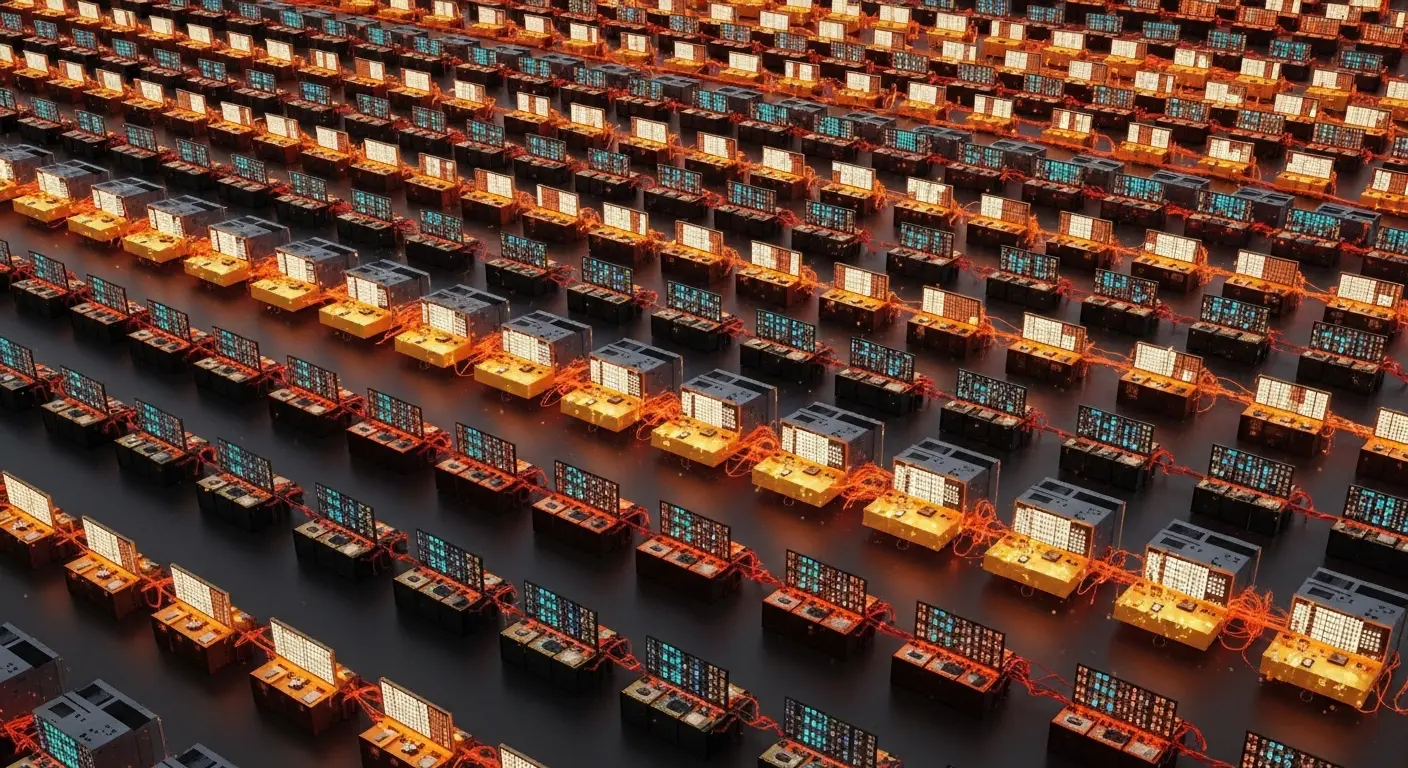
Scientists at the NVIDIA Corporation, have developed a new, artificial intelligence-based pre-decoder for the surface code that significantly reduces the time required for error correction in quantum computing. Christopher Chamberland and colleagues have created a scalable system that operates in a block-wise parallel fashion, effectively removing the majority of physical errors before they are passed to subsequent processing stages. The architecture achieves end-to-end decoding runtimes of approximately 1 microsecond per round utilising NVIDIA GB300 GPUs. This approach not only accelerates decoding but also demonstrably improves logical error rates, even surpassing existing methods at code distances up to 13. Crucially, the system can learn directly from experimental data, circumventing the need for detailed and often unavailable circuit-level noise models. These results represent a key step towards building a practical and high-throughput decoding framework essential for large-distance quantum computers.
Artificial intelligence accelerates quantum error correction to sub-microsecond speeds
Decoding runtimes for quantum error correction now fall below 1 microsecond per round, establishing a new benchmark for practical quantum computation. This breakthrough is attributable to a scalable, artificial intelligence-based pre-decoder specifically designed for surface codes, which proactively mitigates physical errors before they propagate and corrupt calculations. Previously, achieving such speed presented a substantial obstacle to progress in the field. The surface code is a leading candidate for quantum error correction due to its relatively high threshold for fault tolerance and its suitability for implementation on planar qubit architectures. However, decoding surface codes is computationally intensive, requiring complex algorithms and significant processing power. The integrated pipeline, combining this novel pre-decoder with the established PyMatching decoder, delivers end-to-end performance of order (O(1 μs)) at large code distances using NVIDIA GB300 GPUs. This simultaneously lowers logical error rates. Logical error rates represent the probability of an error occurring in the encoded quantum information, and minimising these rates is paramount for reliable quantum computation.
A larger model, trained with a more extensive dataset, outperformed correlated PyMatching up to a code distance of 13, demonstrating improved performance over existing methods and establishing a clear pathway towards high-throughput quantum processing. Code distance is a critical parameter in quantum error correction, representing the number of physical qubits used to encode a single logical qubit; higher code distances provide greater error protection but also increase the complexity of decoding. The team also developed a noise-learning architecture capable of inferring decoding weights directly from experimental data, thus bypassing the need for detailed, and often inaccurate, circuit-level noise models. This is particularly important as characterising noise in quantum hardware is a challenging task. Utilising multiple GPUs further reduced decoding runtimes to below 1 microsecond per round, demonstrating the potential for parallel processing and significantly faster calculations. The parallel architecture allows for the simultaneous processing of multiple blocks of data, dramatically reducing the overall decoding time. This scalability is crucial for handling the large data volumes associated with high-distance quantum codes.
Rapid error mitigation unlocks potential for scalable quantum computation
Sub-microsecond runtimes represent a key advancement, although scaling this approach to the much larger codes, with distances in the thousands, needed for truly useful quantum computation remains a significant hurdle. Current quantum error correction schemes require a substantial overhead in terms of physical qubits to protect a single logical qubit. Achieving fault-tolerant quantum computation necessitates codes with very high distances, demanding correspondingly large and complex decoding algorithms. The modular decoding framework offers adaptability to varying noise conditions, extending current results to a code distance of 13. This adaptability is achieved through the AI-based learning process, which allows the decoder to adjust its parameters based on the observed noise characteristics of the quantum hardware. This system’s ability to learn from data potentially optimises performance even with imperfect knowledge of hardware flaws, paving the way for more durable quantum systems and reducing the computational burden on global decoders. The pre-decoder effectively filters out a significant portion of the errors locally and in parallel, sharply lessening the computational load on subsequent stages, achieving end-to-end runtimes below one microsecond per round with current hardware. This reduction in computational load is critical for enabling real-time quantum error correction.
Surface codes are now an established method of encoding quantum information to protect it from errors, offering a balance between performance and complexity. The pre-decoder’s architecture is backend-agnostic, meaning it can be adapted to work with different types of quantum hardware and qubit technologies. This flexibility is essential for ensuring the long-term viability of the decoding framework. Furthermore, the modular design allows for easy integration with arbitrary global decoders, providing a versatile and adaptable solution for quantum error correction. The ability to learn directly from experimental data offers a significant advantage, offering adaptability and removing the need for detailed knowledge of hardware imperfections. Future work will focus on scaling this approach to larger code distances and exploring its performance on different quantum computing platforms, bringing us closer to realising the full potential of fault-tolerant quantum computation.
The research demonstrated a new AI-based pre-decoder for surface codes that achieves decoding times of approximately one microsecond per round on NVIDIA GB300 GPUs. This matters because faster decoding is essential for real-time, fault-tolerant quantum computing, reducing the computational burden on subsequent processing stages. The system improves logical error rates up to a code distance of 13 and learns decoding weights directly from experimental data, offering adaptability to different quantum hardware. Authors intend to scale this approach to larger code distances and test it on various quantum computing platforms.
👉 More information
🗞 Fast and accurate AI-based pre-decoders for surface codes
🧠 ArXiv: https://arxiv.org/abs/2604.12841



See today’s quantum computing news on Quantum Zeitgeist for the latest breakthroughs in qubits, hardware, algorithms, and industry deals.



