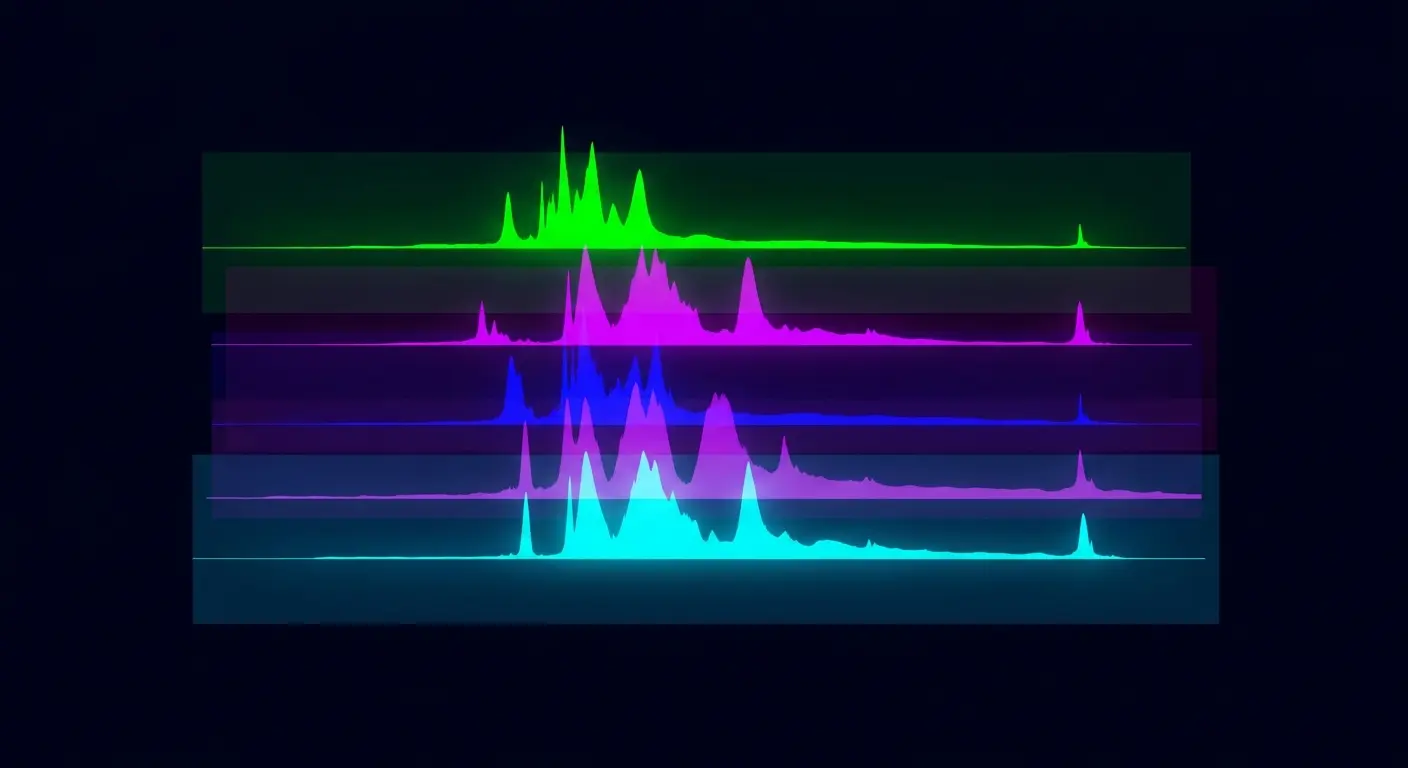
Researchers at the University of Manchester, led by Sion Meredith, have developed a new optimisation framework to improve control of quantum systems susceptible to noise. The framework integrates automatic differentiation with the non-Markovian uniTEMPO algorithm, facilitating the direct optimisation of complex quantum control protocols. Applying this methodology to semiconductor quantum dots and optimising multi-pulse excitation schemes, including Swing-UP of a Quantum EmmiteR (SUPER) and Floquet-engineered Two-Photon Excitation (FTPE), the team achieved high preparation fidelities and consistently surpassed the performance of standard pulse techniques. Critically, the optimised approach demonstrates enhanced thermal stability, offering a promising route towards more reliable quantum technologies operating in realistic conditions.
Adiabatic rapid passage enhances fidelity and thermal stability in quantum dot control
Single-exciton state fidelities reached 99.66%, representing a subtle yet significant improvement over the 99.63% achieved using standard two-pulse techniques. This advancement, enabled by the integration of adiabatic rapid passage (ARP) and the novel optimisation framework, overcomes previous limitations in controlling semiconductor quantum dots. Conventional methods often struggled to consistently exceed 99.6% fidelity due to the pervasive influence of environmental noise, which introduces non-Markovian effects, memory effects that complicate the system’s evolution. The new framework efficiently navigates complex parameter spaces, optimising over 29 independent controls to achieve these results. This was a task previously hindered by laborious manual calculations and the computational cost of exploring such a high-dimensional space. Automatic differentiation allows for the precise calculation of gradients, guiding the optimisation process towards optimal control parameters, while the uniTEMPO algorithm effectively handles the non-Markovian dynamics inherent in these systems.
Optimised protocols exhibit superior thermal durability, consistently outperforming standard resonant pi-pulses and two-photon excitation, particularly at elevated temperatures. This is crucial for practical applications, as maintaining qubit coherence at higher temperatures reduces the need for expensive and complex cryogenic cooling systems. Multi-pulse excitation schemes, specifically SUPER and FTPE, achieved high preparation fidelities for both single- and bi-exciton generation. Integrating adiabatic rapid passage (ARP) systematically enhances both SUPER and FTPE by smoothly transitioning the quantum state, minimising the impact of noise and imperfections during the excitation process. Pulse areas were constrained to a maximum value for both single-excitons and bi-excitons, alongside a spectral overlap limit of 10% with the emitter’s zero-phonon line, to mitigate unwanted scattering and maintain coherence. Scaling the pulse sequence from two to three pulses improved performance, especially for bi-exciton generation, benefiting from the additional control afforded by the three-level system and allowing for more precise manipulation of the quantum state. However, further increases beyond three pulses yielded diminishing returns, likely due to limitations imposed by the phonon bath, the vibrational modes of the crystal lattice, and experimental constraints related to pulse timing and coherence. The phonon bath introduces decoherence, limiting the effectiveness of increasingly complex pulse sequences.
Advancing thermal stability in quantum dot control through optimised manipulation frameworks
Quantum dots, nanoscale semiconductors pivotal for constructing future quantum computers, necessitate increasingly sophisticated techniques to shield them from disruptive environmental noise. These noises include charge fluctuations, nuclear spin interactions, and, importantly, phonon interactions. A powerful optimisation framework, deftly combining automatic differentiation with the non-Markovian uniTEMPO algorithm, has now been demonstrated to refine the manipulation of these delicate systems, achieving high preparation fidelities for single- and bi-excitons and suggesting the potential to build more robust solid-state qubits. The uniTEMPO algorithm is particularly well-suited for handling non-Markovian dynamics because it propagates the system’s density matrix in time without relying on the Markov approximation, which assumes that the system has no memory of its past. Maintaining qubit stability is vital in real-world conditions, and the superior performance at elevated temperatures suggests a pathway towards practical quantum devices less susceptible to thermal instability. Scientists at the University of Sheffield contributed to the development of a method for optimising complex quantum processes with greater efficiency by combining automatic differentiation with the uniTEMPO algorithm, allowing for precise calculation of system response and enabling the exploration of a wider range of control parameters. This approach moves beyond traditional trial-and-error methods, offering a systematic and efficient way to design optimal control protocols.
The significance of this work extends beyond simply achieving higher fidelities. The ability to optimise control protocols in the presence of strong non-Markovian noise is crucial for building scalable quantum computers. As the number of qubits increases, the system becomes more susceptible to noise, and the need for robust control techniques becomes even more pressing. The developed framework provides a versatile tool for optimising a wide range of quantum control tasks, including qubit initialisation, state manipulation, and readout. Future research will focus on extending this framework to more complex quantum systems and exploring its potential for optimising other quantum algorithms. The framework’s ability to account for non-Markovian effects is particularly important for solid-state qubits, which are inherently susceptible to these types of noise. Furthermore, the improved thermal stability demonstrated by the optimised protocols could significantly reduce the cost and complexity of building and operating quantum computers, paving the way for wider adoption of this transformative technology.
The research successfully optimised multi-pulse excitation schemes, including Swing-UP and Floquet-engineered Two-Photon Excitation, for single- and bi-exciton generation in semiconductor quantum dots. This optimisation, achieved by combining automatic differentiation with the uniTEMPO algorithm, yields higher preparation fidelities than standard methods, particularly at elevated temperatures. This demonstrates improved thermal robustness, which is important for building stable quantum devices susceptible to thermal instability. The scientists indicate they will extend this framework to more complex quantum systems and algorithms.
👉 More information
🗞 Efficient optimisation of multi-parameter quantum control protocols for strongly-coupled systems
🧠 ArXiv: https://arxiv.org/abs/2604.19621



See today’s quantum computing news on Quantum Zeitgeist for the latest breakthroughs in qubits, hardware, algorithms, and industry deals.