

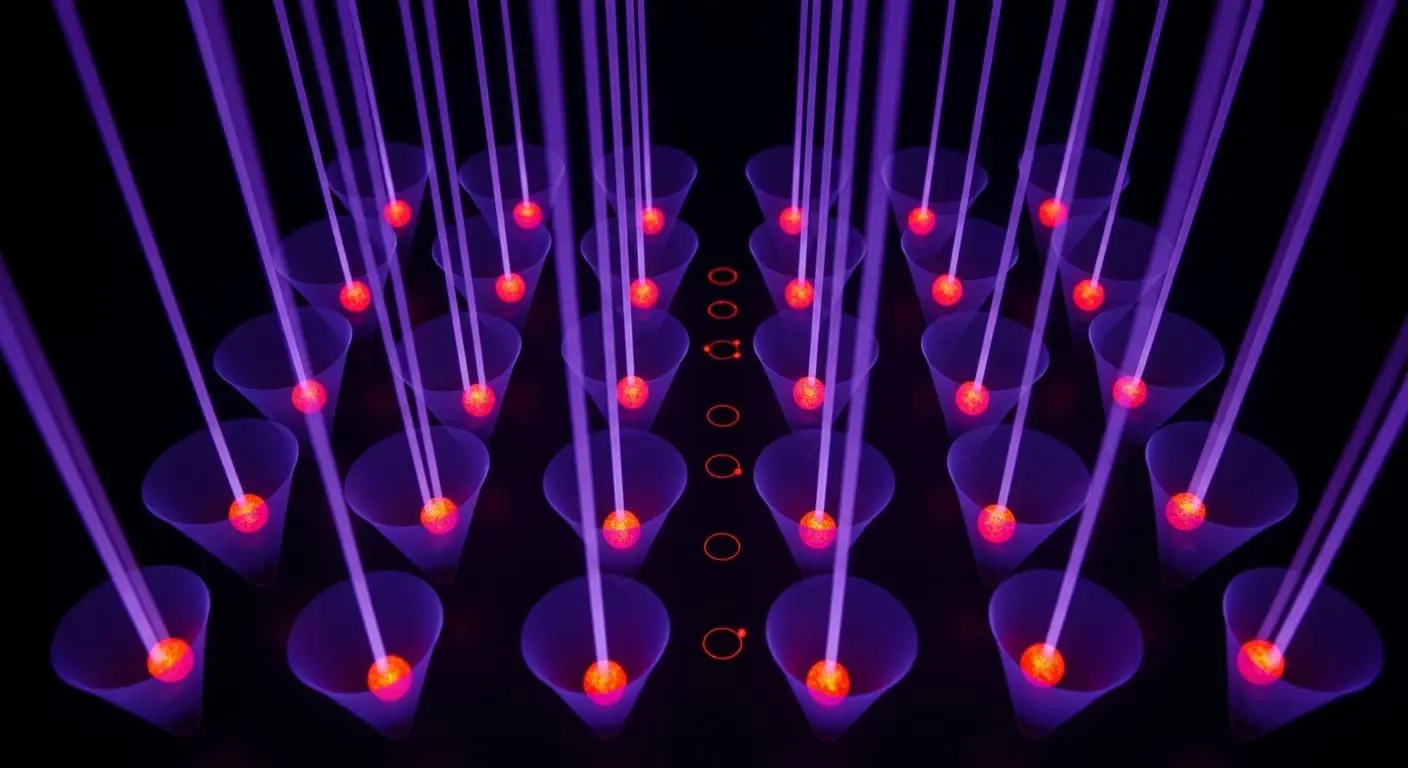
Scientists at Ramakrishna Mission Vivekananda Educational and Research Institute, specifically Akshay Panda and Anwesha Chattopadhyay, have developed a composite theoretical model investigating junctions between two one-dimensional (1D) PXP chains as mechanisms for controlling quantum information exchange. Their work demonstrates that manipulating the constraints at these junctions allows for tunable information insulation, effectively shattering the system’s Hilbert space into distinct fragments and generating a superposition of chaotic energy spectra. The model predicts the existence of a chirally protected zero-energy mode and the emergence of novel Fock states exhibiting spatially tunable thermal regions, potentially paving the way for programmable Rydberg atom platforms designed for advanced quantum control applications.
A crucial aspect of this research lies in the behaviour of a ‘hard wall’, a perfect reflector, positioned at the junction between the PXP chains, initially preventing any quantum information leakage between the two sides. The researchers found that this seemingly impenetrable barrier can be made permeable by deliberately relaxing the constraints applied to the atoms at the junction sites. Introducing multiple ‘frozen junctions’, points of strong constraint, leads to a fragmentation of the Hilbert space into disjoint Krylov fragments. The number of these fragments increases exponentially with the number of engineered defects, offering a high degree of control over the system’s quantum state. Furthermore, the energy level statistics within each symmetry-resolved sector are strictly Poissonian, indicating that the tensor sum of the disjoint Hamiltonians results in a pure superposition of the chaotic spectra inherent to the individual PXP chains. The study also identifies the presence of a chirally protected zero-energy mode, characterised by localised peaks at the physical edges of the system and also within the bulk of the material.
Architectural control of Hilbert space fragmentation using Rydberg atom arrays
Maintaining the delicate quantum state of information is a fundamental challenge in the development of future quantum technologies. A novel approach to information ‘caging’, based on the principle of Hilbert space fragmentation, focuses on creating and sustaining ‘frozen junctions’ between chains of atoms. This technique offers a potential solution to the decoherence problems that plague many quantum systems. David McKay and colleagues at the University of Oxford, in collaboration with Immanuel Bloch’s group at the Max Planck Institute of Quantum Optics, acknowledge that physically realising these stable junctions within a practical Rydberg atom array represents a significant experimental hurdle. The precise control required over individual atom interactions and the maintenance of coherence times are key challenges that need to be addressed.
Programmable Rydberg atom platforms, which utilise optical tweezers to precisely manipulate and arrange individual atoms, offer a promising avenue for physically implementing this ‘caging’ of quantum information. These platforms allow for the creation of custom-designed atomic arrays with tailored interactions. The theoretical architecture proposed by Panda and Chattopadhyay supports the existence of chirally protected zero-energy modes and novel Fock states possessing spatially-defined thermal properties. These features are particularly attractive for quantum information processing, as they offer inherent protection against certain types of noise and allow for the creation of complex quantum states. However, a critical area for future research concerns the long-term durability of these fragmented states and the feasibility of scaling these systems into larger, more complex quantum systems capable of performing meaningful computations. Understanding the effects of imperfections and environmental noise on the stability of the junctions is paramount.
Manipulating constraints at junctions between one-dimensional PXP chains allows for the creation of tunable barriers, effectively ‘caging’ quantum states and inducing the formation of Krylov fragments. Fragmentation of a quantum system’s Hilbert space, which represents the complete set of all possible states the system can occupy, provides a powerful route to isolate and protect quantum information from external disturbances. The detailed model developed by the researchers describes two 1D PXP chains joined by a junction that functions as a kinematic barrier to quantum information exchange. The permeability of this barrier is controlled by relaxing the constraints applied to the atoms at the junction sites, and the introduction of multiple junctions leads to the fragmentation of the Hilbert space into disjoint Krylov fragments. Specifically, the model predicts the creation of 51 such fragments under certain conditions. These tunable barriers are created through this process, with the number of junctions directly determining the degree of fragmentation and, consequently, influencing the size and isolation of the resulting quantum states. The PXP chain itself is a well-studied model in condensed matter physics, known for its interesting many-body properties and its potential for realising exotic quantum phases. The ‘PXP’ designation refers to the pattern of particle-hole-particle excitations that dominate the low-energy behaviour of the chain.
The chirally protected zero-energy mode identified in the model is particularly noteworthy. Chirality refers to the property of being non-superimposable on its mirror image, and protection implies that the mode is robust against certain types of perturbations. This mode could serve as a robust channel for quantum information transfer, as its properties are insensitive to local disturbances. The novel Fock states with spatially tunable thermal regions offer further possibilities for manipulating and controlling quantum information. Fock states are quantum states with a definite number of particles, and the ability to control their spatial distribution of energy opens up new avenues for designing quantum devices. The implications of this research extend beyond fundamental quantum physics, potentially impacting fields such as quantum computing, quantum simulation, and the development of novel quantum materials. Further investigation into the practical realisation of these theoretical concepts within Rydberg atom arrays is crucial for unlocking their full potential.
The research demonstrated that a composite chain model, built from two constrained PXP chains, creates a barrier to quantum information exchange. Relaxing constraints at the junctions between these chains allows control over this barrier and fragments the system into as many as 51 isolated quantum states. This fragmentation means the system’s energy levels follow predictable Poissonian statistics, and a protected zero-energy mode was identified which may offer a robust channel for quantum information transfer. The authors suggest further work focuses on realising these findings using Rydberg atom platforms.
👉 More information
🗞 Tunable information insulation induced by constraint mismatch
🧠 ArXiv: https://arxiv.org/abs/2604.00732




See today’s quantum computing news on Quantum Zeitgeist for the latest breakthroughs in qubits, hardware, algorithms, and industry deals.



