The persistent challenge of dissipating energy from quantum systems, essential for maintaining coherence and enabling complex computations, typically demands precise knowledge of the system’s internal structure. However, recent research published in a leading physics journal demonstrates a counterintuitive approach to cooling, achieving energy reduction via randomised measurements without requiring detailed system characterisation. This work, conducted by Josias Langbehn, George Mouloudakis, and Giovanna Morigi from Freie Universität Berlin, alongside Igor Gornyi of Karlsruhe Institute of Technology, Emma King and Raphaël Menu from Saarland University, Yuval Gefen of the Weizmann Institute of Science, and Christiane P. Koch also of Freie Universität Berlin, details a protocol utilising a reservoir of ancillary qubits – termed ‘meter’ qubits – to induce cooling through sequential interactions. The study, entitled ‘Universal cooling of quantum systems via randomised measurements’, reveals that by carefully controlling the interactions and energy levels of these meter qubits, a system can be effectively cooled irrespective of its inherent properties, offering a potentially versatile framework for quantum control and information processing.
The pursuit of quantum control necessitates efficient cooling mechanisms, and researchers continually refine techniques to remove energy from quantum systems. Recent investigations demonstrate cooling occurs even without detailed prior knowledge of a system’s properties, challenging conventional approaches that rely on precise spectral analysis. Traditionally, cooling quantum systems demands intimate knowledge of their energy levels to selectively remove energy. However, scientists now explore methods mimicking natural cooling processes, utilising reservoirs of ‘meter’ qubits initialised in their ground state to establish a cooling mechanism based on interaction rather than detailed system knowledge.
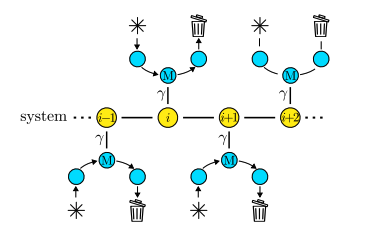
This innovative approach employs a reservoir of “meter” qubits, which sequentially interact with the target system before being discarded, effectively mimicking measurement without retaining the measurement results. A qubit, short for quantum bit, is the basic unit of quantum information. These meter qubits act as intermediaries, absorbing energy from the target system through interaction. Researchers discovered cooling occurs when interactions between the system and meter qubits, alongside the energy level spacing of the meters, are randomly selected, offering a significant advantage for cooling complex systems where detailed spectral information is unavailable or difficult to obtain. The universality of this protocol suggests broad applicability in engineering, controlling, and manipulating matter far from equilibrium, particularly benefiting advancements in information processing and quantum technologies.
Scientists are also investigating phenomena deviating from standard
Scientists are also investigating phenomena deviating from standard thermal behaviour, such as anti-thermalization, where cooling can paradoxically induce heating, challenging established understandings of thermodynamics. This counterintuitive behaviour arises in specific, highly controlled quantum systems and requires a nuanced understanding of energy transfer mechanisms. They are developing scalable protocols to enhance cooling efficiency and improve quantum system control, including exploring the role of entanglement – a quantum phenomenon where particles become linked and share the same fate – and feedback mechanisms to stabilise and manipulate quantum states.
Current investigations highlight the importance of understanding open system dynamics, where interactions between a quantum system and its environment play a crucial role. The environment introduces noise and decoherence, processes that degrade quantum information. Researchers have found that under conditions of weak interaction strength and extended interaction times, the rotating wave approximation holds true. This approximation simplifies calculations by neglecting rapidly oscillating terms, ensuring that energy-exchange processes favour cooling and opening possibilities for designing more efficient and robust cooling systems. It allows for a more tractable mathematical description of the energy transfer, facilitating the development of practical cooling strategies.
🗞 Universal cooling of quantum systems via randomized measurements
🧠 DOI: https://doi.org/10.48550/arXiv.2506.11964