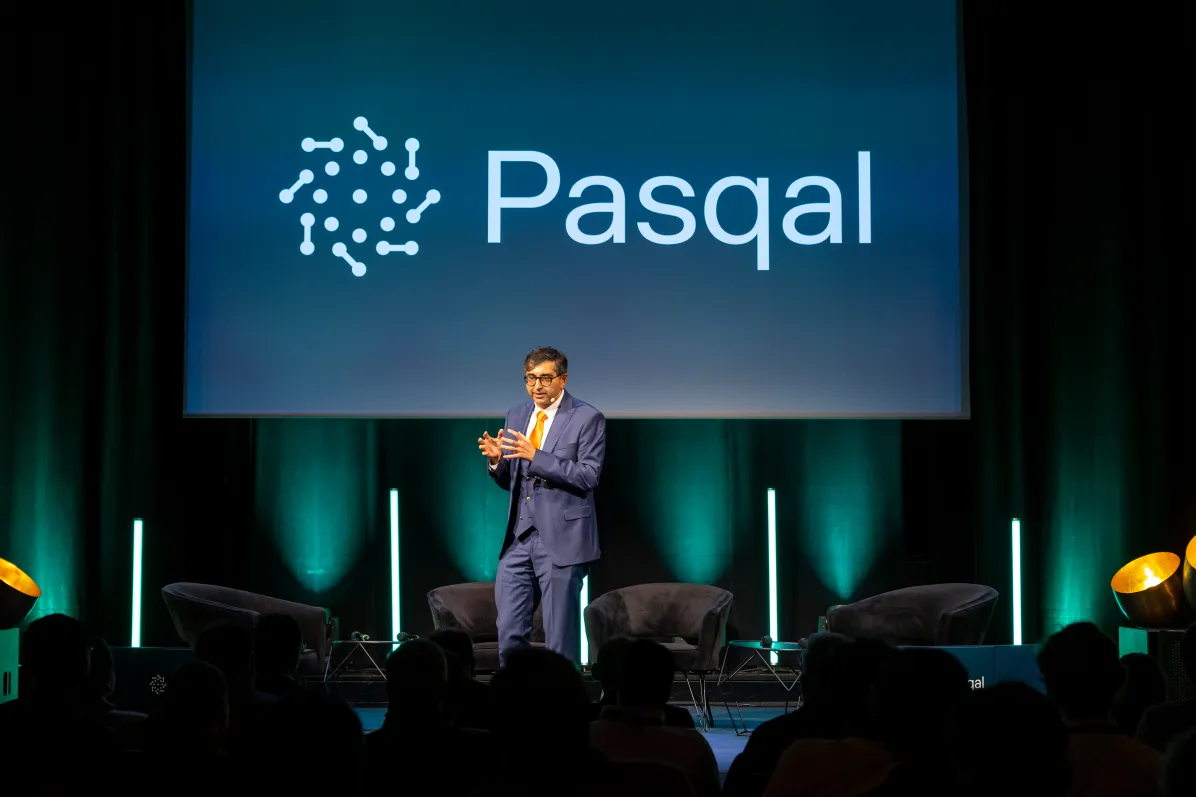
More than 150 leaders from over 10 countries gathered in Paris on World Quantum Day to discuss a shift in quantum computing. Pasqal, a neutral-atom quantum computing company, hosted the event to highlight the technology’s move toward practical application and integration with existing high-performance computing systems. The company detailed achievements expected in 2025, including demonstrations of “logical qubits,” a crucial step beyond simply increasing qubit count and toward building stable, error-corrected computers. Pasqal is also preparing to become a publicly traded company through a business combination with Bleichroeder Acquisition Corp., signaling growing investor confidence in its commercial viability. “The conversations at Pasqal Thoughts 2026 make one thing clear: quantum computing is no longer a technology of the distant future; it is becoming an operational tool for solving real business, industrial, and scientific challenges today,” said Wasiq Bokhari, CEO of Pasqal.
Pasqal Thoughts 2026: Quantum Computing’s Shift to Deployment
The half-day gathering brought together representatives from industry, research institutions, and government agencies to discuss integrating quantum capabilities into existing high-performance computing ecosystems. This concentrated international effort underscores a growing consensus that the era of theoretical quantum promise is giving way to tangible applications. Pasqal leveraged the event to highlight advancements beyond simply increasing qubit counts; the company demonstrated “logical qubits” in 2025, a critical step towards building stable, error-corrected quantum computers. This achievement addresses a longstanding challenge in the field, moving beyond raw computational power to focus on reliability and accuracy. Sessions detailed how these developments are impacting diverse sectors, with financial institutions like Crédit Agricole CIB exploring quantum solutions for portfolio optimization and fraud detection. “Partnering with Pasqal has shown us that quantum computing is already relevant to concrete financial use cases, from credit-risk monitoring to portfolio optimization,” said Pierre Dulon, Global Head of the Technology Sector at Crédit Agricole CIB.
Neutral-Atom Processors Integrated with HPC Infrastructure
The convergence of quantum computing and traditional high-performance computing (HPC) took center stage at the recent Pasqal Thoughts 2026 event in Paris, signaling a shift from purely theoretical research toward practical application. This integration isn’t simply about adding quantum capabilities; it’s about creating hybrid workflows where quantum processors accelerate specific tasks within larger classical computations. A key focus was the High-Performance Computer and Quantum Simulator (HPCQS) hybrid project, a collaborative effort between European HPC centers GENCI and CINECA, co-funded by the European HPC Joint Undertaking and Italy’s Ministry of University and Research. This initiative demonstrates a commitment to building infrastructure that can seamlessly utilize both quantum and classical resources, further underscoring its trajectory toward scaling operations and wider deployment.
The conversations at Pasqal Thoughts 2026 make one thing unequivocally clear: quantum computing is no longer a technology of the distant future; it is becoming an operational tool for solving real business, industrial, and scientific challenges today.
Wasiq Bokhari, CEO of Pasqal
Crédit Agricole CIB & Industry Quantum Use Case Examples
Pasqal’s annual “Pasqal Thoughts” event in Paris served as a focal point for demonstrating the expanding practical applications of quantum computing, attracting over 150 leaders from ten nations on World Quantum Day. Beyond theoretical advancements, the gathering highlighted collaborative efforts to integrate quantum processors into existing high-performance computing ecosystems, showcasing a shift toward tangible results. The event featured discussions on how quantum approaches could revolutionize portfolio optimization, derivatives pricing, and fraud detection, demonstrating a focused effort to address real-world challenges. Leaders from Thales, EDF, and the Links Foundation presented active experiments, ranging from satellite constellation mission planning to energy systems optimization and telecommunications resource allocation.
As we work alongside supercomputing centers, global enterprises, and research institutions, we are building the foundation for large‑scale, practical quantum computing that we believe will transform entire sectors over the coming decade.
Wasiq Bokhari, CEO of Pasqal
Quantum-Classical Convergence: QRMI & Hybrid Architectures
A key focus of the event was the development of interfaces allowing quantum processors to work seamlessly alongside classical supercomputers. Paco Martin of IBM detailed progress on the Quantum Resource Management Interface (QRMI), designed to orchestrate quantum resources from multiple architectures alongside classical clusters and AI accelerators within environments like SLURM, creating what the company terms a “quantum-centric supercomputing environment.” This convergence isn’t merely about adding quantum capabilities; it’s about building a cohesive system where each component contributes optimally to complex calculations. The event underscored the growing synergy between quantum computing and artificial intelligence, with discussions exploring how emerging hybrid architectures can unlock new approaches to complex computational challenges.
Partnering with Pasqal has shown us that quantum computing is already relevant to concrete financial use cases, from credit-risk monitoring to portfolio optimization.
Pierre Dulon, Global Head of the Technology Sector at Crédit Agricole CIB




See today’s quantum computing news on Quantum Zeitgeist for the latest breakthroughs in qubits, hardware, algorithms, and industry deals.