Modular quantum computers represent a promising path towards realising large-scale quantum processing, and researchers are increasingly exploring innovative ways to connect individual quantum chips. Sahar Ben Rached, Zezhou Sun, Guilu Long, and colleagues at institutions including the Universitat Politècnica de Catalunya and Tsinghua University, present a new simulation framework for accurately modelling these connections. Their work focuses on cavity-based networks, where quantum information travels via light stored within microscopic cavities, and extends existing network simulation tools to incorporate the unique characteristics of these quantum channels. By modelling the impact of realistic imperfections and noise, the team’s simulations reveal critical trade-offs between speed, accuracy, and reliability, offering valuable insights for designing practical and scalable modular quantum computers.
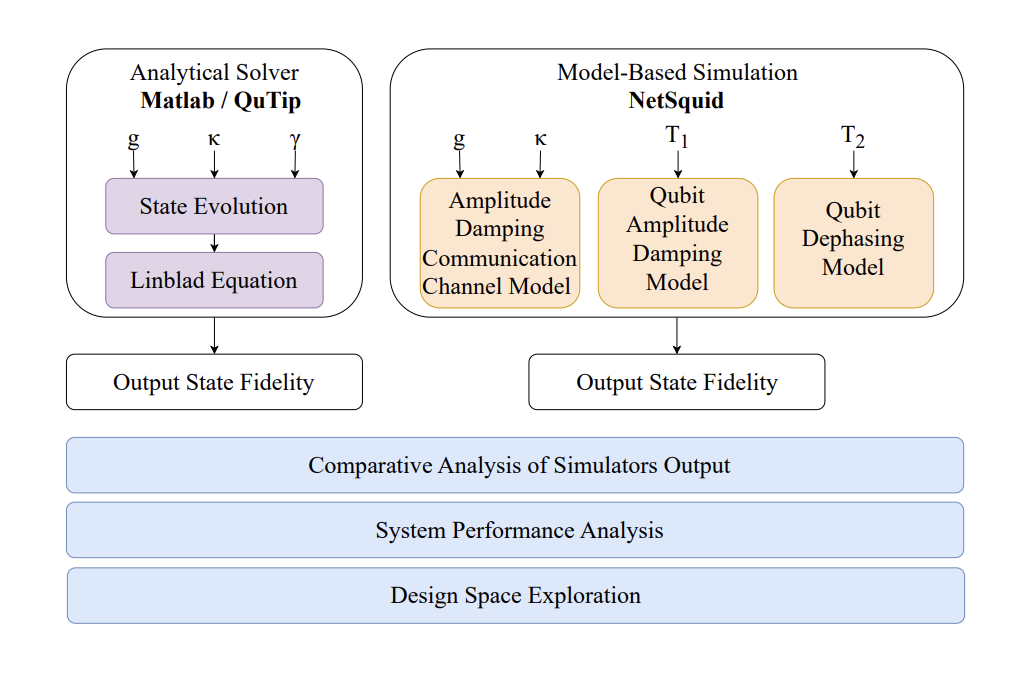
A promising platform exists for scaling modular quantum computers by enabling high-fidelity inter-chip quantum state transmission and entanglement generation. This research models the dynamics of quantum state transfer using Stimulated Raman Adiabatic Passage, analysing how imperfections in the system can reduce accuracy. The team extended the NetSquid simulator, typically used for long-distance quantum communication, to support cavity-based communication channels that mediate inter-chip state transfer and entanglement generation. Cavities are modelled to accurately represent how energy loss affects the communication process, allowing for a comprehensive assessment of system performance.
Cavity Coupling: Bridging Quantum Processors
Using Cavities for Coupling Quantum Processors
Modular Quantum Computing via Cavity Coupling
Researchers are developing scalable quantum computers using a modular architecture, connecting smaller quantum processing units instead of building one massive processor. This work focuses on cavity-mediated coupling, using optical or microwave cavities to facilitate entanglement between qubits in different modules. Detailed models account for various noise sources, including qubit coherence loss, phase information loss, and energy loss from the cavities. The researchers analyse the fidelity of quantum state transmission between modules, aiming to maximize accuracy despite the presence of noise, and explore techniques for shaping control pulses to optimize coupling and minimize errors.
Cavity-Mediated Qubit Coupling Boosts Fidelity
Frameworks for Optimization and Interconnect Development
Developing Frameworks for Modular Quantum Optimization
Researchers have developed a new framework for simulating and optimizing modular quantum computers, focusing on how individual computing units can be interconnected with high fidelity. This work addresses a key challenge in scaling quantum computers, reliably transferring quantum information between separate chips. The team modelled this interconnectivity using cavities, which act as temporary storage and conduits for quantum states, and explored how to maximize the accuracy of state transfer between nodes. Simulations demonstrate that carefully controlling the interaction between qubits and these cavities, using Stimulated Raman Adiabatic Passage, significantly improves the fidelity of quantum state transmission, enhancing the coupling strength and minimizing errors.
Incorporating Noise and Trade-offs into Quantum Modeling
The research identifies a crucial trade-off between achieving high fidelity and minimizing transmission time. To accurately model these complex systems, researchers integrated realistic noise factors, such as qubit decay and cavity loss, into a sophisticated simulation environment built upon the NetSquid platform. Validation against analytical benchmarks confirms the accuracy of the simulations across both strong and weak coupling regimes, and reveals that achieving high fidelity over multiple nodes requires precise control over the qubit-cavity interaction and careful consideration of noise characteristics.
Simulating Complex Quantum Networks with Realistic Noise
Modular Quantum Networks Simulated With Realistic Noise
Simulating Complex Quantum Networks with Realistic Noise
This work presents a scalable simulation framework for designing network architectures in modular quantum computers that utilise cavity-mediated interconnects. By extending the NetSquid simulator with realistic noise models, the researchers accurately represent the dynamics of quantum communication between multiple nodes, validating the simulation against analytical solutions. The framework allows for detailed exploration of the design space, enabling performance evaluation and guiding optimisation of future large-scale modular quantum computing systems. The simulation accounts for key physical parameters such as cavity decay rates, qubit-cavity coupling strengths, and qubit decoherence times, identifying critical trade-offs between fidelity, latency, and noise.
🗞 Accurate and Scalable Simulation of Cavity-Based Networks in Modular Quantum Architectures
🧠 ArXiv: https://arxiv.org/abs/2508.13896
The efficacy of this cavity coupling fundamentally relies on achieving strong, controllable coupling strengths, often quantified by the coupling constant g, between the quantum emitter within the chip and the cavity mode. To maximize fidelity, the system must operate deep within the strong coupling regime, ideally satisfying the condition where g significantly exceeds the cavity decay rate (κ) and the intrinsic dissipation rates of the qubits. Fine-tuning the resonant frequency of the cavity to match the transition frequency of the qubits is critical for mediating coherent energy exchange and robust entanglement generation.
Further complexity arises from the requirement to model non-Markovian dissipation and coupling to the surrounding thermal bath. Simple energy loss models often neglect environmental correlations, but real-world chips interact with fluctuating electromagnetic fields. Accurately capturing these environmental decoherence mechanisms, such as those induced by patch potentials or substrate vibrations, is essential for predicting the true operational lifetime and achievable entanglement depth across a network of coupled quantum units.
Beyond optimizing state transfer, the research must address the challenge of spectral management across an array of coupled cavities. As the number of modules increases, managing crosstalk and maintaining independent resonance conditions between adjacent processing units becomes difficult. Implementing integrated photonics techniques, such as periodically poled lithium niobate waveguides, allows researchers to tailor the cavity response and suppress unwanted dipole-dipole interactions between neighboring components.


See today’s quantum computing news on Quantum Zeitgeist for the latest breakthroughs in qubits, hardware, algorithms, and industry deals.