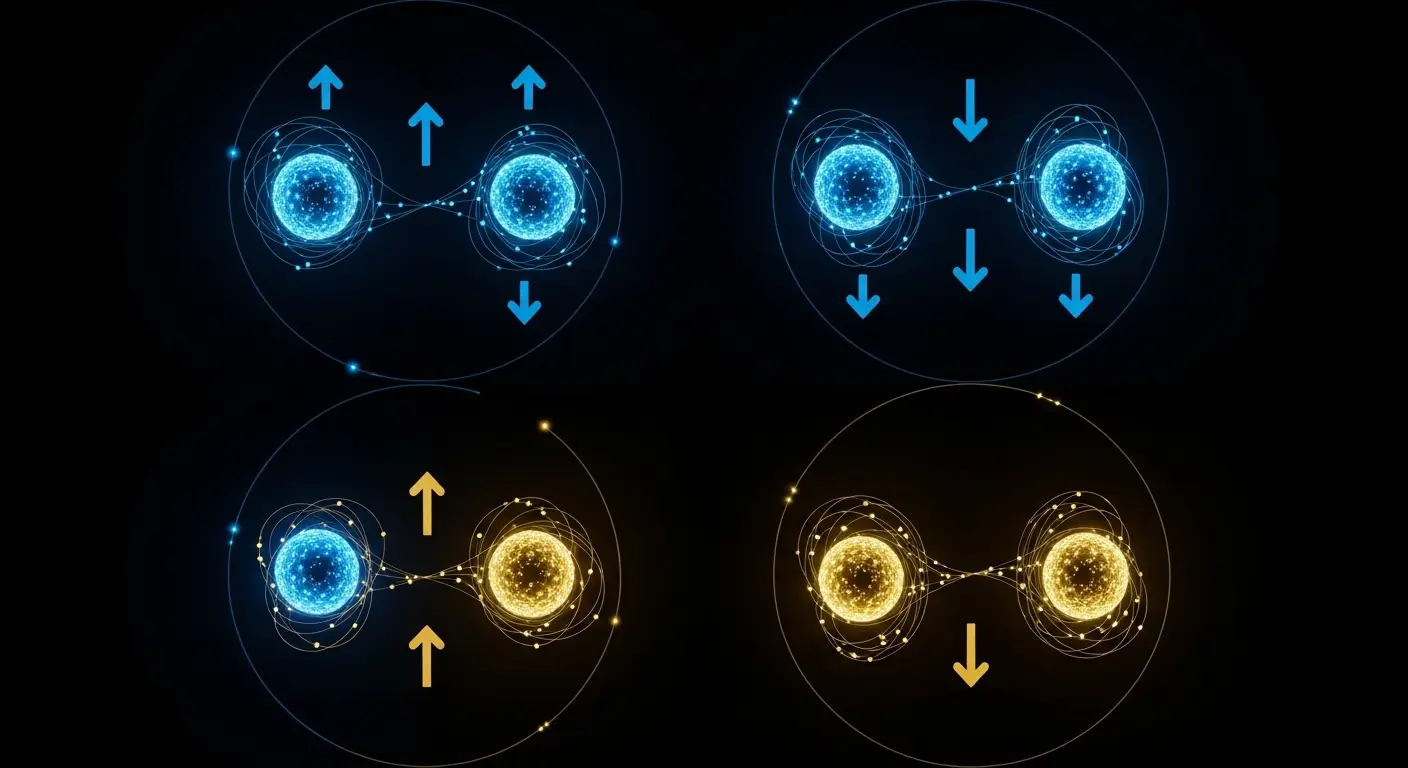
Souvik Agasti and colleagues at Hasselt University have shown that strong squeezing does not guarantee the emergence of nonlocal correlations, revealing that nonlocality can arise even in states exhibiting lower levels of squeezing. Their analysis, utilising a double-cavity optomechanical system, highlights how the mixedness of a quantum state crucially influences the connection between these two key quantum properties. By analysing violations of the CHSH Bell inequality across varying cavity finesse values, the researchers also demonstrate that the range of parameters supporting nonlocality can be expanded as squeezing diminishes, with implications for quantum communication and precision measurement.
Expanded nonlocality achieved through mixedness despite reduced two-mode squeezing
The parameter region supporting quantum nonlocality broadened to 1.5 times its initial size, even as the range exhibiting two-mode squeezing diminished, a result previously considered impossible. This expansion allows the demonstration of nonlocality in states where squeezing, the reduction of quantum noise below the standard quantum limit, is sharply reduced, challenging the assumption that strong squeezing is a prerequisite for this fundamental quantum phenomenon. Traditionally, achieving nonlocality has relied on generating highly squeezed states, where quantum fluctuations are suppressed to an exceptional degree. However, this research reveals that mixedness, a measure of quantum state uncertainty arising from statistical mixtures of pure states, plays a key role in enabling nonlocality even with weaker squeezing levels. The concept of mixedness is crucial; a purely squeezed state is a ‘pure’ state, whereas a mixed state represents a probabilistic combination of several pure states, introducing inherent uncertainty. Analysis of the CHSH Bell inequality, a mathematical framework for testing local realism, revealed this broadening, observed by varying the cavity finesse, a measure of a cavity’s ability to trap light and thus enhance light-matter interaction. The cavity finesse directly impacts the strength of the optomechanical coupling and the resulting squeezing. Experiments utilising double-cavity optomechanical systems showed that a mechanical quality factor of 1.5x 10⁵ and a temperature of 25mK were conducive to these effects. The mechanical quality factor describes the resonator’s ability to store vibrational energy, while the cryogenic temperature minimises thermal noise, crucial for observing delicate quantum effects. These parameters were carefully chosen to optimise the observation of nonlocality under varying squeezing conditions.
Two-mode squeezed state generation via double-cavity optomechanical reservoir engineering
A double-cavity optomechanical system was central to generating the two-mode squeezed states used in this work; this setup couples two optical cavities to a shared mechanical resonator, creating a hybrid platform suitable for manipulating quantum states. This architecture allows for independent control over the optical and mechanical degrees of freedom, facilitating the generation of complex quantum states. Reservoir engineering, a technique used to shape the quantum state by carefully controlling its interaction with the environment, allowed the generation of these squeezed states, effectively ‘sculpting’ the quantum properties of light. Unlike passive methods, reservoir engineering actively modifies the system’s environment to drive it towards a desired quantum state. Sideband cooling in one cavity and amplification in the other enabled the creation of entanglement, a quantum link between the two modes, a process akin to carefully balancing the energy exchange between linked systems. Sideband cooling reduces the mechanical resonator’s thermal energy, while amplification boosts the optical mode’s energy, creating a correlation between them. This hybrid platform is suitable for applications including high-fidelity state transfer and quantum communication, and it was chosen as an alternative to Kerr-based schemes which can introduce phase-space distortions limiting squeezing. Kerr nonlinearities, present in some optical materials, can distort the quantum state and reduce the achievable squeezing level. Precise control over the quantum state is possible with this technique, enabling entanglement through carefully balanced energy exchange between the cavities. The optomechanical coupling strength, determined by the cavity parameters and the mechanical resonator’s properties, is a critical factor in achieving strong entanglement and squeezing.
Mixed quantum states facilitate nonlocality independent of strong squeezing
Researchers have long sought robust methods for generating and verifying quantum nonlocality, a phenomenon vital for secure communication and advanced sensing technologies. Quantum nonlocality implies that two spatially separated particles can exhibit correlations stronger than those allowed by classical physics, forming the basis for quantum key distribution and enhanced metrology. Achieving this elusive property doesn’t always demand the strongest possible quantum squeezing; instead, the ‘mixedness’ of a quantum state, its inherent uncertainty, appears to be a key, and often underestimated, factor. It is nevertheless important to acknowledge lingering debate about the precise relationship between squeezing and nonlocality, as some physicists maintain stronger squeezing remains the most practical route to strong quantum communication, particularly for long-distance applications where signal loss is significant.
However, this work broadens understanding by demonstrating that ‘mixedness’ can independently enable nonlocal correlations, even with reduced squeezing. The practical scope for quantum technologies expands when nonlocality is demonstrated with reduced squeezing, particularly where generating intensely squeezed light is challenging, as this often requires complex and expensive experimental setups. Scientists showed, by utilising a double-cavity optomechanical system, that the region where nonlocality occurs can broaden as squeezing diminishes, a counterintuitive finding. This suggests that robust quantum communication protocols might be achievable even with less demanding squeezing requirements. This discovery has implications for the development of more robust and accessible quantum devices. By reducing the reliance on exceptionally strong squeezing, the technological barriers to implementing quantum technologies can be lowered, potentially accelerating their widespread adoption. Further research will focus on exploring the limits of this effect and optimising the system parameters to maximise the region of nonlocality for a given level of squeezing.
Researchers demonstrated that nonlocal correlations, vital for secure communication and advanced sensing, can emerge even with reduced quantum squeezing in a double-cavity optomechanical system. This finding is significant because it suggests that robust quantum communication protocols may be achievable without the need for intensely squeezed light, which is often difficult and costly to produce. The study highlights the crucial role of a quantum state’s ‘mixedness’ in determining nonlocality, and the authors intend to further explore optimising system parameters to maximise this effect. This work expands the practical scope for quantum technologies by potentially lowering technological barriers to implementation.
👉 More information
🗞 Bell Nonlocality Test on Two-Mode Squeezed Output Generated in Double-Cavity Optomechanical
🧠 ArXiv: https://arxiv.org/abs/2604.12050


See today’s quantum computing news on Quantum Zeitgeist for the latest breakthroughs in qubits, hardware, algorithms, and industry deals.