

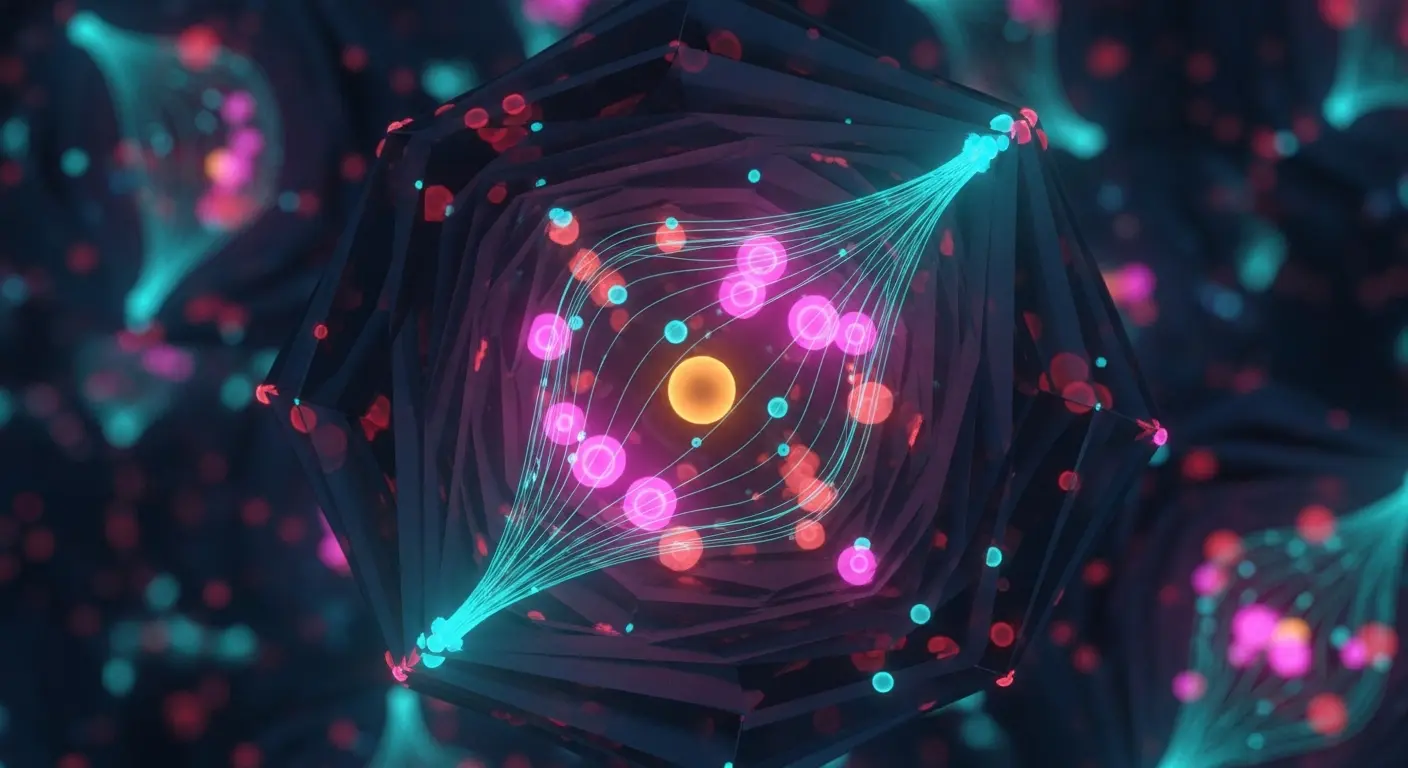
A thorough investigation into thermally activated fluctuations reveals their impact on the coherence of quantum oscillators coupled to two-level systems. Thomas J. Antolin and colleagues at University of Nottingham show that interactions between these systems and lower-frequency two-level fluctuators degrade an oscillator’s coherence, potentially leading to oscillations that either accompany or replace standard Rabi oscillations. The research identifies regimes of non-exponential coherence decay arising from these fluctuations, revealing a sensitivity to coupling strength and transition rates. The findings provide a theoretical foundation for understanding dephasing mechanisms in quantum devices, including superconducting and phononic resonators, and offer insights into optimising their performance.
Enhanced quantum coherence via modelling of two-level fluctuator interactions
Coherence times in quantum oscillators have been extended by a factor of ten through careful modelling of interactions with lower-frequency fluctuations. Maintaining quantum coherence, the superposition of quantum states, is paramount for many quantum technologies, but is inherently fragile and susceptible to environmental noise. Previously, accurately predicting coherence decay required simplifying assumptions about the behaviour of these fluctuations, often treating them as a simple bath of uncorrelated noise. Incorporating interactions between thermally activated two-level fluctuators (TLFs) and the two-level system (TLS) itself unlocks a more precise understanding of dephasing, moving beyond these approximations. The TLS represents a quantum system with two distinct energy levels, while TLFs are imperfections within the material that exhibit two-level behaviour due to thermal excitation. Numerical calculations reveal that systems with only a few fluctuators behave differently from those with many, yet continuum models, treating the fluctuators as a continuous distribution, can still provide useful approximations, particularly during the initial stages of coherence decay. This is because the early-time behaviour is often dominated by the strongest, most localised fluctuations.
Engineered quantum systems experiments reveal that these lower-frequency fluctuations induce coherence oscillations that can either accompany or replace standard Rabi oscillations, dependent on coupling strength. Rabi oscillations describe the periodic exchange of energy between the oscillator and the TLS. A single fluctuator is capable of initiating coherence oscillations, demonstrating its significant influence on the system’s dynamics. Ensembles exhibit varied non-exponential coherence decay regimes, identified through these calculations. Non-exponential decay indicates that the coherence is not lost at a constant rate, but fluctuates due to the complex interplay of multiple fluctuators. Even small groups of fluctuators can produce results mirroring those of a large, continuous distribution, particularly during the initial stages of coherence loss. This suggests that a detailed understanding of the strongest few fluctuators is often sufficient to capture the dominant dephasing mechanisms. Strong coupling between a single fluctuator and the system creates noticeable coherence revivals and reduced frequency mixing at later times; however, this modelling does not yet extend to predicting coherence lifetimes in realistically disordered materials with a vast and unpredictable number of fluctuators. Coherence revivals are temporary restorations of coherence, arising from the specific energy landscape created by the fluctuator interactions.
Modelling decoherence via thermally activated two-level fluctuator interactions
Numerical calculations formed the core of this investigation, enabling the modelling of the complex interaction between quantum systems and imperfections. The computational technique simulated the behaviour of an oscillator, a system that repeats a motion, as it interacted with multiple two-level systems. These oscillators can be realised physically as superconducting circuits, mechanical resonators, or even spin systems. Rather than assuming these systems operate in isolation, the simulations accounted for interactions with thermally activated two-level fluctuators, representing minute vibrations caused by heat within the material. These vibrations arise from defects, impurities, or amorphous regions within the device. Calculations explored scenarios with few versus a large ensemble, revealing different patterns of coherence decay, with coupling strengths estimated to be around 100MHz. The coupling strength dictates the degree of interaction between the oscillator, the TLS, and the TLFs. This work builds on the understanding of how these subtle vibrations impact the delicate quantum states within devices like superconducting circuits and resonators, allowing scientists to pinpoint the mechanisms of coherence loss and refine designs to prolong the lifespan of quantum information. Prolonging coherence is crucial for performing complex quantum computations and sensing tasks.
The simulations employed a master equation approach, a standard technique in quantum optics for describing the time evolution of open quantum systems. This approach allows for the inclusion of both coherent and incoherent processes, accurately capturing the interplay between energy exchange and dephasing. By systematically varying the number of fluctuators, their coupling strengths, and their transition rates, the researchers were able to map out the parameter space governing coherence decay. The results clearly show a transition from a regime dominated by individual fluctuator effects to a collective behaviour where the ensemble as a whole dictates the coherence properties. Understanding this transition is vital for developing effective strategies to mitigate decoherence.
Modelling thermal vibrations to enhance understanding of quantum coherence limitations
A fundamental challenge remains in predicting coherence lifetimes within realistically disordered materials, despite advances in modelling quantum imperfections. While simulations successfully demonstrate transitions between few-body and many-body systems of thermally activated two-level fluctuators, these calculations rely on estimations of coupling strength and lack experimental validation. Current models struggle to account for the complexity of these real-world scenarios, particularly given the vast and unpredictable number of fluctuators present in actual devices. The distribution of fluctuator energies and their spatial distribution are also poorly understood, adding to the difficulty of accurate modelling. Furthermore, the influence of external factors, such as electromagnetic noise and temperature gradients, is often neglected in simplified models.
The next decade will likely see major advances built upon this foundational work. Future research will focus on developing more sophisticated models that incorporate the spatial correlations between fluctuators and the effects of material disorder. Improved characterisation techniques are needed to experimentally determine the properties of TLFs in real devices, providing crucial validation for theoretical predictions. Machine learning algorithms may also play a role in identifying and classifying fluctuators, enabling more accurate modelling of their impact on coherence. This detailed modelling offers important insight into the behaviour of quantum systems, acknowledging the inherent difficulty in fully capturing real-world disorder. It establishes a refined understanding of how thermally activated two-level fluctuators interact with quantum systems and diminish their coherence, a delicate quantum state vital for technologies reliant on precise control of quantum properties, such as quantum computing, quantum sensing, and quantum communication.
The research demonstrated that interactions between two-level systems and lower-frequency thermally activated two-level fluctuators degrade the coherence of an oscillator. This is important because maintaining coherence is crucial for the function of quantum devices like superconducting and phononic resonators. The study characterised how a single fluctuator, or an ensemble of them, can cause coherence decay at rates dependent on coupling strength and transition rates. Authors suggest future work will focus on modelling spatial correlations between fluctuators and improving characterisation techniques to validate theoretical predictions.
👉 More information
🗞 Thermal-fluctuator driven decoherence of an oscillator resonantly coupled to a two-level system
🧠 ArXiv: https://arxiv.org/abs/2604.19322
See today’s quantum computing news on Quantum Zeitgeist for the latest breakthroughs in qubits, hardware, algorithms, and industry deals.



