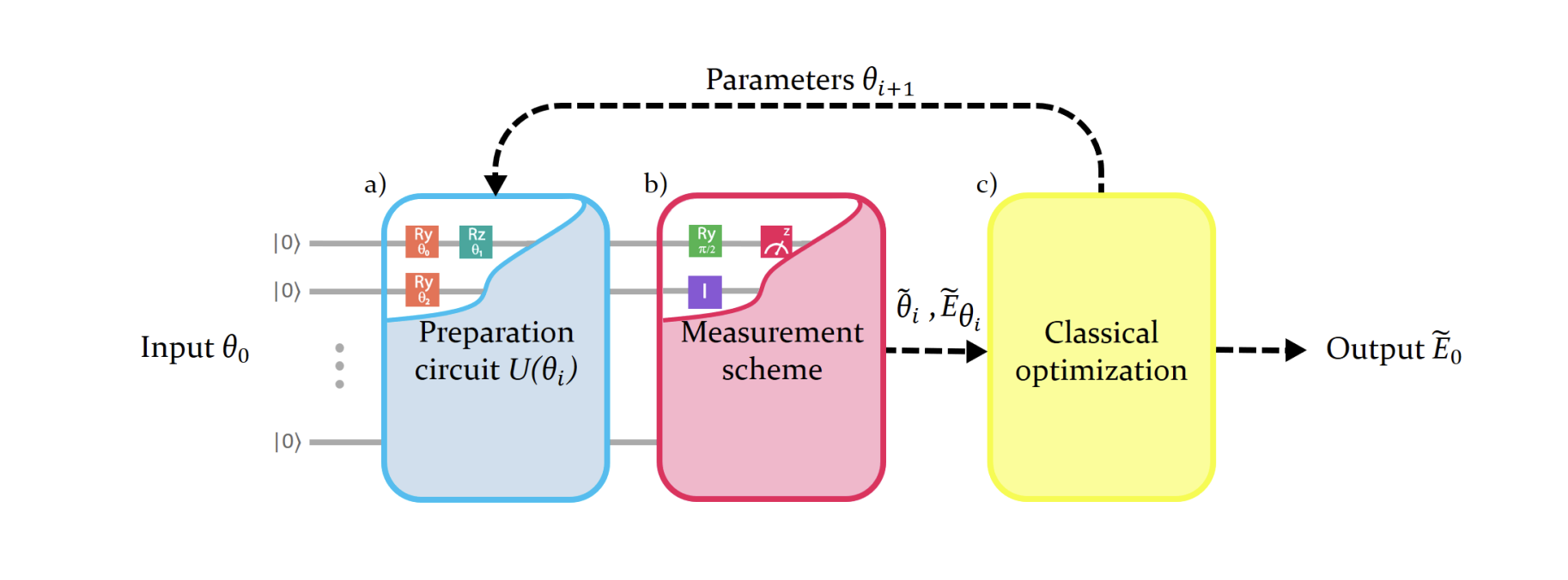
Variational Quantum Eigensolver (VQE) represents a promising pathway towards realising practical quantum computation, but its performance is hampered by challenges such as noise and difficult optimisation landscapes. Ijaz Ahamed Mohammad, Yury Chernyak, and Martin Plesch, from the Institute of Physics and Matej Bel University, address this issue by focusing on improving the classical optimisation component of VQE. Their work introduces HOPSO, a modified version of Harmonic Oscillator-based Particle Swarm Optimisation, specifically designed to handle the periodic nature of the parameters within VQE and to resist the effects of noise. Testing HOPSO on molecular hydrogen and lithium hydride, the team demonstrates that it achieves competitive accuracy in calculating ground-state energies and significantly outperforms existing classical optimisation methods, particularly when simulating realistic noisy conditions, suggesting a viable route towards scaling VQE to tackle more complex systems.
This approach models each potential solution as a particle undergoing damped motion, guiding it towards promising solutions while preventing indefinite oscillation through a damping factor that reduces movement over time. A key innovation is the introduction of random time sampling, encouraging broader exploration of the solution space, and a threshold amplitude, ensuring particles continue exploring even when approaching potential solutions to prevent them from getting stuck in local optima. This provides a robust balance between exploring new possibilities and exploiting promising ones. This work demonstrates that a carefully tailored classical optimizer can significantly improve performance and scalability, addressing limitations in current VQE implementations by focusing on the classical component responsible for refining quantum calculations. This algorithm, originally developed for classical optimization problems, was adapted to address the specific demands of VQE, accounting for the cyclical nature of quantum parameters and the inherent noise present in quantum measurements.
HOPSO was modified to respect parameter periodicity and maintain stability even with noisy data, allowing it to explore the parameter space more effectively. To test their approach, the researchers applied the modified HOPSO algorithm to simulate the behavior of hydrogen and lithium hydride molecules, encoded as quantum systems with four and eight quantum bits, respectively, and compared its performance against widely used classical optimizers under both ideal and noisy conditions. The results consistently demonstrated that HOPSO achieved competitive accuracy and exhibited greater robustness and reliability, particularly with the more complex lithium hydride molecule and realistic levels of quantum noise. VQE aims to calculate the ground state energy of molecules, but its success relies on effectively navigating complex computational landscapes. Standard optimization methods often struggle with the unique characteristics of quantum systems, particularly the periodic nature of quantum parameters and the inherent noise present in quantum measurements.
HOPSO was adapted to account for this periodicity
HOPSO was adapted to account for this periodicity and maintain stability even with noisy data, allowing it to explore the solution space more effectively. Evaluations on hydrogen and lithium hydride molecules, encoded as quantum problems with 4 and 8 quantum bits respectively, demonstrate HOPSO’s advantages. The results indicate that HOPSO’s physically-inspired dynamics are well-suited to navigate the complex and noisy landscapes characteristic of VQE optimization, achieving competitive ground-state energy approximations and improved robustness against local minima and cost-function noise compared to other classical optimizers. These findings support the idea that revisiting classical optimization methods grounded in physical principles can benefit quantum-classical hybrid algorithms. The study highlights the value of algorithmic robustness in VQE, particularly when dealing with realistic noise conditions and limited resources. Future research will focus on developing adaptive versions of HOPSO, exploring strategies for co-designing quantum and classical components, and integrating the algorithm with error mitigation and ansatz adaptation techniques on actual quantum hardware.
🗞 HOPSO: A Robust Classical Optimizer for VQE
🧠 ArXiv: https://arxiv.org/abs/2508.13651