More than 500 global leaders have signaled a growing shift in their approach to quantum AI, with uncertainty around practical applications now outweighing concerns about implementation costs. The SAS survey reveals this reversal from 2025 findings indicates organizations are moving beyond assessing affordability to demanding demonstrable value from the emerging technology. Experts anticipate quantum hardware will be production-ready by the early 2030s, creating urgency for exploration now. “Organizations of all sizes are eager to develop intellectual property – their original, patented approach to quantum AI – so they’ll be ready as the technology comes of age,” said Bill Wisotsky, Principal Quantum Architect at SAS, reflecting a desire for proactive preparation despite cautious investment.
2026 SAS Survey Reveals Quantum AI Adoption Barriers
Uncertainty over practical applications now eclipses cost as the primary hurdle to adopting quantum AI, according to a new survey of over 500 global leaders conducted by SAS. SAS surveyed leaders across diverse industries to gauge sentiment surrounding quantum AI, a field involving the execution of machine learning algorithms on existing quantum hardware, potentially accelerating tasks from hours to minutes. The 2026 survey identified a clear ranking of adoption barriers, with “uncertainty around practical, real-world uses” taking the lead, followed by “high cost of implementation,” “lack of trained personnel,” and “lack of knowledge or understanding.” Limited availability of solutions and regulatory ambiguity also presented challenges. SAS positions quantum AI as a spectrum bridging classical and quantum computing, envisioning hybrid approaches where each excels; this allows organizations to leverage the strengths of both paradigms. Despite strong interest, Wisotsky notes leaders are proceeding cautiously, wary of substantial investments without guaranteed returns.
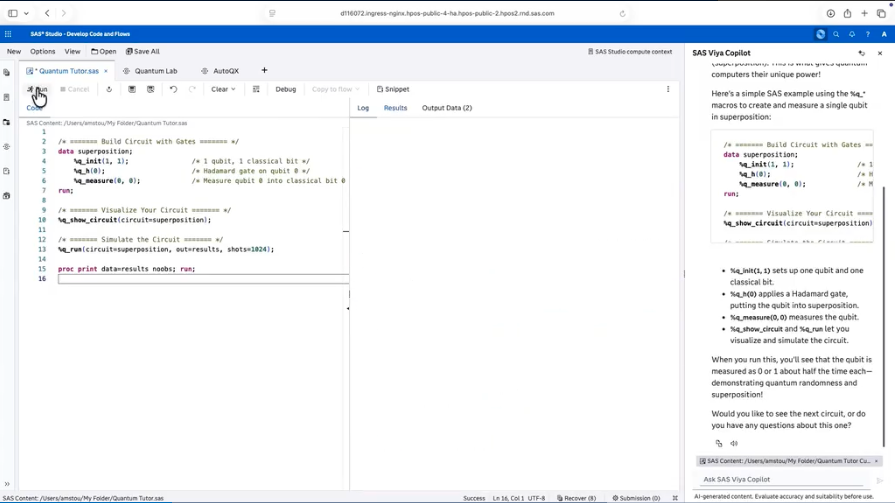
SAS aims to address these concerns with SAS Quantum Lab, a forthcoming tool for SAS Viya customers designed to lower the barriers to entry and facilitate real-world exploration. “This survey illuminates what SAS experts were already seeing in the market: that leaders are excited to use quantum, but the barriers to entry have been too high, and that requires a solution,” explained Amy Stout, Head of Quantum Product Strategy at SAS. Early testing of the lab demonstrates performance boosts exceeding 100 times speedup and 99% cost savings, alongside a virtual tutor to accelerate learning and guide innovation.
SAS Quantum Lab: Lowering Costs for Quantum Exploration
Quantum computing remains largely experimental, yet interest in harnessing its potential is demonstrably high; over 500 global leaders participated in a recent SAS survey examining adoption barriers and potential applications. While initial hurdles centered on the expense of implementation, the primary concern has shifted significantly. The latest findings reveal that “uncertainty around practical, real-world uses” now surpasses cost as the biggest obstacle, indicating a maturing conversation focused on demonstrable value rather than affordability alone. This shift underscores the need for accessible tools that bridge the gap between theoretical promise and tangible results. The lab aims to reduce the financial and technical barriers currently hindering wider adoption, offering a platform for both quantum experts and those new to the field. The lab will allow users to compare classical, quantum, and hybrid approaches side-by-side, identifying optimal solutions for specific business challenges.
A virtual quantum AI tutor will further accelerate learning, providing guidance and sample code. Respondents to the SAS survey outlined a diverse range of potential applications, from enhancing fraud detection in financial services to optimizing 5G network traffic and accelerating drug discovery.
This survey illuminates what SAS experts were already seeing in the market: that leaders are excited to use quantum, but the barriers to entry have been too high, and that requires a solution.
Amy Stout, Head of Quantum Product Strategy at SAS
Quantum AI Use Cases: From Fraud Detection to NLP
The potential applications driving this interest are diverse, ranging from bolstering financial security to accelerating scientific discovery. Survey respondents highlighted a desire to enhance fraud detection systems, enabling the identification of complex transaction patterns with greater efficiency. Beyond finance, organizations envision quantum AI optimizing 5G network traffic in real-time, accelerating molecular simulations for drug development, and refining supply chain logistics. Machine learning workflows also stand to benefit, particularly in predictive modeling and the training of large language models for natural language processing tasks, potentially reducing optimization time and resource demands. “If you’re ready to explore quantum AI, we’re ready to work with you,” added Wisotsky, inviting collaboration to determine valuable, safe, and sensible applications of the technology.
Organizations of all sizes are eager to develop intellectual property – their original, patented approach to quantum AI – so they’ll be ready as the technology comes of age.
Bill Wisotsky, Principal Quantum Architect at SAS



See today’s quantum computing news on Quantum Zeitgeist for the latest breakthroughs in qubits, hardware, algorithms, and industry deals.