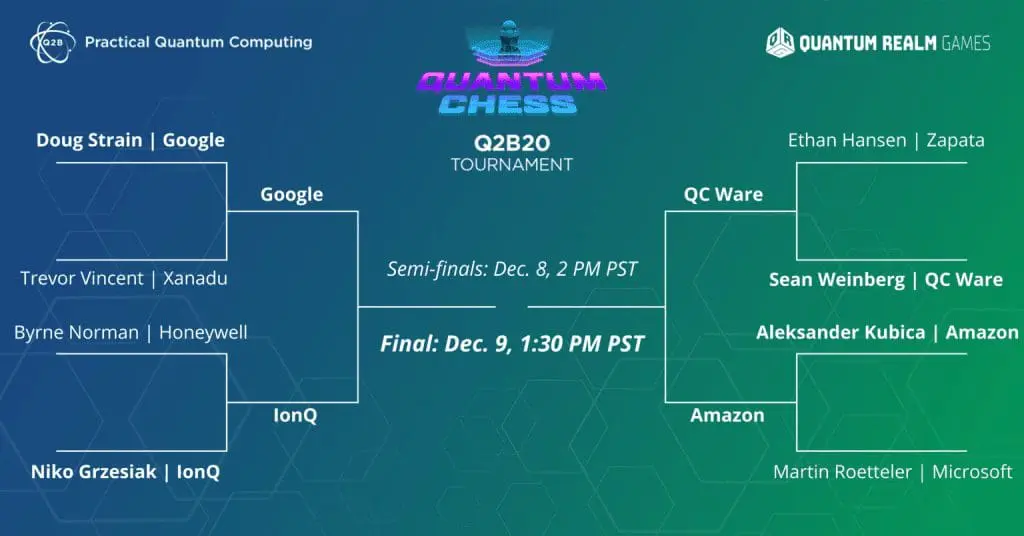
Recently, Q2B and Quantum Realm started a quantum chess tournament. The participants include Google, Honeywell, Zapata, and many other companies sending representatives to play the new game of quantum chess. It will last until December 8, 2 PM PST.
If you are familiar with the game of chess, then quantum chess will be news to you. Drawing from the rules of quantum physics and classical chess, the game offers a new and unique twist to what many call an already mentally taxing game.
Designed by Quantum Realm, quantum chess does not require players to have a PhD. in quantum physics, though it does entail knowledge of quantum states and more. Quantum chess uses the same pieces as standard chess, though this is where differences start appearing. Pieces are on more than one board, due to the concept of superposition, for example.
Superposition allows a chess piece to be in more than one state at the same time, or more than one square occupied by the piece.
All non-pawn pieces can split and merge with the rules in mind, occupying two squares at once or merging together again. Merge moves cannot capture opponent pieces, however. This brings further complexity to the game.
When a move targets a square occupied by a different type and color, the game will measure and determine if some squares are occupied or empty. This makes some of the superposition in play ‘collapse’ so that pieces are longer in that state. Measurements are designed to answer a yes or no question. Yes means that the move is performed, and no means no action is taken. The next player will be free to move then.
Capturing also requires taking superposition in mind, and measurement will be used to determine if that is possible. Even if the answer is no, it does not mean that path is blocked. The attacking piece is also not absent.
Exclusion is when a target cannot be captured by the move performed. The game will measure and determine the outcome. In the same way as above, the no answer does not mean the path is blocked, and the target square is not necessarily occupied.
Castling also involves two targets, and measurement will occur for both of them. It cannot be used to capture and is always an exclusion movement.
The game is won when you capture the opponent’s king and ensure that the opponent has no king, either in superposition or otherwise.
Quantum chess is not chess with probability, but a quantum simulation involving superposition and complex amplitudes.
If you would like to watch the tournament games, it is possible to see them being streamed here.
Read more about Quantum Chess with Quantum Realm
Q2B QCAware Original article