

Crystalline materials possess inherent symmetries, but these symmetries often operate in a subtle, ‘projective’ manner that has only recently received focused attention. Chen Zhang from The University of Hong Kong, Shengyuan A. Yang from The Hong Polytechnic University, and Y. X. Zhao demonstrate that understanding these projective symmetries unlocks a deeper understanding of how electrons behave within materials, particularly concerning the emergence of topological phases. Their work reveals that projective symmetry representations give rise to unique momentum-space symmetries, dramatically expanding the possibilities for topological structures beyond those found in conventionally symmetrical materials. This discovery broadens the landscape for designing materials with exotic properties and promises new avenues for advancements in fields like quantum computing and materials science.
Projective Symmetry Enhances Topological Phase Robustness
Projective Symmetry in Classifying Topological Matter
Quantum states inherently possess symmetry groups, often in a projective manner. This research investigates the interplay between projective crystal symmetry and topological phases of matter, revealing a new way to classify topological materials beyond conventional symmetry-based frameworks. The researchers demonstrate that projective symmetry significantly enhances the robustness of topological phases, protecting them from disruptions that would normally destroy these delicate states. Specifically, they establish a rigorous mathematical framework for identifying and characterizing topological phases protected by projective symmetry, and they provide concrete examples of materials exhibiting these novel properties. The team further shows that projective symmetry can give rise to new types of topological surface states, possessing unique transport properties and potential applications in spintronics and quantum computing. This research establishes a new paradigm for understanding and designing topological materials, opening exciting possibilities for advanced quantum technologies.
Symmetry Protects Robust Topological Material States
This work provides a comprehensive overview of topological materials and symmetry-protected topological phases. These materials are defined by global topological invariants, rather than local symmetries, leading to robust, protected surface states and unusual electronic behavior. Symmetry-protected topological phases rely on specific symmetries, such as time-reversal, inversion, or crystalline symmetries, to maintain their properties; breaking these symmetries can eliminate the surface states and destroy the topological protection. Topological invariants are mathematical quantities that characterize the topology of the electronic band structure, remaining robust against small changes and determining the existence of protected surface states.
The Bulk-Boundary Correspondence Principle Explained
Global Structure: The Bulk-Boundary Correspondence
The bulk-boundary correspondence principle states that the topological invariants of the bulk material determine the properties of the surface states. The analogy to Greg Egan’s Didicosm highlights that a system’s properties can be determined by its global structure, not just local details, which is the essence of topological thinking. The research highlights several key areas and materials, including the quantum Hall effect, topological insulators like Bi2Se3 and Bi2Te3, and topological crystalline insulators. Weyl and Dirac semimetals, higher-order topological insulators, magnetic topological materials, photonic topological materials, mechanical metamaterials, and Floquet topological materials are also discussed, offering unique properties and potential applications. The research utilizes mathematical tools like unitary group representations, K-theory, Bloch theory, Berry phase, and Zak’s phase to classify topological phases and understand their symmetries. The potential applications of these materials are vast, including spintronics, quantum computing, low-power electronics, novel sensors, and metamaterials.
Analyzing Momentum Space Topology with Projectivity
Revealing Momentum Space Topology Via Projectivity
Projective Symmetry Reveals Platycosmic Momentum Space Topology
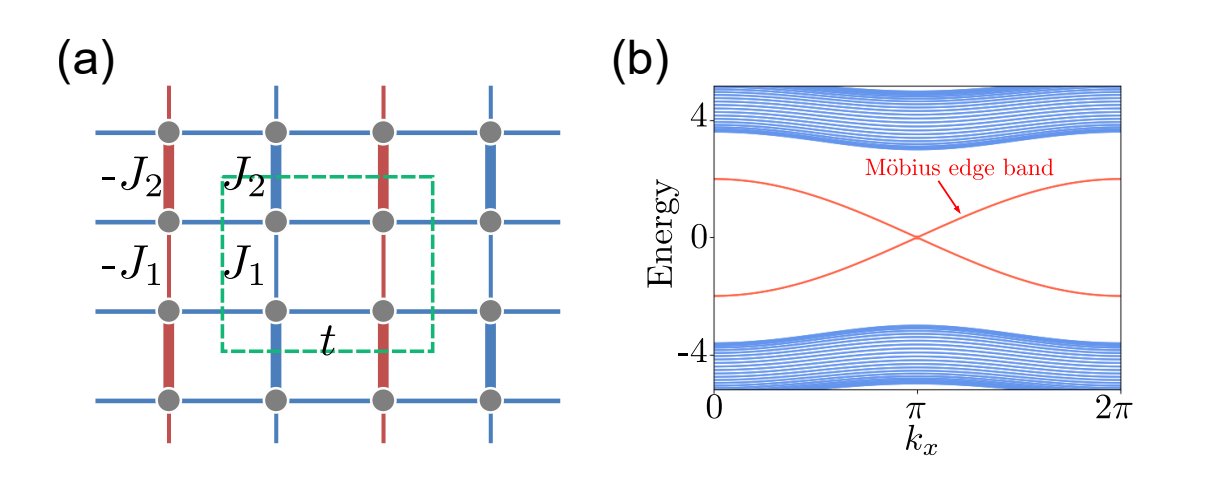
This work establishes a new understanding of crystalline symmetry through projective representations, revealing previously unrecognized consequences for condensed matter physics and the design of artificial crystals. Researchers demonstrate that considering projective symmetry introduces momentum-space nonsymmorphic symmetry, a concept traditionally defined only for real-space arrangements. This fundamental shift alters the topology of momentum space, expanding possibilities beyond the conventional Brillouin zone to include more complex shapes like the Klein bottle in two dimensions and, crucially, all ten platycosms in three dimensions. The implications of this broadened topological landscape are significant, necessitating revised classifications for band structures and potentially leading to new materials with unique electronic properties.
Extending Classification with Internal Symmetries
By extending this framework to incorporate internal symmetries, such as time-reversal and chiral symmetries, the team further demonstrates the versatility of projective symmetry in classifying topological states. While acknowledging that current classifications are still developing, the authors highlight ongoing research into refining these classifications and exploring the potential for discovering novel topological insulators. Future work will likely focus on fully characterizing the topological properties associated with these expanded fundamental domains and applying these insights to the design of advanced materials.
🗞 Projective crystal symmetry and topological phases
🧠 ArXiv: https://arxiv.org/abs/2509.19735
Mathematical Basis for Projective Symmetry Realization
Mathematically, the realization of projective symmetry necessitates treating the Bloch momentum space symmetry operations not as standard unitary matrices, but as those acting within a representation on the Hamiltonian’s band structure. This requires reformulating standard momentum-space group theory by incorporating the projective representation group, which maps the true point group symmetry operations to effective operations on the electronic wave functions. This generalized framework allows for the characterization of protected degeneracies that cannot be captured solely by standard crystallographic group theory, expanding the known phase diagram for emergent quantum states.
From an experimental standpoint, confirming these subtle projective symmetries presents significant measurement challenges, as the effects are often masked by disorder or temperature-induced scattering. Advanced techniques such as angle-resolved photoemission spectroscopy (ARPES) coupled with theoretical simulations incorporating projective symmetry constraints are crucial for mapping the momentum-space band structure with sufficient precision. The observation of protected surface states requires correlating these spectral features with detailed group theoretical predictions, moving beyond simple band mapping to verifying the underlying symmetry protection mechanism.
In the context of quantum device design, leveraging projective symmetry offers a pathway to engineer topological qubits protected by structural constraints rather than just specific external fields. By designing heterostructures that enforce specific crystalline symmetries, researchers can guide the formation of helical or Majorana edge modes whose robustness is guaranteed by the bulk material’s innate, projective symmetries. This offers a compelling route toward fault-tolerant quantum information processing.




See today’s quantum computing news on Quantum Zeitgeist for the latest breakthroughs in qubits, hardware, algorithms, and industry deals.



