

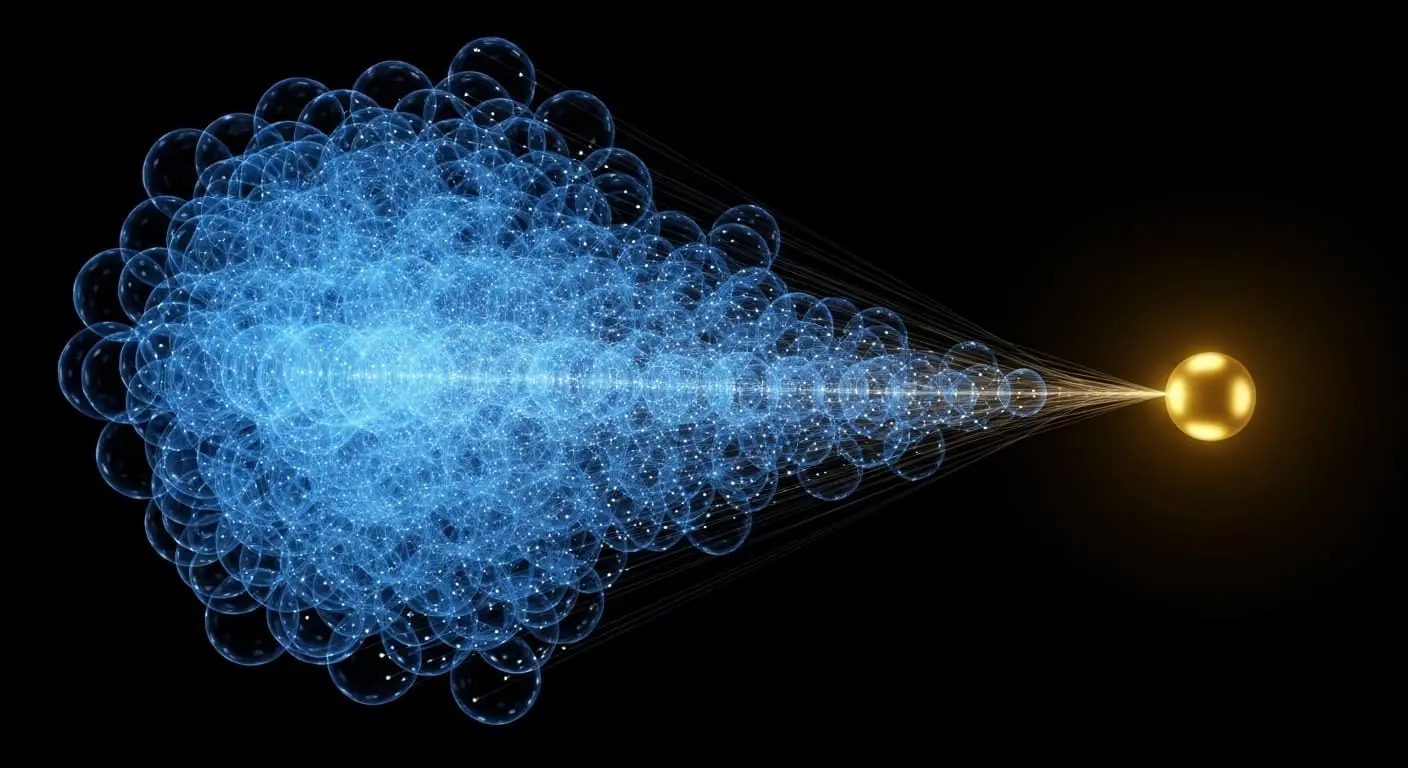
Soumyojyoti Dutta and colleagues at Indian Institute of Technology Jodhpur present the phase quantum walk, a new method for distributing arbitrary graph states using only basic two-qubit resources. The approach overcomes the limitations of previous techniques, which were largely restricted to generating GHZ states, and offers a unified framework for measurement-based quantum communication and modular quantum computing. Theoretical analysis demonstrates optimal fidelity independent of the coin operator and noise, and hardware validation on an IBM quantum processor achieved high-fidelity distribution, reaching 0.924 for a four-qubit GHZ state, across multiple network topologies. These results confirm predictions about the walk’s strong performance and pave the way for more flexible quantum networks.
CZ gate implementation distributes arbitrary graph states via phase kickback
The Phase Quantum Walk, or PQW, functions by utilising a CZ gate, a fundamental operation in quantum computing akin to a switch altering qubit states based on the other’s condition, to move quantum information around a network. Unlike earlier methods reliant on CNOT gates and limited to generating GHZ-type entanglement, the PQW employs this CZ gate as its core ‘shift’ operator, effectively replacing the traditional method of rearranging qubit positions. This subtle change is important, allowing the distribution of any arbitrary graph state, visualised as a network of connected nodes representing entangled qubits, from simple two-qubit resources. Experiments on the IBM Heron r2 processor, a CZ-native system, achieved a fidelity of 0.924 for GHZ4 and 0.922 for L4 graph states, statistically equivalent results verified across up to 4096 outcomes. Utilising a CZ gate instead of conventional CNOT gates allows generation of any arbitrary graph state from basic two-qubit resources, surpassing limitations of previous methods.
Consistent high-fidelity entanglement distribution across diverse quantum network topologies
A fidelity of 0.924 has now been achieved for a four-qubit GHZ state and 0.922 for an L4 graph state, statistically identical results representing a strong improvement over previous methods limited to simpler GHZ-type entanglement. This marks the first experimental confirmation that the reliability of entanglement distribution remains consistent irrespective of network topology, a vital step towards scalable quantum networks. The Phase Quantum Walk, or PQW, enables this by utilising a CZ gate, a fundamental quantum operation, to distribute arbitrary graph states from basic two-qubit resources, bypassing the constraints of earlier techniques.
Entanglement distribution maintains consistent fidelity regardless of network topology, achieving 0.924 for a four-qubit GHZ state and 0.922 for an L4 graph state on the ibm marrakesh processor. This consistency stems from utilising a Phase Quantum Walk, or PQW, which employs CZ gates to distribute entanglement from basic two-qubit resources, bypassing limitations of previous methods restricted to simpler entanglement types. Detailed analysis, including verification across 64 outcomes and simulations with varying noise levels, demonstrated that optimal fidelity is maintained even under depolarising, phase damping, and amplitude damping noise channels. Furthermore, the protocol scales linearly with graph size, requiring a number of qubits and CZ gates proportional to the number of connections, making resource scaling manageable.
Phase Quantum Walks enable high-fidelity distribution of complex multi-qubit graph states
Establishing reliable quantum networks demands more than simply sending entangled particles; it requires distributing complex, multi-qubit entanglement known as graph states, essential for advanced computations. This work introduces a new method, the Phase Quantum Walk, which bypasses previous limitations tied to generating only simpler GHZ states. However, assessing how well this technique scales to significantly larger, more complex systems remains a key challenge for future research.
Demonstrating near-identical fidelity across different graph states on a single quantum processor, IBM’s Heron r2, is a significant step forward. This work creates more complex ‘graph states’ crucial for advanced quantum computing, bypassing limitations of earlier methods which primarily generated simpler entangled states known as GHZ states. The Phase Quantum Walk, a new technique, has been demonstrated for distributing complex entanglement between quantum bits, or qubits.
This method creates ‘graph states’, essential for more powerful quantum computers, bypassing previous limitations on entanglement distribution. Scientists can now distribute arbitrary graph states, complex arrangements of entangled qubits, using only basic two-qubit resources by introducing the Phase Quantum Walk; earlier approaches were largely confined to simpler arrangements. Experimental validation on IBM’s Heron r2 processor confirmed a consistent fidelity of 0.924 for a four-qubit GHZ state and 0.922 for an L4 graph state, irrespective of network topology, a crucial step towards scalable quantum networks.
The research successfully demonstrated the distribution of arbitrary graph states using a new technique called the Phase Quantum Walk. This matters because it overcomes previous limitations in quantum networks, which were largely restricted to generating simpler entangled states. Experiments on the IBM Heron r2 processor achieved a fidelity of approximately 0.92 for both GHZ4 and L4 graph states, confirming the prediction that fidelity remains consistent regardless of graph topology. The authors suggest further work is needed to assess how this method scales with increasing graph size and qubit numbers.
👉 More information
🗞 The Phase Quantum Walk: A Unified Framework for Graph State Distribution in Quantum Networks
🧠 ArXiv: https://arxiv.org/abs/2604.02169


See today’s quantum computing news on Quantum Zeitgeist for the latest breakthroughs in qubits, hardware, algorithms, and industry deals.

