
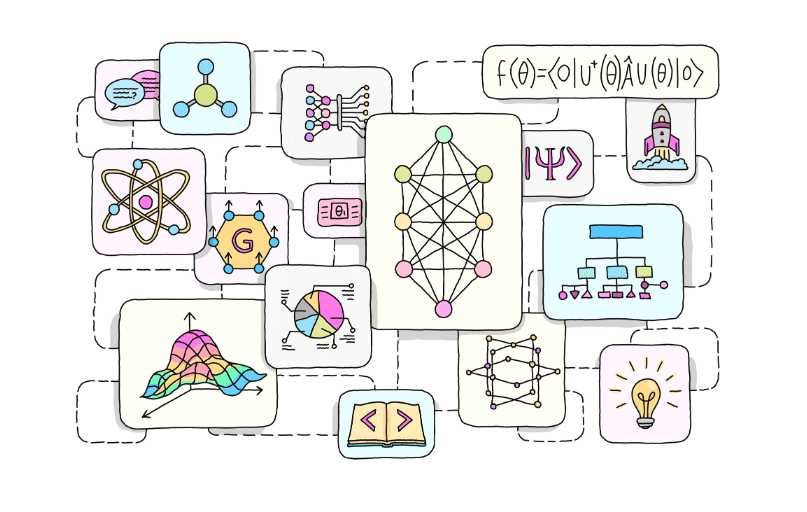
The development of quantum software is progressing beyond simple circuit execution towards modularity and specialized applications. Current efforts prioritize domain-specific languages (DSLs) designed for fields like chemistry, materials science, and finance, aiming to simplify development by abstracting low-level complexities. A significant focus remains on error management, employing both error mitigation techniques to reduce the impact of inaccuracies and, increasingly, error correction methods, despite their computational overhead. Cloud-based platforms are democratizing access to quantum resources, though security and interoperability present ongoing challenges. Standardized benchmarks are crucial for evaluating progress in both hardware and software.
PennyLane, an open-source software framework, exemplifies the integration of quantum machine learning (QML) into the quantum software landscape. It provides an interface for combining quantum and classical computation, enabling developers to build and train hybrid quantum-classical models. This approach is vital because current quantum hardware is not yet capable of running complex machine learning algorithms independently. PennyLane facilitates the development of variational quantum algorithms, such as variational quantum eigensolvers and quantum generative adversarial networks, which are designed to leverage the potential advantages of quantum computation within the constraints of near-term quantum devices.
The co-design of quantum software and hardware is becoming essential, with platforms incorporating QML libraries, quantum simulation tools, and reusable software components. This allows developers to test and debug code on classical computers before deploying it on limited quantum hardware. The future of quantum computing envisions these machines as integral parts of a broader computational ecosystem, requiring ongoing collaboration between hardware and software developers, a commitment to standardization, and the creation of robust, scalable, and user-friendly tools to fully realize the potential of quantum computation.
Quantum Computing Fundamentals
Quantum computing leverages the principles of quantum mechanics – superposition and entanglement – to perform computations fundamentally different from classical computers. Classical computers store information as bits representing 0 or 1. Quantum computers utilize quantum bits, or qubits, which, due to superposition, can represent 0, 1, or a combination of both simultaneously. This allows quantum computers to explore a vastly larger computational space than classical computers, potentially enabling solutions to problems currently intractable for even the most powerful supercomputers. The ability to exist in multiple states concurrently dramatically increases the potential processing power, but also introduces significant challenges in maintaining the quantum state, a phenomenon known as decoherence, which limits the duration of computations. This is because any interaction with the environment can collapse the superposition, forcing the qubit into a definite state, thereby losing the computational advantage.
The principle of entanglement is crucial to quantum computing’s potential. When two or more qubits are entangled, their fates are intertwined, regardless of the physical distance separating them. Measuring the state of one entangled qubit instantaneously determines the state of the others, a correlation that doesn’t exist in classical physics. This interconnectedness allows for the creation of complex quantum algorithms where operations on one qubit can affect the others, enabling parallel processing and the exploration of exponentially large solution spaces. However, creating and maintaining entanglement is extremely delicate, requiring precise control over the qubits and shielding them from environmental noise. The fragility of entanglement is a major obstacle in building practical quantum computers, as any disturbance can break the entangled state and disrupt the computation.
Quantum algorithms, such as Shor’s algorithm for factoring large numbers and Grover’s algorithm for searching unsorted databases, demonstrate the potential speedups offered by quantum computation. Shor’s algorithm, for example, can factor large numbers exponentially faster than the best-known classical algorithms, posing a potential threat to current encryption methods. Grover’s algorithm provides a quadratic speedup for searching unsorted databases, which, while not exponential, is still significant for large datasets. These algorithms rely on the unique properties of quantum mechanics, such as superposition and entanglement, to explore multiple possibilities simultaneously and efficiently find the desired solution. However, implementing these algorithms requires a substantial number of qubits with high fidelity, which is currently beyond the capabilities of existing quantum hardware.
The realization of qubits is a significant engineering challenge, with several different physical systems being explored. Superconducting circuits, trapped ions, photonic qubits, and topological qubits are among the leading candidates. Superconducting qubits, based on the Josephson effect, are currently the most advanced in terms of qubit count and control, but they suffer from decoherence and require extremely low temperatures. Trapped ions offer longer coherence times but are more difficult to scale up. Photonic qubits utilize photons as qubits, offering potential for room-temperature operation and long-distance communication, but they are challenging to control and entangle. Topological qubits, based on exotic states of matter, are theoretically more robust against decoherence, but their experimental realization is still in its early stages. Each approach has its own advantages and disadvantages, and the optimal qubit technology remains an open question.
Quantum error correction is essential for building fault-tolerant quantum computers. Qubits are inherently susceptible to noise and errors, which can corrupt the computation. Quantum error correction codes encode quantum information in a redundant manner, allowing for the detection and correction of errors without destroying the quantum state. These codes require a significant overhead in terms of the number of physical qubits needed to encode a single logical qubit, meaning that a large number of physical qubits are needed to perform a meaningful computation. Developing efficient and scalable quantum error correction codes is a major research challenge, as the overhead can quickly become prohibitive. The effectiveness of quantum error correction depends on the type and rate of errors, as well as the fidelity of the quantum gates used to implement the code.
The development of quantum algorithms is not limited to speedups over classical algorithms; quantum machine learning (QML) is an emerging field that explores the potential of quantum computers to enhance machine learning tasks. QML algorithms aim to leverage quantum phenomena to improve the performance of machine learning models, such as classification, regression, and clustering. Quantum support vector machines, quantum neural networks, and quantum principal component analysis are among the QML algorithms being investigated. These algorithms can potentially offer speedups or improved accuracy compared to their classical counterparts, but they also require significant quantum resources and are still in their early stages of development. The practical benefits of QML remain to be demonstrated, but the field holds promise for revolutionizing machine learning.
Hybrid quantum-classical algorithms represent a pragmatic approach to utilizing near-term quantum computers. These algorithms combine the strengths of both quantum and classical computers, offloading computationally intensive tasks to the quantum computer while relying on the classical computer for control and data processing. Variational quantum eigensolver (VQE) and quantum approximate optimization algorithm (QAOA) are examples of hybrid algorithms used for optimization and quantum chemistry problems. These algorithms are designed to be resilient to noise and can be implemented on near-term quantum hardware with limited qubit count and coherence time. While hybrid algorithms may not offer exponential speedups, they can provide a practical advantage for specific problems and pave the way for more advanced quantum algorithms.
Variational Quantum Circuits Explained
Variational quantum circuits (VQCs) represent a hybrid quantum-classical approach to quantum computation, designed to leverage the strengths of both quantum and classical resources. Unlike universal fault-tolerant quantum algorithms which require substantial qubit counts and error correction, VQCs operate with a relatively small number of qubits and are more resilient to noise, making them suitable for near-term quantum devices. The core principle involves parameterizing a quantum circuit – defining it with adjustable parameters – and then optimizing these parameters using a classical optimization algorithm to minimize a cost function. This cost function is designed to reflect the desired computational task, such as classifying data, solving optimization problems, or simulating quantum systems. The quantum circuit acts as a parameterized quantum feature map, transforming classical data into a quantum state, and the classical optimizer adjusts the circuit parameters to maximize the information extracted from this quantum state for the specific task at hand.
The structure of a VQC typically consists of layers of parameterized quantum gates applied to a set of qubits. These gates, such as rotations around the X, Y, and Z axes (Rx, Ry, Rz), are controlled by the adjustable parameters. The choice of gates and their arrangement within the circuit defines the expressibility of the VQC – its ability to represent a wide range of quantum states. A deeper circuit, with more layers and gates, generally offers greater expressibility but also increases the complexity of the optimization process. The output of the quantum circuit is then measured, and the measurement results are used to evaluate the cost function. The classical optimizer then updates the circuit parameters based on the gradient of the cost function, aiming to minimize its value. This iterative process continues until a satisfactory solution is found, or a predefined convergence criterion is met. The effectiveness of a VQC depends heavily on the choice of the cost function, the circuit architecture, and the optimization algorithm employed.
The optimization process within VQCs presents significant challenges. The cost function landscape is often highly non-convex, meaning it contains many local minima and saddle points. Classical optimization algorithms can easily get trapped in these local minima, preventing them from finding the global minimum, which corresponds to the optimal solution. This phenomenon is known as barren plateau, where the gradient of the cost function vanishes exponentially with the number of qubits, making it difficult to train the circuit effectively. Several techniques have been developed to mitigate these challenges, including the use of different optimization algorithms, such as gradient descent, stochastic gradient descent, and adaptive optimization methods, as well as the incorporation of regularization terms into the cost function to prevent overfitting. Furthermore, careful initialization of the circuit parameters can help to avoid regions of the parameter space where the gradient is small.
The expressibility and trainability of VQCs are closely related. A highly expressive circuit can represent a wide range of quantum states, but it may also be more difficult to train due to the increased complexity of the cost function landscape. Conversely, a less expressive circuit may be easier to train but may not be able to achieve the same level of performance. Finding the right balance between expressibility and trainability is crucial for designing effective VQCs. Techniques such as circuit pruning, where unnecessary gates are removed from the circuit, and circuit compression, where multiple gates are replaced with a smaller number of equivalent gates, can help to reduce the complexity of the circuit without sacrificing too much expressibility. Additionally, the use of hardware-efficient ansatze, which are specifically designed to be implemented on a particular quantum hardware platform, can improve the trainability of the circuit.
The choice of the cost function is paramount in VQC design. For classification tasks, the cost function is often based on the cross-entropy loss, which measures the difference between the predicted probabilities and the true labels. For optimization problems, the cost function is typically based on the objective function that needs to be minimized or maximized. For quantum simulation, the cost function is designed to minimize the difference between the expectation value of a Hamiltonian operator calculated using the quantum circuit and the exact solution. The cost function must be carefully chosen to reflect the desired computational task and to be compatible with the quantum hardware and the classical optimization algorithm. Furthermore, the cost function should be designed to be smooth and differentiable to facilitate the optimization process.
The application of VQCs extends to diverse areas, including quantum chemistry, materials science, and machine learning. In quantum chemistry, VQCs can be used to calculate the ground state energy of molecules, which is a fundamental problem in computational chemistry. In materials science, VQCs can be used to simulate the properties of materials, such as their electronic structure and magnetic properties. In machine learning, VQCs can be used to build quantum classifiers, quantum regressors, and quantum generative models. The potential of VQCs in these areas is significant, but further research and development are needed to overcome the challenges associated with their implementation and to realize their full potential. The development of more efficient optimization algorithms, more expressive circuit architectures, and more robust quantum hardware will be crucial for advancing the field of VQCs.
The integration of VQCs with classical machine learning techniques is a promising avenue for research. Hybrid quantum-classical algorithms, such as the Variational Quantum Eigensolver (VQE) and the Quantum Approximate Optimization Algorithm (QAOA), combine the strengths of both quantum and classical resources to solve complex problems. In these algorithms, the quantum circuit is used to prepare a quantum state that encodes the solution to the problem, and the classical computer is used to optimize the circuit parameters to minimize the cost function. The combination of quantum and classical resources can lead to significant performance improvements over purely classical or purely quantum algorithms. The development of new hybrid quantum-classical algorithms and the optimization of existing algorithms will be crucial for realizing the full potential of VQCs in the era of near-term quantum computing.
Pennylane’s Differentiable Programming
PennyLane’s approach to differentiable programming distinguishes itself through its integration of quantum computation within established machine learning frameworks, enabling the calculation of gradients of quantum circuits with respect to their parameters. This capability is crucial for optimizing quantum algorithms using gradient-based methods, mirroring techniques widely employed in classical machine learning. Unlike traditional quantum simulators which may offer limited differentiability or require manual derivation of gradient formulas, PennyLane automates this process using a technique called the “parameter-shift rule.” This rule efficiently computes gradients by evaluating the quantum circuit with slight parameter perturbations, effectively sidestepping the need for analytical gradient calculations which can become intractable for complex circuits. The implementation relies on a hybrid quantum-classical approach, where quantum computations are performed on a chosen hardware or simulator, and the gradient calculations and optimization are handled by classical computing resources.
The parameter-shift rule, central to PennyLane’s differentiability, is mathematically derived from the properties of quantum gates and their effect on the circuit’s output. Specifically, it leverages the linearity of quantum gates and the fact that the expectation value of an observable is a linear function of the gate parameters. By evaluating the circuit with parameter shifts of +s/2 and -s/2 (where ‘s’ is a shift parameter), the gradient can be approximated as the difference between these two expectation values, scaled by the shift parameter. This method is demonstrably more efficient than methods requiring the computation of the Jacobian matrix, particularly for circuits with a large number of parameters. The accuracy of the approximation depends on the choice of the shift parameter, which must be sufficiently small to maintain the linearity assumption but large enough to avoid numerical instability. PennyLane provides tools for automatically determining an appropriate shift parameter based on the circuit’s structure and the chosen device.
PennyLane’s differentiable programming capabilities extend beyond simple parameter optimization. It supports higher-order derivatives, which are essential for more advanced optimization algorithms like Newton’s method and for performing sensitivity analysis of quantum circuits. Calculating higher-order derivatives is computationally expensive, but PennyLane employs techniques like automatic differentiation and finite difference methods to efficiently approximate these derivatives. Furthermore, PennyLane’s architecture allows for the differentiation of entire quantum workflows, including measurements, post-processing, and classical computations. This holistic approach enables the optimization of complex quantum algorithms that involve both quantum and classical components, facilitating the development of more powerful and efficient quantum machine learning models. The ability to differentiate through measurements is particularly important, as it allows for the optimization of measurement bases and strategies to maximize information gain.
The implementation of differentiable programming in PennyLane is not limited to specific quantum devices or simulators. It supports a wide range of backends, including popular quantum computing platforms like IBM Quantum, Rigetti, and Xanadu, as well as classical simulators like TensorFlow and PyTorch. This flexibility allows users to seamlessly switch between different backends without modifying their code, enabling them to experiment with different hardware and simulation environments. PennyLane’s backend-agnostic design is achieved through a unified interface that abstracts away the details of each backend, providing a consistent programming experience. This abstraction also simplifies the process of porting quantum algorithms to different platforms, reducing the effort required to adapt to new hardware technologies. The modular architecture of PennyLane allows for the easy addition of new backends, ensuring that the framework remains compatible with emerging quantum computing technologies.
PennyLane’s integration with popular machine learning frameworks like TensorFlow and PyTorch is a key aspect of its design. This integration allows users to leverage the existing tools and infrastructure of these frameworks for building and training quantum machine learning models. PennyLane provides custom layers and operations that can be seamlessly integrated into TensorFlow and PyTorch models, enabling the use of gradient-based optimization algorithms for training quantum circuits. This integration also facilitates the use of automatic differentiation tools provided by these frameworks for calculating gradients of quantum circuits. The ability to combine quantum and classical computations within a single model allows for the development of hybrid quantum-classical algorithms that can leverage the strengths of both paradigms. This approach is particularly promising for solving complex machine learning problems that are intractable for classical algorithms alone.
The advantages of PennyLane’s differentiable programming approach extend to variational quantum algorithms (VQAs), a class of hybrid quantum-classical algorithms that rely on optimizing a parameterized quantum circuit. PennyLane’s automatic differentiation capabilities simplify the implementation of VQAs by eliminating the need for manual gradient calculations. This simplification reduces the risk of errors and allows researchers to focus on designing and optimizing the quantum circuit itself. Furthermore, PennyLane’s support for higher-order derivatives enables the use of more advanced optimization algorithms for VQAs, potentially leading to faster convergence and improved performance. The framework’s flexibility and backend-agnostic design make it well-suited for exploring different VQA architectures and hardware platforms. The ability to differentiate through measurements is particularly important for VQAs, as it allows for the optimization of measurement strategies to maximize the accuracy of the results.
PennyLane’s differentiable programming capabilities are not without limitations. The computational cost of calculating gradients can be significant, especially for complex quantum circuits and large datasets. The accuracy of the gradient approximation depends on the choice of the shift parameter and the numerical precision of the computations. Furthermore, the framework’s performance can be affected by the overhead associated with the hybrid quantum-classical architecture. However, ongoing research and development efforts are focused on addressing these limitations through techniques like gradient compression, adaptive shift parameter selection, and optimized hybrid architectures. The framework’s open-source nature and active community contribute to its continuous improvement and expansion of its capabilities.
Hybrid Quantum-classical Algorithms
Hybrid quantum-classical algorithms represent a pragmatic approach to leveraging the potential of quantum computation in the near term, acknowledging the limitations of current quantum hardware. These algorithms strategically partition computational tasks between classical computers, which excel at certain operations, and quantum processors, which offer advantages for specific calculations. The core principle involves utilizing quantum circuits to perform computations that are intractable for classical algorithms, such as simulating quantum systems or optimizing complex functions, while relying on classical processing for tasks like data pre- and post-processing, optimization control loops, and overall algorithm orchestration. This division of labor circumvents the need for fault-tolerant, large-scale quantum computers, enabling exploration of quantum advantage with noisy intermediate-scale quantum (NISQ) devices. The effectiveness of these algorithms hinges on carefully designing the quantum circuit to maximize its computational benefit and minimize the impact of quantum noise, alongside efficient classical optimization routines to extract meaningful results from the quantum computations.
Variational Quantum Eigensolver (VQE) is a prominent example of a hybrid quantum-classical algorithm, primarily employed for determining the ground state energy of a quantum system. The algorithm operates by parameterizing a quantum circuit, known as an ansatz, and utilizing a classical optimizer to adjust the circuit parameters. The quantum computer evaluates the expectation value of a Hamiltonian operator for a given set of parameters, and the classical optimizer iteratively updates these parameters to minimize the energy. This iterative process continues until the energy converges to a minimum, approximating the ground state energy of the system. VQE’s applicability extends beyond quantum chemistry to areas like materials science and condensed matter physics, offering a pathway to simulate complex systems that are beyond the reach of classical computational methods. The choice of ansatz is crucial, as it dictates the expressibility of the quantum circuit and its ability to accurately represent the ground state wavefunction.
Quantum Approximate Optimization Algorithm (QAOA) is another significant hybrid algorithm designed to tackle combinatorial optimization problems. Similar to VQE, QAOA employs a parameterized quantum circuit and a classical optimizer. However, instead of minimizing energy, QAOA aims to maximize the expectation value of a cost Hamiltonian, which encodes the objective function of the optimization problem. The algorithm alternates between applying a mixing Hamiltonian, which explores the solution space, and the cost Hamiltonian, which evaluates the quality of the current solution. The classical optimizer adjusts the parameters governing the application of these Hamiltonians to improve the solution iteratively. QAOA’s performance is heavily influenced by the choice of parameters, the depth of the quantum circuit, and the structure of the optimization problem. It has potential applications in areas like logistics, finance, and machine learning.
The success of hybrid algorithms is intrinsically linked to the concept of barren plateaus, a phenomenon where the gradient of the cost function vanishes exponentially with the number of qubits or the circuit depth. This poses a significant challenge for classical optimization algorithms, as they struggle to navigate these flat regions of the parameter space. Several strategies have been proposed to mitigate barren plateaus, including careful initialization of parameters, layer-wise training of the quantum circuit, and the use of alternative optimization algorithms. Furthermore, the design of expressive yet trainable ansätze is crucial to avoid overly complex circuits that exacerbate the barren plateau problem. Research continues to explore novel techniques for overcoming this obstacle and enhancing the scalability of hybrid algorithms.
PennyLane, a cross-platform Python library, facilitates the development and training of hybrid quantum-classical models. It provides a device-agnostic interface, allowing users to seamlessly integrate quantum computations from various hardware platforms and simulators. PennyLane’s automatic differentiation capabilities enable efficient gradient-based optimization of quantum circuits, streamlining the training process. The library supports a wide range of quantum devices, including those from IBM Quantum, Rigetti, and Xanadu, as well as classical simulators. PennyLane’s modular design and extensive documentation make it a valuable tool for researchers and developers exploring the potential of quantum machine learning. It also offers features for quantum circuit visualization, noise simulation, and performance analysis.
The integration of PennyLane with machine learning frameworks like TensorFlow and PyTorch further expands its versatility. This allows users to leverage the power of these established frameworks for data preprocessing, model building, and evaluation, while seamlessly incorporating quantum computations into their workflows. The ability to define custom quantum layers and integrate them into existing neural network architectures opens up new possibilities for quantum-enhanced machine learning. This integration also facilitates the development of hybrid models that combine the strengths of both classical and quantum computation. The ease of use and flexibility of PennyLane make it an attractive platform for exploring the intersection of quantum computing and machine learning.
Despite the promise of hybrid algorithms and tools like PennyLane, significant challenges remain. Quantum hardware is still in its early stages of development, and current devices are limited in terms of qubit count, coherence time, and gate fidelity. These limitations impact the performance of hybrid algorithms and restrict the size of problems that can be tackled. Furthermore, the development of efficient and scalable classical optimization algorithms is crucial for extracting meaningful results from quantum computations. Addressing these challenges requires continued advancements in both quantum hardware and software, as well as innovative algorithmic designs that can overcome the limitations of current technology.
Quantum Neural Network Architectures
Quantum neural networks (QNNs) represent a convergence of quantum computation and machine learning, seeking to leverage quantum mechanical phenomena to enhance the capabilities of artificial neural networks. Traditional artificial neural networks, while powerful, are limited by the computational resources required for training and operation, particularly with increasingly complex datasets. QNNs aim to overcome these limitations by encoding information into quantum states and utilizing quantum gates for processing, potentially enabling exponential speedups for certain machine learning tasks. These architectures differ significantly from classical neural networks in their fundamental operations; instead of weighted sums and activation functions, QNNs employ unitary transformations and quantum measurements to perform computations, offering a fundamentally different approach to information processing and pattern recognition. The development of these networks is still in its nascent stages, with ongoing research focused on identifying specific machine learning problems where QNNs can demonstrably outperform their classical counterparts.
Several distinct QNN architectures are currently being explored, each with its own strengths and weaknesses. One prominent approach involves variational quantum circuits (VQCs), where a parameterized quantum circuit is trained to minimize a cost function, similar to the training process in classical neural networks. The parameters of the quantum circuit are adjusted iteratively using classical optimization algorithms, with the quantum computer acting as a co-processor. Another architecture utilizes quantum autoencoders, which aim to compress and reconstruct data using quantum states, potentially enabling more efficient data representation and dimensionality reduction. Furthermore, quantum convolutional neural networks (QCNNs) are being developed to process data with spatial correlations, leveraging quantum entanglement to extract features more effectively. The choice of architecture depends heavily on the specific machine learning task and the available quantum hardware.
The implementation of QNNs presents significant challenges, primarily due to the limitations of current quantum hardware. Existing quantum computers are noisy intermediate-scale quantum (NISQ) devices, characterized by a limited number of qubits and high error rates. These errors can significantly degrade the performance of QNNs, requiring sophisticated error mitigation techniques. Furthermore, the preparation and measurement of quantum states are inherently probabilistic, introducing additional sources of noise and uncertainty. Overcoming these challenges requires advancements in both quantum hardware and quantum algorithms. Error correction codes, which protect quantum information from noise, are crucial for building fault-tolerant QNNs, but they come at a significant overhead in terms of qubit requirements.
The training of QNNs also poses unique challenges compared to classical neural networks. The parameter space of a quantum circuit can be exponentially large, making it difficult to find optimal parameters using classical optimization algorithms. Gradient-based optimization methods, commonly used in classical machine learning, can suffer from the “vanishing gradient” problem in QNNs, where the gradients become exponentially small as the depth of the quantum circuit increases. This can hinder the learning process and prevent the QNN from converging to a good solution. Researchers are exploring alternative optimization algorithms, such as gradient-free methods and evolutionary algorithms, to address these challenges. Furthermore, techniques like barren plateau mitigation are being developed to improve the trainability of deep QNNs.
A key area of investigation within QNNs is the exploration of quantum kernels. These kernels, analogous to those used in support vector machines, map classical data into a high-dimensional quantum feature space, where patterns may be more easily discernible. The quantum feature map is implemented using a quantum circuit, and the kernel function is calculated by measuring the overlap between quantum states. Quantum kernels have the potential to capture complex relationships in data that are difficult to capture with classical kernels. However, calculating quantum kernels efficiently requires access to a quantum computer, and the choice of quantum feature map is crucial for achieving good performance. The development of efficient quantum kernel estimation algorithms is an active area of research.
The potential applications of QNNs are diverse, spanning various fields such as drug discovery, materials science, financial modeling, and image recognition. In drug discovery, QNNs could be used to predict the properties of molecules and identify promising drug candidates. In materials science, they could be used to simulate the behavior of materials and design new materials with desired properties. In financial modeling, they could be used to predict market trends and manage risk. In image recognition, they could be used to improve the accuracy and efficiency of image classification and object detection. However, it is important to note that QNNs are not a panacea and may not outperform classical machine learning algorithms for all tasks.
The integration of QNNs with existing machine learning frameworks is crucial for accelerating their adoption. PennyLane, an open-source software library, plays a significant role in this integration by providing a platform for developing and training hybrid quantum-classical machine learning models. PennyLane allows users to define quantum circuits and integrate them seamlessly with classical machine learning libraries such as TensorFlow and PyTorch. This enables researchers and developers to experiment with QNNs without needing to be experts in quantum computing. Furthermore, PennyLane supports various quantum hardware backends, allowing users to run their QNNs on different quantum computers and simulators. The development of user-friendly software tools like PennyLane is essential for democratizing access to quantum machine learning.
Applications In Drug Discovery
PennyLane, a cross-platform Python library for quantum machine learning, facilitates the integration of quantum computing with machine learning algorithms, offering potential advancements in various fields, including drug discovery. Traditional drug discovery is a protracted and expensive process, often taking over a decade and costing billions of dollars to bring a single drug to market. A significant bottleneck lies in accurately predicting the properties of molecules and their interactions with biological targets. Quantum machine learning, leveraging the principles of quantum mechanics, offers a potential pathway to overcome these limitations by enabling the modeling of molecular systems with greater accuracy and efficiency than classical methods. PennyLane provides the necessary tools to implement and test these quantum algorithms, bridging the gap between theoretical quantum computation and practical applications in pharmaceutical research.
The application of PennyLane in drug discovery primarily revolves around quantum algorithms designed to enhance molecular simulations and predictive modeling. Variational Quantum Eigensolver (VQE) is a prominent algorithm utilized to calculate the ground state energy of molecules, a crucial parameter in determining molecular stability and reactivity. PennyLane simplifies the implementation of VQE by providing pre-built devices and differentiable programming capabilities, allowing researchers to optimize quantum circuits for specific molecular systems. Furthermore, quantum generative adversarial networks (QGANs) are being explored for de novo drug design, where the algorithm learns to generate novel molecular structures with desired properties. PennyLane’s integration with machine learning frameworks like TensorFlow and PyTorch enables the training of these QGANs on quantum hardware or simulators, accelerating the drug discovery process.
A key advantage of utilizing PennyLane in molecular simulations is its ability to handle the exponential scaling of computational complexity associated with quantum systems. Classical computers struggle to accurately model the interactions between electrons in molecules due to the many-body problem, where the number of variables grows exponentially with the number of electrons. Quantum computers, leveraging the principles of superposition and entanglement, can potentially represent these complex interactions more efficiently. PennyLane allows researchers to encode molecular Hamiltonians into quantum circuits, enabling the simulation of molecular properties that are intractable for classical computers. This capability is particularly valuable in areas such as protein folding, where understanding the three-dimensional structure of proteins is crucial for drug design.
PennyLane’s differentiable programming capabilities are essential for optimizing quantum circuits used in drug discovery. In VQE, for example, the parameters of the quantum circuit are adjusted iteratively to minimize the energy of the molecule. This optimization process requires calculating gradients, which represent the rate of change of the energy with respect to the circuit parameters. PennyLane automatically computes these gradients using techniques such as the parameter-shift rule, enabling efficient optimization of quantum circuits. This feature is crucial for adapting quantum algorithms to specific molecular systems and achieving accurate results. The ability to seamlessly integrate quantum computations with classical optimization algorithms is a significant advantage of PennyLane.
Beyond VQE and QGANs, PennyLane supports a range of other quantum machine learning algorithms relevant to drug discovery. Quantum kernel methods, for example, can be used to classify molecules based on their properties, enabling the identification of potential drug candidates. Quantum support vector machines (QSVMs) offer the potential for improved classification accuracy compared to classical SVMs. PennyLane provides the tools to implement and evaluate these algorithms, allowing researchers to explore their potential for drug discovery applications. The flexibility of the library allows for the customization of quantum circuits and the integration of different machine learning techniques.
The integration of PennyLane with cloud-based quantum computing platforms is crucial for scaling up drug discovery applications. Access to quantum hardware is currently limited, but cloud platforms such as Amazon Braket, Azure Quantum, and IBM Quantum Experience provide access to a range of quantum processors. PennyLane seamlessly integrates with these platforms, allowing researchers to run quantum algorithms on real quantum hardware. This capability is essential for validating the performance of quantum algorithms and exploring their potential for solving real-world drug discovery problems. The ability to leverage cloud-based quantum resources is a key enabler for the widespread adoption of quantum machine learning in the pharmaceutical industry.
Despite the potential benefits, several challenges remain in applying PennyLane and quantum machine learning to drug discovery. The current generation of quantum computers is still limited in terms of qubit count, coherence time, and gate fidelity. These limitations restrict the size and complexity of the molecular systems that can be accurately simulated. Furthermore, the development of efficient quantum algorithms and the optimization of quantum circuits for specific drug discovery tasks require significant research and development efforts. However, ongoing advancements in quantum hardware and algorithm development are paving the way for the realization of the full potential of quantum machine learning in the pharmaceutical industry.
Finance And Optimization Problems
PennyLane, a cross-platform Python library for quantum machine learning, facilitates the integration of quantum computing with established optimization techniques commonly used in finance. Traditional financial modeling often relies on classical optimization algorithms to solve complex problems such as portfolio optimization, risk management, and derivative pricing. These methods, while effective in many scenarios, can become computationally intractable when dealing with a large number of variables or complex constraints. Quantum algorithms, specifically Variational Quantum Eigensolver (VQE) and Quantum Approximate Optimization Algorithm (QAOA), offer potential speedups for certain optimization problems, and PennyLane provides a platform to implement and test these algorithms alongside their classical counterparts. The library’s differentiable programming capabilities allow for the seamless integration of quantum circuits into existing machine learning workflows, enabling hybrid quantum-classical optimization strategies.
The application of quantum optimization to finance centers on reformulating financial problems into mathematical forms suitable for quantum algorithms. Portfolio optimization, for instance, can be expressed as a quadratic unconstrained binary optimization (QUBO) problem, which is naturally amenable to QAOA. Similarly, risk management tasks, such as Value-at-Risk (VaR) calculation, can be mapped onto optimization problems that leverage quantum annealing or VQE. PennyLane’s ability to define custom quantum devices and cost functions allows financial analysts to tailor these algorithms to specific problem instances. The library supports various quantum backends, including simulators and actual quantum hardware, enabling users to explore the performance of quantum optimization algorithms in different environments. This flexibility is crucial for assessing the potential benefits of quantum computing in finance.
A key advantage of PennyLane lies in its automatic differentiation capabilities, which are essential for training variational quantum circuits. Variational quantum algorithms rely on iteratively adjusting the parameters of a quantum circuit to minimize a cost function. Automatic differentiation allows PennyLane to efficiently compute the gradients of the cost function with respect to the circuit parameters, enabling the use of gradient-based optimization algorithms. This is particularly important in finance, where the cost functions often involve complex financial models and market data. The library’s integration with popular machine learning frameworks, such as TensorFlow and PyTorch, further simplifies the development and deployment of hybrid quantum-classical optimization strategies. This interoperability allows financial institutions to leverage their existing machine learning infrastructure while exploring the potential of quantum computing.
The performance of quantum optimization algorithms in finance is heavily influenced by the choice of quantum circuit ansatz and optimization algorithm. PennyLane provides a range of pre-defined quantum circuit templates, as well as the ability to define custom circuits. The selection of an appropriate ansatz is crucial for capturing the relevant features of the optimization problem. Similarly, the choice of optimization algorithm can significantly impact the convergence speed and accuracy of the solution. PennyLane supports various classical optimization algorithms, such as stochastic gradient descent and Adam, as well as quantum-inspired optimization algorithms. The library’s benchmarking tools allow users to compare the performance of different algorithms and ansatzes on specific financial problems. This is essential for identifying the most promising approaches for achieving quantum advantage.
However, the current state of quantum hardware presents significant challenges for the practical application of quantum optimization in finance. The limited number of qubits, high error rates, and short coherence times of existing quantum devices restrict the size and complexity of the problems that can be solved. Furthermore, the overhead associated with encoding classical data into quantum states and extracting the results can negate the potential speedups offered by quantum algorithms. PennyLane addresses these challenges by providing tools for error mitigation and quantum circuit compilation. Error mitigation techniques aim to reduce the impact of noise on the quantum computation, while circuit compilation optimizes the quantum circuit for execution on specific hardware. These tools are essential for maximizing the performance of quantum optimization algorithms on near-term quantum devices.
The integration of quantum machine learning with financial modeling also necessitates careful consideration of data encoding and feature selection. Financial data often consists of high-dimensional, noisy, and non-stationary time series. Encoding this data into quantum states in a way that preserves its relevant information and minimizes the quantum resource requirements is a challenging task. PennyLane provides tools for data encoding, such as amplitude encoding and angle encoding, as well as techniques for feature selection and dimensionality reduction. These tools allow financial analysts to preprocess their data and prepare it for quantum computation. The choice of encoding scheme and feature selection method can significantly impact the performance of quantum machine learning algorithms in finance.
Beyond portfolio optimization and risk management, PennyLane can be applied to a wide range of other financial problems. These include derivative pricing, fraud detection, algorithmic trading, and credit scoring. In derivative pricing, quantum algorithms can potentially speed up the Monte Carlo simulations used to estimate the value of complex financial instruments. In fraud detection, quantum machine learning algorithms can identify patterns and anomalies in transaction data that are indicative of fraudulent activity. In algorithmic trading, quantum reinforcement learning algorithms can optimize trading strategies and maximize profits. In credit scoring, quantum machine learning algorithms can improve the accuracy of credit risk assessments. The versatility of PennyLane makes it a valuable tool for exploring the potential of quantum computing in various areas of finance.
Error Mitigation Strategies Explored
Error mitigation represents a crucial area of development in the pursuit of practical quantum computation, acknowledging that current and near-term quantum devices are inherently noisy. These errors stem from various sources, including imperfect quantum gates, decoherence—the loss of quantum information—and measurement inaccuracies. Unlike quantum error correction, which aims to actively suppress errors through redundancy and complex encoding schemes, error mitigation techniques focus on reducing the impact of errors on the final result without requiring substantial overhead in qubit resources. Several strategies are employed, broadly categorized by their approach to addressing noise. One prominent method is zero-noise extrapolation (ZNE), which involves running a quantum circuit with artificially increased noise and then extrapolating the result back to the zero-noise limit, effectively estimating what the outcome would be in an ideal scenario. This relies on the assumption that the noise scales predictably with the artificial noise introduced, allowing for a reliable estimation of the error-free result.
Another significant error mitigation strategy is probabilistic error cancellation (PEC), which involves augmenting the quantum circuit with additional operations designed to probabilistically cancel out the effects of noise. This is achieved by introducing carefully chosen “canceling” gates that, when combined with the noise, ideally result in a net error of zero. The challenge lies in accurately characterizing the noise and designing the canceling gates to effectively counteract it. PEC requires a detailed understanding of the noise affecting the quantum circuit, often necessitating extensive calibration and characterization procedures. Furthermore, the effectiveness of PEC depends on the specific noise model and the ability to accurately implement the canceling gates. The implementation of PEC can be computationally demanding, requiring significant resources for circuit optimization and calibration.
Variational error mitigation (VEM) represents a hybrid quantum-classical approach, leveraging the power of machine learning to mitigate errors. In VEM, a parameterized quantum circuit is optimized to minimize the impact of noise on the final result. This optimization is performed using a classical optimizer, which adjusts the parameters of the quantum circuit based on measurements obtained from the quantum device. The key advantage of VEM is its adaptability to different noise characteristics and its potential to achieve high levels of error mitigation with relatively low overhead. However, VEM requires careful selection of the parameterized circuit and the optimization algorithm to ensure convergence and avoid overfitting to the noise. The performance of VEM is also sensitive to the choice of the cost function and the quality of the training data.
Beyond these primary strategies, several other error mitigation techniques are under active development. These include symmetry verification, which exploits known symmetries in the problem to identify and correct errors, and dynamical decoupling, which applies a series of carefully timed pulses to suppress decoherence. The choice of the most appropriate error mitigation strategy depends on the specific quantum algorithm, the characteristics of the quantum hardware, and the available resources. It is also important to note that error mitigation is not a perfect solution and cannot completely eliminate errors. However, it can significantly improve the accuracy of quantum computations and enable the exploration of more complex algorithms on near-term quantum devices. The combination of multiple error mitigation techniques is also being explored to achieve even higher levels of accuracy.
The effectiveness of error mitigation strategies is heavily reliant on accurate noise characterization. Understanding the types of errors present in a quantum device—whether they are coherent, incoherent, or correlated—is crucial for selecting and implementing the appropriate mitigation technique. Techniques like randomized benchmarking and quantum process tomography are employed to characterize the performance of quantum gates and identify sources of noise. This characterization process is often complex and time-consuming, requiring careful calibration and analysis of experimental data. Furthermore, the noise characteristics of a quantum device can change over time, necessitating periodic recalibration and characterization. Accurate noise characterization is therefore a critical prerequisite for successful error mitigation.
A significant challenge in error mitigation is the scalability of these techniques. Many error mitigation strategies introduce additional overhead in terms of circuit complexity or measurement requirements. As the size and complexity of quantum algorithms increase, this overhead can become prohibitive. Therefore, there is a need for error mitigation techniques that are scalable and can efficiently handle large-scale quantum computations. Research efforts are focused on developing techniques that minimize overhead while maintaining high levels of accuracy. This includes exploring techniques that leverage the structure of the quantum algorithm to reduce the number of measurements required or that utilize more efficient error mitigation circuits.
The interplay between error mitigation and error correction is also an important area of research. While error correction aims to actively suppress errors, error mitigation focuses on reducing their impact on the final result. In the future, it is likely that a combination of both techniques will be necessary to achieve fault-tolerant quantum computation. Error mitigation can be used to improve the performance of error correction codes, while error correction can provide a more robust foundation for error mitigation. The development of hybrid approaches that combine the strengths of both techniques is a promising avenue for future research. This requires a deep understanding of the underlying error mechanisms and the development of algorithms that can effectively leverage both error mitigation and error correction.
Hardware Agnostic Development Benefits
Hardware-agnostic development, a core tenet of frameworks like PennyLane, offers substantial benefits in the nascent field of quantum machine learning by decoupling algorithm design from specific quantum hardware. This approach allows researchers and developers to prototype, test, and refine quantum algorithms without immediate access to, or dependence on, a particular quantum computing platform. The primary advantage lies in mitigating the risks associated with hardware limitations and rapid technological advancements; quantum hardware is currently characterized by high error rates, limited qubit counts, and varying connectivity architectures. By abstracting away these hardware-specific details, developers can focus on the core algorithmic logic and ensure their code remains adaptable as hardware matures. This flexibility is crucial, as algorithms optimized for one hardware platform may not perform optimally, or even function correctly, on another, necessitating costly and time-consuming re-optimization efforts.
The ability to simulate quantum algorithms on classical hardware is a direct consequence of hardware agnosticism, and it is a critical component of the development workflow. PennyLane, and similar frameworks, facilitate this by providing interfaces to various classical simulators, allowing developers to test and debug their code at scale without requiring access to expensive and limited quantum resources. While simulations cannot fully replicate the behavior of a true quantum computer due to the exponential scaling of Hilbert space, they provide a valuable approximation for algorithm validation and performance analysis. Furthermore, the use of simulators enables the development of hybrid quantum-classical algorithms, where quantum computations are seamlessly integrated with classical processing, leveraging the strengths of both paradigms. This is particularly important in the near-term, where quantum computers are expected to function as co-processors alongside classical computers, rather than replacing them entirely.
A significant benefit of hardware-agnostic development is the promotion of portability and reproducibility of quantum machine learning research. By defining algorithms in a hardware-independent manner, researchers can share their code and results with greater confidence, knowing that others can reproduce their findings on different quantum platforms. This is essential for fostering collaboration and accelerating progress in the field. The lack of standardization in quantum hardware and software currently poses a significant challenge to reproducibility, as algorithms developed on one platform may be difficult or impossible to run on another. Hardware agnosticism addresses this issue by providing a common interface for accessing and controlling different quantum devices, ensuring that algorithms can be executed consistently across various platforms.
The abstraction offered by hardware-agnostic frameworks also simplifies the process of algorithm optimization and benchmarking. Developers can experiment with different algorithmic parameters and optimization techniques without being constrained by the limitations of a specific hardware platform. This allows them to identify the most efficient algorithms and optimize their performance for a wider range of quantum devices. Benchmarking algorithms across different hardware platforms is crucial for understanding their strengths and weaknesses, and for identifying the most suitable hardware for a given application. Hardware agnosticism facilitates this process by providing a consistent framework for evaluating algorithm performance across various platforms.
Furthermore, hardware-agnostic development encourages the creation of modular and reusable code components. By decoupling algorithm logic from hardware-specific details, developers can create libraries of reusable quantum functions and circuits that can be easily integrated into different applications. This promotes code sharing and collaboration, and reduces the time and effort required to develop new quantum machine learning algorithms. The ability to reuse code components also improves the reliability and maintainability of quantum software, as changes to the underlying hardware do not require extensive modifications to the algorithm logic. This is particularly important in the rapidly evolving field of quantum computing, where hardware is constantly being updated and improved.
The development of quantum kernels, a key component of quantum machine learning, benefits significantly from hardware agnosticism. Quantum kernels map classical data into a quantum feature space, allowing quantum algorithms to perform complex pattern recognition tasks. The design and optimization of quantum kernels can be performed independently of the underlying quantum hardware, allowing researchers to explore a wider range of kernel designs and optimize their performance for different datasets. Hardware agnosticism also allows quantum kernels to be seamlessly integrated with classical machine learning algorithms, leveraging the strengths of both paradigms. This is particularly important in the near-term, where quantum computers are expected to function as co-processors alongside classical computers.
Finally, hardware-agnostic development fosters innovation by lowering the barrier to entry for researchers and developers. By abstracting away the complexities of quantum hardware, these frameworks allow individuals with limited experience in quantum physics to contribute to the field of quantum machine learning. This broader participation can lead to new insights and breakthroughs that would not have been possible otherwise. The ability to prototype and test algorithms without requiring access to expensive quantum resources also encourages experimentation and exploration, accelerating the pace of innovation in the field. This democratization of quantum computing is crucial for realizing the full potential of this transformative technology.
Quantum Data Encoding Methods
Quantum data encoding, a critical component of quantum machine learning, involves translating classical data into quantum states to leverage quantum computational advantages. Several methods exist, each with its own strengths and weaknesses regarding expressibility, fidelity, and resource requirements. A common approach is basis encoding, where each classical data value is mapped to a computational basis state, such as |0⟩ or |1⟩ for binary data. While straightforward, this method’s scalability is limited by the exponential growth of the Hilbert space with increasing data dimensions, requiring a substantial number of qubits to represent even moderately sized datasets. Amplitude encoding offers a more compact representation by encoding data values into the amplitudes of a quantum state, potentially requiring fewer qubits but demanding precise amplitude preparation, which can be experimentally challenging and susceptible to errors.
Another prominent technique is angle encoding, where data features are mapped to rotation angles of qubits. This method is particularly well-suited for variational quantum algorithms, as the rotation gates can be directly implemented as variational parameters. However, angle encoding can suffer from the barren plateau problem, where the gradient of the cost function vanishes exponentially with the number of qubits, hindering the training process. Feature maps, a more general approach, utilize parameterized quantum circuits to transform classical data into quantum states. These circuits can be designed to capture complex relationships within the data, enhancing the model’s expressibility. The choice of feature map significantly impacts the model’s performance, and designing effective feature maps remains an active area of research. The effectiveness of these encoding methods is also contingent on the specific quantum algorithm employed and the characteristics of the dataset.
The fidelity of quantum data encoding is paramount, as errors introduced during the encoding process can propagate through the quantum computation, degrading the overall performance. Several factors contribute to encoding errors, including imperfections in quantum gates, decoherence, and measurement errors. Quantum error correction techniques can mitigate these errors, but they come at the cost of increased qubit overhead and computational complexity. Furthermore, the choice of encoding method can influence the susceptibility to errors. For instance, amplitude encoding is particularly sensitive to amplitude preparation errors, while angle encoding can be affected by gate calibration errors. Developing robust encoding schemes that are resilient to noise is crucial for realizing practical quantum machine learning applications. The impact of encoding errors is often assessed through metrics such as the fidelity of the encoded quantum state with respect to the ideal state.
Beyond these primary methods, hybrid approaches are gaining traction. These combine elements of different encoding schemes to leverage their respective advantages. For example, one might use basis encoding for a subset of features and amplitude encoding for others, optimizing the trade-off between qubit requirements and encoding fidelity. Another approach involves using data re-uploading, where the classical data is repeatedly encoded and processed by the quantum circuit, enhancing the model’s ability to learn complex patterns. The effectiveness of hybrid encoding schemes depends on the specific dataset and the chosen quantum algorithm. Careful consideration must be given to the interplay between different encoding methods and their impact on the overall computational cost and performance. The design of optimal hybrid encoding schemes often requires extensive experimentation and optimization.
The resource requirements of quantum data encoding are a significant constraint in current quantum computing platforms. The number of qubits needed to encode a dataset scales with the dimensionality of the data and the chosen encoding method. Amplitude encoding, while potentially compact, requires a large number of qubits to represent the amplitudes accurately. Angle encoding, while more qubit-efficient, can suffer from the barren plateau problem, requiring deeper circuits and more computational resources. Feature maps, while expressive, can also be computationally expensive to implement. Furthermore, the preparation of encoded quantum states can require complex quantum circuits and precise control over quantum gates. Minimizing the resource requirements of quantum data encoding is crucial for enabling practical quantum machine learning applications on near-term quantum devices.
The choice of encoding method also impacts the expressibility of the quantum model, which refers to its ability to represent complex functions and learn intricate patterns. Highly expressive models can capture subtle relationships within the data, leading to improved performance. However, increased expressibility often comes at the cost of increased computational complexity and resource requirements. There is a trade-off between expressibility, computational cost, and resource requirements that must be carefully considered when designing a quantum machine learning model. Techniques such as kernel methods and quantum feature maps can be used to enhance the expressibility of quantum models without significantly increasing the computational cost. The selection of an appropriate encoding method and feature map is crucial for achieving optimal performance on a given dataset.
Recent research explores data-centric quantum encoding, focusing on preprocessing classical data to enhance its suitability for quantum processing. This includes techniques like dimensionality reduction, feature selection, and data normalization. The goal is to reduce the complexity of the data while preserving its essential information, thereby reducing the resource requirements of quantum encoding and improving the performance of quantum machine learning algorithms. Furthermore, the development of efficient quantum data loading techniques, which minimize the time required to transfer classical data to the quantum computer, is crucial for scaling up quantum machine learning applications. These advancements aim to bridge the gap between classical data processing and quantum computation, paving the way for more practical and efficient quantum machine learning systems.
Benchmarking Quantum Performance Metrics
Benchmarking quantum performance is a complex undertaking, significantly diverging from classical computation benchmarking due to the probabilistic nature of quantum mechanics and the sensitivity of quantum states to environmental noise. Traditional metrics like FLOPS (floating point operations per second) are inadequate; instead, focus shifts to metrics that assess the fidelity of quantum states, the success probability of quantum algorithms, and the resources required to achieve a given level of performance. Quantum Volume, proposed by IBM, attempts to encapsulate a holistic measure of quantum computer capability, considering qubit count, connectivity, and error rates, but it is not without limitations, particularly in its sensitivity to specific circuit structures and its potential to be optimized for particular hardware architectures rather than reflecting general computational power. Assessing performance necessitates careful consideration of the specific quantum algorithm being implemented and the characteristics of the underlying quantum hardware.
A crucial metric is quantum circuit layer operation (CLOP) count, which quantifies the number of sequential layers of quantum gates applied to qubits. Higher CLOP counts generally indicate more complex computations, but this metric must be interpreted cautiously as it doesn’t inherently reflect the quality of the computation or the algorithm’s efficiency. Furthermore, the CLOP count is heavily influenced by the compilation process, where a high-level quantum algorithm is translated into a sequence of native gates executable on the quantum hardware. Different compilers can produce vastly different CLOP counts for the same algorithm, making direct comparisons challenging. Evaluating the performance of quantum algorithms also requires considering the impact of quantum error mitigation and error correction techniques, which introduce overhead in terms of qubit requirements and gate counts, but are essential for achieving reliable results.
Fidelity, a measure of how closely a quantum state matches its intended state, is paramount in assessing quantum performance. Several fidelity metrics exist, including state fidelity, process fidelity, and average gate fidelity. State fidelity quantifies the overlap between the actual output state and the ideal output state, while process fidelity assesses the accuracy of a quantum process in transforming an input state to an output state. Average gate fidelity measures the accuracy of individual quantum gates, providing insights into the quality of the underlying hardware. Achieving high fidelity is particularly challenging in the presence of decoherence and gate errors, which degrade the quantum state over time. Benchmarking efforts often focus on characterizing and mitigating these errors to improve the overall performance of quantum computations.
Beyond single-algorithm performance, benchmarking also involves evaluating the scalability of quantum systems. This entails assessing how performance metrics degrade as the number of qubits increases. Ideal scalability would involve maintaining constant performance as qubit count grows, but in reality, performance typically degrades due to increased error rates and control complexity. Characterizing this degradation is crucial for identifying bottlenecks and guiding the development of more scalable quantum architectures. Metrics like coherence time, which measures how long a qubit maintains its quantum state, are particularly important for assessing scalability, as longer coherence times allow for more complex computations to be performed before the quantum state is lost.
The concept of quantum advantage, demonstrating that a quantum computer can solve a problem that is intractable for classical computers, is a key driver of benchmarking efforts. However, establishing quantum advantage is notoriously difficult, as it requires both a well-defined problem and a rigorous comparison with the best classical algorithms. Many proposed demonstrations of quantum advantage have been challenged by improvements in classical algorithms or by limitations in the experimental setup. Therefore, benchmarking must focus on identifying problems where quantum computers have a clear and sustained advantage, and on developing robust methods for comparing quantum and classical performance.
Variational Quantum Algorithms (VQAs) present unique benchmarking challenges. These hybrid quantum-classical algorithms rely on iterative optimization loops, where a quantum computer evaluates a cost function and a classical computer updates the algorithm’s parameters. Benchmarking VQAs requires assessing both the quantum and classical components of the algorithm, as well as the efficiency of the optimization process. Metrics like the number of iterations required to converge to a solution, the accuracy of the solution, and the robustness of the algorithm to noise are all important considerations. Furthermore, benchmarking VQAs must account for the fact that the optimal parameters may vary depending on the specific problem instance and the choice of optimization algorithm.
The development of standardized benchmarking suites is crucial for advancing the field of quantum computing. These suites would provide a common set of problems and metrics, allowing for fair comparisons between different quantum computers and algorithms. Several initiatives are underway to develop such suites, including the Quantum Algorithm Zoo and the Open Quantum Computing Framework. However, creating a truly comprehensive and representative benchmarking suite is a challenging task, as it must account for the diverse range of quantum algorithms and hardware architectures. Furthermore, the benchmarking suite must be regularly updated to reflect the latest advances in the field and to address emerging challenges.
Future Of Quantum Software Platforms
Quantum software platforms are currently experiencing a period of diversification, moving beyond the initial focus on circuit-based programming models towards more abstract and specialized frameworks. This evolution is driven by the limitations of near-term quantum hardware, specifically the small number of qubits and their susceptibility to noise. Consequently, platforms are increasingly incorporating techniques like variational quantum algorithms, which are hybrid quantum-classical approaches designed to minimize the impact of hardware errors. These algorithms require efficient compilation and optimization tools to translate high-level problem descriptions into executable quantum circuits, and platforms are responding with features like automated differentiation and just-in-time compilation. The development of quantum intermediate representation (QIR) standards is also crucial, aiming to create a hardware-agnostic layer that allows programs to be ported between different quantum architectures, fostering interoperability and reducing vendor lock-in.
The architecture of future quantum software platforms will likely emphasize modularity and composability. This means breaking down complex quantum algorithms into smaller, reusable components that can be easily combined and adapted for different applications. This approach is analogous to software engineering practices in classical computing, where libraries and frameworks are used to accelerate development and improve code quality. Platforms are beginning to incorporate tools for quantum code verification and testing, which are essential for ensuring the correctness and reliability of quantum programs. Furthermore, the integration of quantum simulation capabilities within these platforms is becoming increasingly important, allowing developers to test and debug their code on classical computers before deploying it to actual quantum hardware. This is particularly crucial given the limited availability and high cost of access to quantum computers.
A significant trend in quantum software development is the rise of domain-specific languages (DSLs). These languages are tailored to specific application areas, such as quantum chemistry, materials science, or finance, and provide a more intuitive and efficient way to express quantum algorithms. DSLs often abstract away the low-level details of quantum circuit design, allowing developers to focus on the problem they are trying to solve. Platforms are incorporating DSL compilers and optimization tools to translate high-level DSL code into executable quantum circuits. The development of DSLs requires a deep understanding of both the application domain and the underlying quantum hardware, and it is an area of active research. The success of DSLs will depend on their ability to provide a significant productivity boost for developers and to enable the development of more complex quantum applications.
The integration of machine learning techniques into quantum software platforms is another key area of development. Quantum machine learning (QML) algorithms have the potential to outperform classical machine learning algorithms on certain tasks, but they require specialized software tools for training and deployment. Platforms are incorporating QML libraries and frameworks that provide pre-built QML algorithms and tools for data preprocessing and model evaluation. Variational quantum eigensolvers (VQEs) and quantum generative adversarial networks (QGANs) are two prominent QML algorithms that are being actively explored. The development of QML software requires expertise in both quantum computing and machine learning, and it is an interdisciplinary field. The scalability and robustness of QML algorithms are major challenges that need to be addressed.
The future of quantum software platforms will also be shaped by the emergence of cloud-based quantum computing services. These services provide access to quantum hardware and software tools over the internet, allowing developers to experiment with quantum computing without having to invest in expensive hardware. Cloud-based quantum computing services are democratizing access to quantum computing and accelerating the pace of innovation. Platforms are integrating with cloud providers to offer seamless access to quantum hardware and software tools. Security and privacy are major concerns for cloud-based quantum computing services, and platforms are implementing robust security measures to protect user data. The development of standardized APIs and protocols is crucial for interoperability between different cloud-based quantum computing services.
The development of robust error mitigation and error correction techniques is paramount for the future of quantum software platforms. Near-term quantum devices are inherently noisy, and errors can significantly degrade the performance of quantum algorithms. Error mitigation techniques aim to reduce the impact of errors without requiring full error correction. Error correction techniques aim to detect and correct errors, but they require significant overhead in terms of qubits and quantum gates. Platforms are incorporating tools for error mitigation and error correction, and they are exploring new techniques to improve the reliability of quantum computations. The development of fault-tolerant quantum computers is a long-term goal, but it is essential for realizing the full potential of quantum computing.
The evolution of quantum software platforms is inextricably linked to the development of quantum hardware. As quantum hardware improves, software platforms will need to adapt to take advantage of new capabilities. This includes supporting larger numbers of qubits, improving qubit coherence times, and reducing gate errors. Platforms are actively collaborating with hardware developers to co-design software and hardware solutions. The development of standardized benchmarks and metrics is crucial for evaluating the performance of quantum hardware and software. The future of quantum computing will be shaped by the interplay between software and hardware innovation.