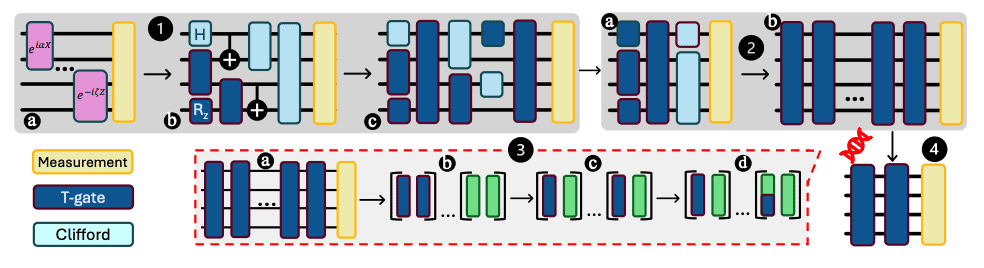
On April 12, 2025, researchers Archisman Ghosh, Avimita Chatterjee, and Swaroop Ghosh published Survival of the Optimized: An Evolutionary Approach to T-depth Reduction, detailing a novel genetic algorithm that achieves up to 79.23% reduction in T-depth for large quantum circuits, offering a scalable optimization framework compatible with diverse fault-tolerant quantum error correction architectures.
The research addresses the challenge of optimizing T-depth in quantum circuits for fault-tolerant quantum computing. It proposes a genetic algorithm-based approach combined with mathematical expansion and greedy initialization to reduce T-gate layers efficiently. The method achieves up to 79.23% T-depth reduction and 41.86% T-count reduction in large circuits, outperforming existing techniques by an average factor of 1.2x. This hardware-agnostic framework is compatible with various quantum error correction architectures, offering a scalable solution for near-term fault-tolerant applications.
This article discusses an innovative approach to optimizing quantum computing resources by employing Genetic Algorithms (GAs) to reduce the overhead associated with T-gates. T-gates are crucial for universal quantum computation as they enable operations beyond the Clifford group, which is essential for achieving computational universality. However, implementing T-gates requires complex processes like magic state distillation, leading to high resource consumption in terms of qubits and time. The key challenges are reducing T-count (number of T-gates) and T-depth (sequential execution time), especially in large-scale quantum circuits.
The proposed solution leverages Genetic Algorithms to iteratively improve potential solutions for merging layers of Pauli/8 gates, effectively navigating complex search spaces. The methodology includes greedy initialization, which prioritizes areas dense in T-gates for merging to accelerate beneficial optimizations. It also employs evolutionary operations that evolve configurations through crossover and mutation, ensuring only viable solutions progress. Additionally, mergeability constraints are implemented to maintain fault-tolerance and correctness by allowing only valid merges.
Testing on 1000 synthetic circuits, particularly those with 90-100 qubits, showed significant reductions in T-depth and T-count. The GA approach outperformed existing lookahead methods by factors of up to 1.8 for T-count and 1.2 for T-depth. Importantly, the optimization occurs pre-magic state distillation, ensuring compatibility with various Quantum Error Correction (QEC) codes like surface codes. This integration is vital for maintaining fault-tolerance in real-world applications across different quantum architectures.
Future considerations include potential scalability to larger circuits and other architectures, as well as further exploration of trade-offs and limitations compared to other optimization techniques. In conclusion, the research presents a comprehensive approach using GAs to optimize T-gate usage, significantly reducing resource overhead. This advancement enhances the feasibility of fault-tolerant quantum computing on near-term hardware, marking a substantial step forward in practical quantum computation. The approach highlights the potential of GAs in optimizing quantum circuits, making them more efficient and paving the way for practical applications in quantum computing.
👉 More information
🗞 Survival of the Optimized: An Evolutionary Approach to T-depth Reduction
🧠 DOI: https://doi.org/10.48550/arXiv.2504.09391