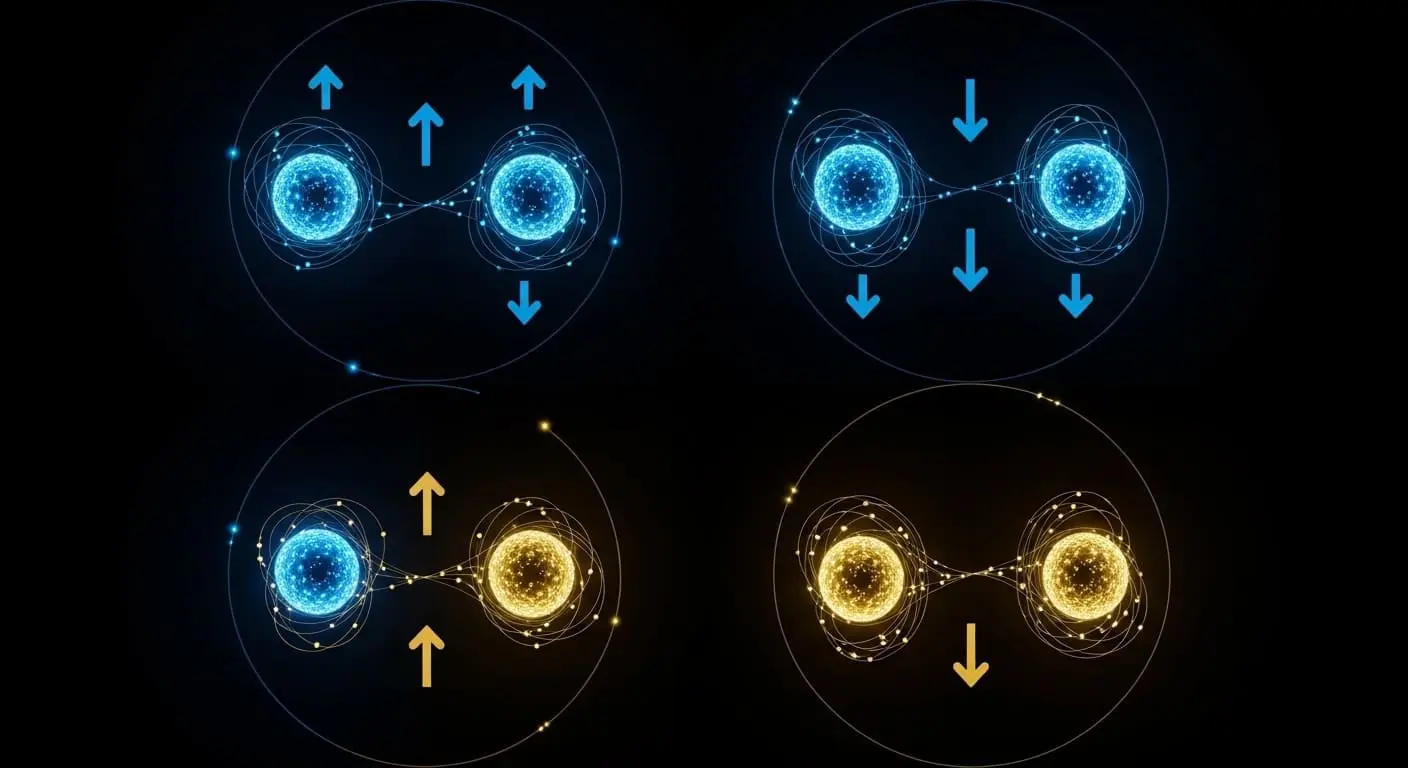
Jannis Erhard and Paul W. Ayers at McMaster University have identified the key conditions for ‘N-representability’, which confirms a functional accurately describes the one-electron reduced density matrix. These conditions guarantee reliable energy calculations in one-electron reduced density matrix functional theory, even with strong interactions between particles. The research reveals that many current functionals, including Hartree-Fock, do not meet these standards, offering vital guidance for improving future approximations and computational methods.
Precise N-representability conditions define variational accuracy in one-electron reduced density matrix functional theory
Necessary and sufficient conditions for N-representability of the universal one-electron reduced density matrix functional are now defined, establishing a threshold previously unattainable for verifying functional validity. These conditions guarantee a variational upper bound on the true energy in one-electron reduced density matrix functional theory, irrespective of particle interaction strength. Prior to this, no such guarantee existed for all systems, meaning functional validity was difficult to confirm. The concept of N-representability stems from the fundamental requirement that a density matrix, which describes the state of a quantum system, must correspond to a physically realisable many-body wavefunction. A functional is considered N-representable if it can generate a density matrix derived from an antisymmetric N-particle wavefunction. Without N-representability, the functional may yield unphysical results, such as energies below the true ground state energy.
As a result, any functional violating these conditions will underestimate the true energy for certain scenarios, a key distinction for accurate modelling. The exact mathematical conditions required for a one-electron reduced density matrix functional to accurately represent the energy of a system have now been pinpointed. For instance, analysis reveals that the Hartree-Fock functional, while effective for certain scenarios, fails to satisfy these conditions when dealing with attractive pairing interactions. Hartree-Fock approximates the many-body wavefunction as a single determinant of single-particle orbitals, neglecting electron correlation effects. This simplification, while computationally efficient, leads to a violation of the N-representability conditions in systems where electron correlation is significant, such as those exhibiting strong pairing phenomena. Consequently, it potentially underestimates the energy in such cases. Violating these conditions inevitably leads to energy underestimation for specific systems, a key finding for functional development. While N-representability is a necessary condition for an exact functional, it does not guarantee high accuracy in approximate functionals, and verifying these conditions remains computationally challenging except for small model systems. The computational difficulty arises from the exponential scaling of the N-representability problem with the number of electrons, making it intractable for large systems.
Defining minimum standards for functional accuracy in quantum chemical modelling
Establishing these rigorous conditions for ‘N-representability’, ensuring a mathematical description aligns with a physically realistic system, feels like finally having a solid foundation for building better approximations in quantum chemistry. The scientists acknowledge that meeting these conditions doesn’t guarantee a highly accurate functional, but it prevents the worst errors of energy underestimation. This raises a key tension: is satisfying these necessary conditions sufficient for practical improvements, or will researchers still need to navigate a complex field of subtle inaccuracies beyond this mathematical threshold. Density matrix functional theory (DMFT) offers a potentially more efficient alternative to wavefunction-based methods for calculating the electronic structure of many-body systems. However, the development of accurate and reliable DMFT functionals has been hampered by the lack of a systematic framework for ensuring N-representability and variational stability.
Identifying functionals that inherently underestimate energy gives scientists a powerful tool for refining their models and focusing computational effort on more promising avenues. Defining both necessary and sufficient conditions for ‘N-representability’, ensuring a mathematical model accurately reflects a physical system with a specific number of electrons, represents a fundamental step forward in density matrix functional theory. This work establishes a rigorous benchmark against which existing and future approximations can be evaluated, moving beyond intuitive assessments of functional validity. The implications extend beyond simply identifying flawed functionals; it provides a pathway for constructing new functionals with guaranteed variational properties. Above all, the established criteria guarantee an upper limit on the true energy of a system, irrespective of electron interactions, a previously unattainable assurance. This assurance is crucial for applications in diverse fields, including materials science, where accurate prediction of ground state energies is essential for understanding and designing new materials with desired properties. Furthermore, the ability to reliably bound the energy from above is vital for exploring potential energy surfaces and locating stable molecular structures, impacting areas such as drug discovery and chemical reaction modelling. The N-representability conditions, as defined by Erhard and Ayers, are expressed mathematically as a set of integral inequalities that must be satisfied by the one-electron reduced density matrix. These inequalities involve the density matrix elements and their derivatives, and their derivation relies on sophisticated mathematical techniques from linear algebra and functional analysis. The 0.5 value, often cited in discussions of N-representability, relates to the minimum eigenvalue of a specific operator acting on the density matrix, and its positivity is a crucial component of the established conditions. The work provides a clear pathway for developing more robust and reliable quantum chemical methods, ultimately advancing our understanding of the fundamental building blocks of matter.
The researchers demonstrated necessary and sufficient conditions for ensuring a mathematical model accurately represents a physical system with a defined number of electrons. These conditions guarantee that energy calculations using density matrix functional theory will provide an upper limit on the true energy of a system, regardless of electron interactions. This is important because it offers a rigorous way to evaluate existing and future approximations within the theory. The authors suggest this mathematical formalism can guide the development of new, more reliable functionals and algorithms.
👉 More information
🗞 Necessary and sufficient conditions for the N-representability of functionals of the one-electron reduced density matrix
🧠 ArXiv: https://arxiv.org/abs/2604.06127
See today’s quantum computing news on Quantum Zeitgeist for the latest breakthroughs in qubits, hardware, algorithms, and industry deals.