

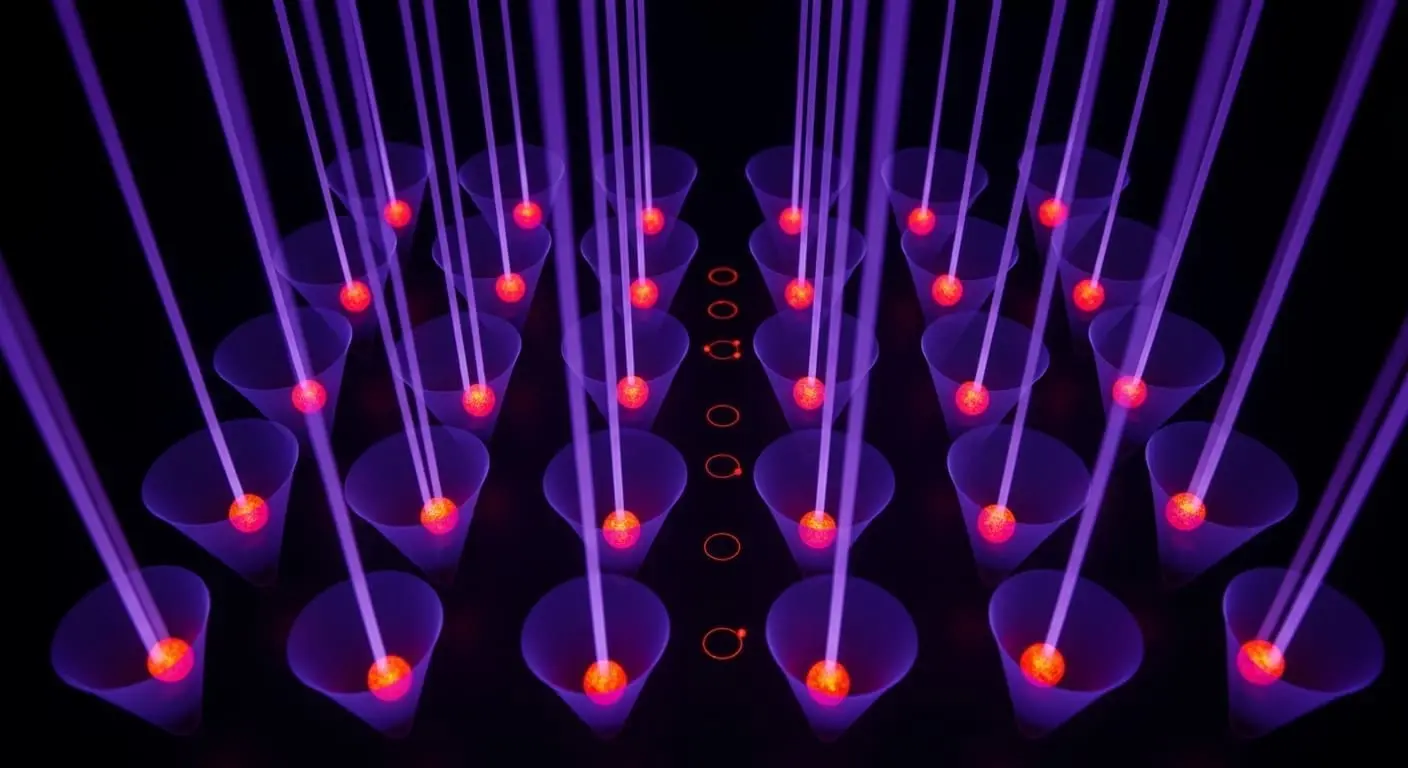
A new system simultaneously cools the ground state of six mechanical modes in two levitated nanoparticles. Qian Zhang and colleagues at Hunan Normal University engineered a coupling between the nanoparticles and a single cavity field, enabling precise control through polarization angle tuning. The research establishes conditions for suppressing unwanted modes and achieving effective cooling, a key step towards generating and manipulating collective quantum effects in multiple massive objects.
Optical polarisation governs simultaneous nanoparticle cooling and mode control
Polarization control was central to achieving simultaneous cooling of multiple nanoparticle modes. Employing optical tweezers, researchers manipulated the angle of polarization between the trapping light and the light within the optical cavity. This cavity-levitated nanoparticle system suspends tiny particles in midair, isolating them from environmental disturbances that typically cause decoherence. By carefully adjusting this angle, the scientists governed the coupling strength of each nanoparticle mode to the cavity field, effectively creating a ‘recipe’ detailing all the energies within the system. The optical cavity enhances the interaction between the nanoparticles and the light field, increasing the rate of cooling. This precise control suppressed unwanted interactions, termed ‘dark modes’, and maximised cooling efficiency across six dimensions of motion for both nanoparticles, circumventing limitations of earlier methods. Dark modes represent vibrational frequencies that are poorly coupled to the cavity field, preventing efficient energy extraction and hindering cooling. The polarization angle acts as a tuning parameter, allowing researchers to selectively enhance coupling to the desired modes while minimising coupling to the dark modes. This is achieved by aligning the polarization of the light with the specific vibrational modes of the nanoparticles, maximising the overlap of their wavefunctions and thus the strength of the interaction. The system utilizes a single-mode cavity, meaning it supports only one wavelength of light, which simplifies the analysis and control of the light-matter interaction. The coupling strength is directly proportional to the square root of the cavity’s finesse, a measure of its ability to store light, and the nanoparticle’s polarizability, which describes its response to an electric field.
Six-dimensional cooling of levitated nanoparticles unlocks ground-state quantum behaviour
A final phonon number of 0.43, a measure of particle motion, has been achieved, representing a substantial improvement over previous achievements which plateaued around 0.83 for single dimensions. Phonons are quanta of vibrational energy, analogous to photons for light. A phonon number of 0.43 indicates that, on average, each mechanical mode has less than half a quantum of vibrational energy, bringing the nanoparticle remarkably close to its ground state. Values above one hinder the observation of true ground-state cooling, while below this threshold, quantum effects become increasingly apparent. The ability to reach such low phonon numbers is crucial for observing quantum phenomena like superposition and entanglement in macroscopic objects. Cooling occurred along the x and y directions, with phonon numbers of 0.83 and 0.81 respectively, demonstrating expansion beyond single-dimensional control. These translational modes correspond to the nanoparticle’s movement along the Cartesian axes. Achieving comparable cooling in multiple dimensions is challenging due to the complex interplay of forces and the need for precise alignment of the optical tweezers.
Successful cooling of the ‘librational’ mode, a twisting motion, extends ground-state cooling to more complex movements, building on earlier work demonstrating position-dependent efficiency in three-dimensional cooling of a single nanoparticle. The librational mode is particularly sensitive to environmental noise and requires careful control of the trapping potential to suppress unwanted excitations. In particular, the team coupled two nanoparticles via light, enabling controllable interactions and paving the way for scalable quantum systems, and observed phenomena like ‘PT-symmetry breaking’, a state where conventional rules of physics no longer apply, in these coupled particles. PT-symmetry breaking occurs when the system’s Hamiltonian is not Hermitian, leading to unusual energy spectra and potential applications in areas like optical switching and sensing. The coupling between the nanoparticles is mediated by the cavity field, allowing for the exchange of energy and momentum between them. This opens up possibilities for creating entangled states and exploring collective quantum phenomena. These advances are also relevant to quantum precision measurement and sensing technologies, highlighting potential real-world applications. For example, levitated nanoparticles could be used as highly sensitive accelerometers or gyroscopes, or as probes for detecting weak forces and fields. While the 0.43 figure is impressive, it does not yet translate to practical quantum devices; significant hurdles remain in maintaining coherence and scaling up these systems to a useful size. Maintaining coherence, the preservation of quantum superposition, is particularly challenging due to the unavoidable interaction with the environment. Scaling up the system requires addressing issues like cross-talk between nanoparticles and maintaining stable trapping potentials for many particles.
Levitating nanoparticles demonstrate complex quantum control despite persistent energy state
Researchers are edging closer to harnessing the bizarre rules of quantum mechanics with increasingly complex systems of levitated nanoparticles. These tiny particles, suspended in mid-air by light, offer a promising platform for observing quantum behaviour in relatively large objects, though the current work highlights a vital dependency on precise control of light polarization. The underlying ‘Hamiltonian’, a mathematical description of the system’s energy, reveals the persistent threat of ‘dark modes’. The Hamiltonian incorporates terms describing the kinetic and potential energy of the nanoparticles, as well as the interaction energy between the nanoparticles and the cavity field. Minimising the influence of dark modes requires careful design of the cavity and the trapping potential, as well as precise control of the polarization angle. Control over six mechanical modes in two levitated nanoparticles establishes a new platform for investigating collective quantum phenomena, potentially leading to new technologies within the decade. Collective quantum phenomena, such as collective vibrations and entanglement, arise from the interactions between multiple nanoparticles and offer unique opportunities for quantum information processing and sensing. Ground-state cooling was successfully demonstrated, reducing particle movement to its lowest possible energy level across six independent modes of motion, and required precise manipulation of light polarization to govern how the particles interact with the optical cavity and optical tweezers. The optical cavity provides a strong and tunable interaction between the nanoparticles and the light field, while the optical tweezers provide precise control over the nanoparticles’ positions and orientations. Overcoming a significant challenge involved suppressing unwanted states that typically hinder efficient cooling of these microscopic systems. These unwanted states arise from imperfections in the trapping potential and the cavity, as well as from fluctuations in the environment. The ability to suppress these states is crucial for achieving high-fidelity quantum control and observing genuine quantum effects.
Successful ground-state cooling of six mechanical modes in two levitated nanoparticles demonstrates a new approach to controlling the motion of macroscopic objects. This achievement matters because reducing unwanted particle motion is essential for observing quantum behaviour in larger systems. Researchers controlled the interaction between the nanoparticles, an optical cavity, and optical tweezers by tuning the polarization angle of light. The authors suggest this work provides a foundation for generating and manipulating collective macroscopic quantum effects in multiple nanoparticles.
👉 More information
🗞 Simultaneous ground-state cooling of six mechanical modes of two levitated nanoparticles
🧠 ArXiv: https://arxiv.org/abs/2604.07971




See today’s quantum computing news on Quantum Zeitgeist for the latest breakthroughs in qubits, hardware, algorithms, and industry deals.



