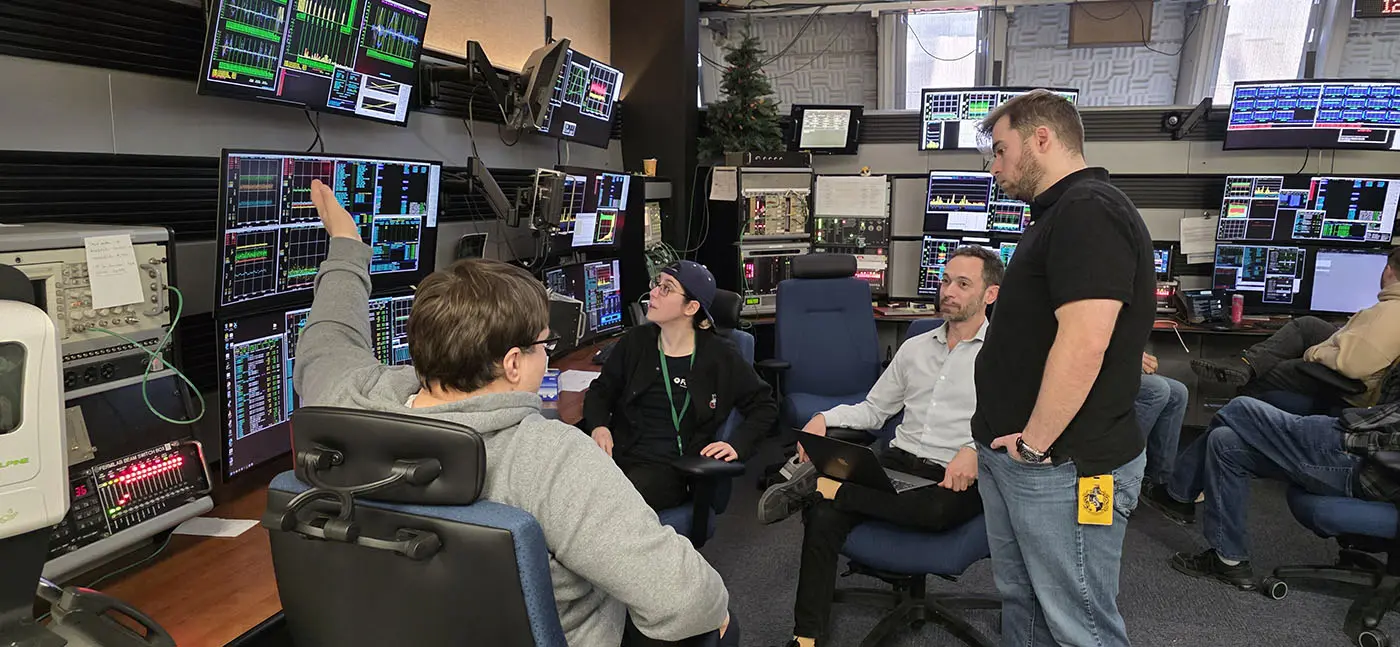
Fermilab is leading a collaborative effort with six other national laboratories to integrate artificial intelligence into the design, construction, and operation of particle accelerators, a project undertaken as part of the Department of Energy’s Genesis Mission. These immensely complex machines, comprised of tens of thousands of interdependent devices, are vital to advancements ranging from cancer treatment to fusion research and, crucially, to eliminating “forever chemicals” from water supplies. The Multi-Office particle Accelerator Team, known as MOAT, aims to create a unified AI system to increase efficiency and accelerate scientific discovery. “MOAT’s ultimate vision is that we integrate AI so fully into the design, construction and operations of accelerators that we fundamentally transform the pace of discovery and the resulting innovations,” said Jonathan Jarvis, MOAT collaborator and director of Fermilab’s Accelerator Research Division.
Genesis Mission Drives Multi-Lab AI Collaboration
The scale of this undertaking reflects a broad national commitment to AI-driven scientific discovery; MOAT is part of the Transformational AI Models Consortium, or ModCon, which will deploy self-improving AI models leveraging DOE resources. Researchers from Berkeley, Argonne, Jefferson, Oak Ridge, SLAC, and Brookhaven are all contributing to this unified approach, a departure from the traditional siloed development of AI prototypes within individual labs. “Usually each of our labs would develop our own standalone prototype,” said Thorsten Hellert, from Berkeley Lab and creator of the Osprey AI tool, “The Genesis Mission has really compelled our community to work together to develop and deploy this new AI software collectively.” Fermilab’s accelerator technology test facility, FAST/IOTA, will serve as a key demonstrator for these AI tools, allowing for testing across diverse accelerator types and particle beams.
Initial demonstrations of MOAT’s work, including the Osprey tool which accelerates tasks by a factor of 100, have already been presented to the DOE Office of Science, and the team is developing digital twins of accelerator complexes for virtual diagnostics and beam tuning. Jean-Luc Vay, head of the Advanced Modeling Program at Lawrence Berkeley National Laboratory, explained that the goal is to speed up discovery and expand knowledge faster than would otherwise be possible.
MOAT Integrates AI Across Accelerator Lifecycle
The pursuit of increasingly sophisticated particle accelerators, essential tools for advancements across multiple scientific disciplines, now benefits from a concerted effort to integrate artificial intelligence throughout their entire lifecycle. Beyond optimizing existing systems, the Multi-Office particle Accelerator Team, or MOAT, is establishing a unified AI framework intended to fundamentally alter the speed of scientific discovery. The sheer scale of these machines necessitates this approach; the most advanced particle accelerators comprise tens or hundreds of thousands of interdependent devices, demanding complex management. MOAT’s initial demonstration showcased the Osprey AI tool, achieving a 100-fold acceleration of specific tasks through the use of AI agents, autonomous systems capable of reasoning and independent action.
MOAT’s ultimate vision is that we integrate AI so fully into the design, construction and operations of accelerators that we fundamentally transform the pace of discovery and the resulting innovations.
Jonathan Jarvis, Fermilab
Osprey AI Agents Achieve 100x Task Acceleration
Beyond fundamental physics, these advancements promise to address pressing real-world challenges, including the removal of “forever chemicals” from water supplies, a benefit stemming from the enhanced capabilities of these powerful machines. Recent demonstrations showcased the initial success of MOAT’s Osprey AI tool, achieving a 100-fold acceleration in specific tasks, a feat enabled by the use of autonomous AI agents. These agents, capable of reasoning and independent action, represent a key component of the Multi-Office particle Accelerator Team’s long-term vision. The AI systems are being trained on decades of operational knowledge, including documented solutions to accelerator errors, allowing for rapid problem-solving with traceable origins. MOAT is developing interconnected “digital twins” of accelerator complexes, enabling virtual diagnostics and testing before implementing changes on the physical hardware.
The goal is for MOAT to speed up how we can discover and expand our knowledge in fundamental physics, chemistry, biology, materials science, and more, faster than would be possible otherwise,”
Vay
FAST/IOTA Facility Validates AI-Driven Accelerator R&D
Fermilab’s accelerator technology test facility, FAST/IOTA, is now serving as a crucial validation point for the Multi-Office Accelerator Team’s (MOAT) ambitious integration of artificial intelligence into particle accelerator research and development. MOAT’s long-term vision extends to leveraging decades of operational knowledge accumulated from facilities like Fermilab. This approach, coupled with the development of interconnected “digital twins” of accelerator complexes, promises to save billions of dollars and years of effort while dramatically enhancing performance and expanding the scope of research, from medical isotope production to the elimination of “forever chemicals” in water, faster than previously possible.
MOAT’s ultimate vision is that we integrate AI so fully into the design, construction and operations of accelerators that we fundamentally transform the pace of discovery and the resulting innovations.
See today’s quantum computing news on Quantum Zeitgeist for the latest breakthroughs in qubits, hardware, algorithms, and industry deals.